Thursday, November 14, 2013

El Caribe: Three Days at Sea

At sea
November 2-3-4, 2013

I'd gone to bed so early the night before then slept remarkably late on this first day at sea.  I woke to a  luxurious feeling of impending relaxation.  Three days at sea with no ports between Boston and St. Thomas.  My goal was simple: do as little as possible.


By noon we were far out at sea, somewhere off the coast of Virginia and sailing south.  The winds at been fierce the night before and had not abated today.  The sea was menacingly rough and sky was slate grey.  It was a good day to stay indoors, read, sit on the balcony and let this marvelous aquatic world go by.


But this foul weather was OK.  We were heading south to places where light was white and days would be  warm.  By late afternoon we'd traveled 325 nautical miles.  Already the air was warmer.


I had been reflective all  day.  Fifty years the day before was the day my grandmother died.  Ten years ago before the day my cousin John got married to Tina in Lake Placid.  A year earlier I'd just flown from Nepal to Bhutan.  Oh, the excitement of that flight as we flew along the spine of the Himalayas, past Mt. Everest then  swooped into the fabled kingdom of Shangrila.


But that was then,and a journey of  that caliber would not be possible this year.  I was grateful I'd been able to do it and know  I'll be able to do it again.  


Just not now.


By sunset the sea was still turbulent but clouds had begun to break.  I sat for a  long time on the balcony--my  first ever on a cruise ship--and watched day turn to night.  I felt the great ship push through the waves and marveled at the great expanse of sky and water.  It would be something I never tired of.


Periodically, I’d see Venus—low and glittery in the night sky—until clouds pushed it away. 

By day’s end I’d managed to fulfill my goal of doing nothing, but I was still exhausted and in bed by 10:00. 

November 3, 2013                                                                                                                               Off the coast of Bermuda   
35˚ 50’ N

For whatever reason I’m in a more than good sleeping cycle.  In the weeks before the surgery and for more than a month afterwards I never slept well.  So falling asleep to the roll and sound of the sea than sleeping a full eight hours was a gift.

Long before I got out bed I knew we were in calmer waters.  We’d left the storm behind us.  I could barely hear the sea slap against the ship’s hull.  When I stepped onto the balcony it was a clear and sunny day.  The sky was exaggerated and powerful clouds scuttled by.  Small, frothy waves crested the surface of the water.  Gone were the angry 12 foot swells we’d experienced for the past 36 hours. 

It would be a fine day and I knew exactly how I’d spend my time.

We were miles off the Atlantic seaboard, somewhere east of the Carolinas.  The ship’s log said we’d traveled more than 700 nautical miles from Boston.

The day promised to be a classic day at sea, and despite three pages of shipboard activities I was going to be loyal to my promise to do as little as possible.

By late morning, after lingering over breakfast, with Glenda, I found myself poolside.  I slathered sunblock on my pale skin and settled back to do little more than read, write, people watch and gaze out at the endless expanse of sea and sky.

Earlier in the day two freighters, heading north, passed the Norwegian Dawn, their decks piled high with large cargo containers.  Just a few days earlier I’d read a travel book—Grounded by Seth Stevenson—about these ships.

We each of us are our own container chip, transporting our various cargoes through the ocean of life.  At ports along the way we may stop to pick up a new lover, a spouse, a child.  At other ports we unload precious items—friends move away, relationships end, parents die. 

Even when we’re lost in the deepest fog, we must try to keep our watch, not to be the cause of ay tragic collisions—do what we can to keep our cargo safe.

All around me on this sunny Sunday on the Atlantic were passengers and crew alike—close to 3,000 souls--all precious cargo, each with his own dreams, fears, sadness and joys.

At a very late dinner the night before we’d been chatting with our waiter, Aristotle, from the Phillipines.  I told him I imagined that there were all sorts of dramas occurring below deck, drama we ass passengers never see.

He’d recently married a fellow crew member, but when she got pregnant it was too difficult to continue the demands of shipboard employ and returned to her family home.  I knew he missed her, and knew he mourned not being home for the birth of his child.

‘I’m just one of the many dramas in the crew quarters,’ he smiled. 

Earlier, Glenda had met woman—not yet 60—who been widowed unexpectedly in March.  They’d been married on a cruise 25 years earlier and this was supposed to be their 60 to each other for her 60th birthday which would be later in the week.  But she was doing this alone.  She’s told Glenda she’d been trembling with fear at the prospect.

The collective cargo on this ship—anniversaries, birthdays, maybe a wedding or two, the recent loss of a loved one—was all unknown to the majority of us.
 
None of us would know the cargo our neighbors onboard were experiencing.  All the more reason, I reflected to walk gently with all we meet.


November 4, 2013

At day break I checked our coordinates: 25˚ N and 1,000 nautical miles south of Boston.  We were on line with Key West, rapidly coming our of the Atlantic and into the warm Caribbean.

It was another beautiful day--clearer and sunnier than the day before.  The calendar read mid-autumn but we'd returned to summer!  Large white clouds sailed by briskly.  I sat on the balcony and let this beautiful world go by--a seemingly endles stretch of sea and sky.  Often, a frenzy of fish would break the water's surface.

By now the days were blurring.  There'd been no landmarks to break up the voyage.  It was warm.  I could be in the Indian Ocean, it could be July or January depending on where I was in the world.  I liked this!

Had I not had access to the 'Captain's Log' on your stateroom TV, there would be no way of taking stock of our progress.  Hour after the ship sailed stolidly through the waves of a tranquil seas.

But we had made progress.  By mid-afternoon we were at the 22nd parallel and more than 1,3000 miles from Boston.  My skin, November pale when I'd boarded, was tanning.

For three days I'd not been bothered by allergies.  For three days I did nothing more than sit by the pool.

Three days earlier I'd set a very low standard for myself and was proud, at day's end, to have accomplished all I'd set out to do.

Not much, and that was perfectely OK with me. 

The next three days would be busy enough!

El Caribe: Ship Ahoy!

Boston, Massachusetts
November 1, 2013
Latitude  42.35° N

I swear, getting out of Plattsburgh is getting harder and harder.  It has never been easy, but it does seem to be getting more difficult.

But out we were on the early morning of November 1st.  The day was full of all sorts of anxieties and stresses.  Strong hurricane force winds were predicted and we were concerned that the little prop jet from Plattsburgh would not take off for the one hour flight to Boston.

But the winds waited, and we were off by 815 am.  Despite a few bumps, we were on the ground an hour later.  We had nothing to do but wait, so we lingered over breakfast then caught a cab to the pier.

The Norwegian Dawn was waiting for us!

Thanks to Glenda´s ability to upgrade our stateroom, we were able to check in early and board the boat. We had no luggage, and we weren't able to get into our room for several hours, so it gave us a good deal of time or orient ourselves to a new cruise liner.

It also gave me time for the first time in week to just stop!

I had read someplace earlier that retirement does not end the stresses in our life.  Yes, the stress of work is gone, but others fill the gap.

Things like health issues.  My new knee, just over two months old, had been fraught with all sorts of anxieties//before and after.  And human relations go awry.  Just the week before I had been verbally assaulted at, of all places, church.  So much for Christian virtue!  No wonder people stay away.

We finally did get to our stateroom--a mini-suite with a balcony--by 4:00 pm-  It was an unusually warm 70 degree November 1st.  I would have gone swimming, used the jaccuzis, but, while we had the room, neither of us had any luggage.  Instead, we entertained ourselves watching pallet after pallet loaded onto the ship. Food to feed an army, as it were.  And we were an army.  2,000 passengers and another 1,000 employees.

Looking back on it we commented how we had loads of time.  Time enough to go into Boston and enjoy a bit of the city.  But we didn't.

It wasn't not until 7:00 pm--a full two hours after our scheduled departure--that we got underway. The ship´s great horn signaled our departure out of Boston harbor.

We stood on the front deck on the 14th floor.  Boston was alight on this early Friday evening.  I was excited for the adventure ahead, for a return of sunshine and heat.  But I lacked the excitement my first two cruise departures brought.  Then I was just about crawling out of my skin.  By now it was old hat.

But I had a massive headache and nothing would do until I lay down and fall asleep.  Only a quick dinner and early to bed would do.

Which is what I did.


Wednesday, October 30, 2013

El Caribe: Boston to Cozumel: 14 days aboard the Norwegian Dawn

Plattsburgh, New York
Latitude 44 41' 57" N
October 31, 2013

In a day friend Glenda and I will be on our way.  First, a short flight to Boston, breakfast at the airport, then a short taxi ride to the Boston port.  We board the Norwegian xxx and set sail at 5:00 pm.  this is what I consider my reward for a three month rehabilitation from a full knee replacement in August.

A year ago I'd arrived in Kathmandu, Nepal on this date.  This year it would be impossible to do that trip.  There is still fatigue, my knee still buckles and the reality is that my knee just oculd not sustain a trip of that caliber.

So this is a good compromise.  Two weeks aboard ship with six stops.  Then a week on the Carribean coast of Mexico with most of the time in Playa del Carmen--home more than once in my Mexican coastal days.  On November 21st I fly to Mexico City  and will get to spend Thanksgiving at the Casa and watching the very beginnings of the Christmas season emerge.  By the  time I leave in early December Christmas trees  will be for sale, the Christmas street markets will have emerged and the azaleas will have just come into bloom.

I'll be home in time for Christmas here then back to DF in January.  A short winter.

SHIP NAME:
Norwegian Dawn
SAILING DATE:
11/1/2013 
Date
Port-Itinerary


11/1/2013
BOSTON, MASSACHUSETTS
 

11/2/2013
AT SEA

11/3/2013
AT SEA
 
11/4/2013
AT SEA

11/5/2013
ST.THOMAS, UNITED STATES VIRGIN ISLANDS


11/6/2013 ST. JOHN'S, ANTIGUA, ANTIGUA
BRIDGETOWN, BARBADOS
AT SEA


11/9/2013
WILLEMSTAD, NETHERLAND ANTILLES


11/10/2013 ORANJESTAD, ARUBA


11/11/2013
AT SEA


11/12/2013
AT SEA


11/13/2013
COZUMEL, MEXICO

11/14/2013
AT SEA
 
11/15/2013

TAMPA, FLORIDA


Monday, May 6, 2013

Speech given at the Grand Opening of the CAFEMIN Library

Mexico City, Mexico
May 3, 2014

Thank you for coming today.  Welcome to the CAFEMIN Library.

Normally, I don´t have a problem speaking extemporaneously in front of a group--in English. But in Spanish....that is a different story.  Please forgive me, but I have to use my notes.

I was in Mexico City last October to visit an Australian friend, Rachelle, who was visiting.  Rachelle has been a long time guest at La Casa de los Amigos.

One night, she said to me, ¨Dan...you have to speak to Lis. She has a project she is certain you will be interested in.¨

That night, we met at a small restaurant to discuss the project.  A new refugee center was opening, the nuns in charge had a library, lots of books, but no one to organize it.  ¨You´re the best,¨ Lis told me.

The following Saturday we made a trip to Los Misterios.  A large group of young people form Belize were painting  I met with Sister Miriam who showed me the space.  I was excited.  I´d get a chance to design a library which is something we´re all trained to do, but rarely do.

The nuns wanted a library.  They had the books and the space, but lacked a specialist.

I remember two things about that visit--there were piles and piles of books in the library--books on the shelves and books in boxes--lots and lots of boxes.  I also remember what seemed to be hundreds of books drying on the stage.  (It wasn´t until much, much later when I learned that someone had left a faucet running unchecked for hours.  The overflow destroyed many books, and almost all the files of one of the case workers.)

That night I wrote Sister Mirian.

¨What do you want in a library?¨
¨Do you want a library with lots of books or a quality library with fewer books?
¨Who will be using the library?¨
¨What exactly is your goal?¨

We wrote each other during the fall and early winter, and then I arrived at CAFEMIN at the end of January.

For a full month I separated books, brochures and magazines--some of which dated the the 1960´s.  I filled three bags of garbage, but I also found treasures--books that dated back to the early part of the 19th centuries, books more than 200 years old.

I was very excited.  When I was a student in graduate school, a standard project was to design a library,  but the reality is that very few of us ever have the opportunity to do that.  We make changes, but little more than that.

This would be my time.

When the books were separated, I then began the long process of putting them on the shelves.

This morning I received an email from a dear friend and colleague.  Her advice is reflected in the design of the library that you now see.

¨Congratulations,¨ it read. ¨You´ve  accomplished something great, no matter how small...¨

I immediately wrote back.  ¨But it wasn´t a small job.  What you see reflects hundred and hundreds of hours. But many of those hours came from others who generously shared their time to help me out.

I did not do this job alone and I could not have finished this first stage without the help of many people.  I would never have had this opportunity had it not been for them.  Thank you, Lis, and thank you Rachelle.  I am very grateful.

Secondly, I would like to thank Mirian.  Mirian is my boss and the intermediary between me and CAFEMIN.

Thank you, Mirian, for a great deal.

Thank you for having confidence in me.  You knew that I knew my job and I appreciate, a lot, the respect that you showed me.

Also, and this is important to know, Mirian is my Italian grandmother.

Normally, I only eat two meals a day, but early on I was invited to join the sisters for lunch--their main meal of the day.  Initially, I said no, but then realized that was rude, so I began to join them.

¨Eat, Dan.¨  Eat,¨ she exhort me.

¨But I´m not hungry, Mirian.  Really. I´m satisifed with me orange.

¨No, Dan, eat.¨

And  did, and it was always delicious, and then I began to look forward to lunch.

Finally, one day I was curious.  ¨Mirian,¨ I asked her, ¨Is your family Italian?¨

My grandmother was from Italy, so yes.¨

Ah ah!  I finally understood.

Mirian...when it´s 2:00 pm, and I´m back in New York, I´m going to start wondering...when´s it time to eat?

As a matter of fact, Mirian is an excellent cook, and I´m going to your fabulous dinners.

Thank you, Mirian.

I also want to thank Leonore.  Leo came to the library many, many times to help.  She became my right hand woman.

I know the job was boring, but Leo typed the catalog numbers on the labels, attached them to the books then wrote the bibliographic information in each book--almost 1,000 times.

Thank you, Leo!

I want to thank Rony.  Rony was a guest here from January to March when he returned to Honduras.  Rony was a man who was not afraid of hard work.

He moved boxes and boxes of books out of the library.  He repaired shelving units and leveled the shelves when necessary--few of which were level.  He moved shelving units out of the library and other ones in.

Thank you, Rony.  Without your help my work here would have much more difficult.

I also want to thank Jose.  YOu have become my friend during my time here.  Thank you for all the wonderful chats--in English and in Spanish.  Thank you for all of your advice, and for letting me know that the library will move forward while I´m away.

I want to thank my friend Gerardo.

Gerardo works full time and is a full time student, but twice he he cam here to help me.  With his tools, he finished the shelf work that Rony began and then attached them to the wall.  And two days ago he came again--this time with his drill--to hang the art work.

Thank you, Gerardo.

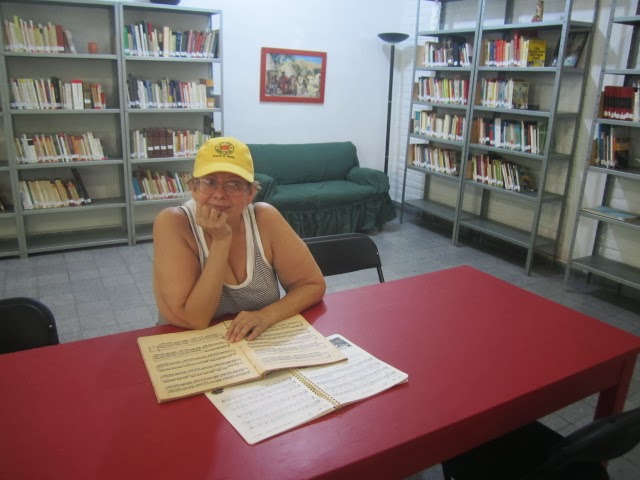
I want to thank Celia for making the slip cover that covers the sofa.  Underneath that slip cover is a more-than-ugly sofa that, I think, had been relegated to the garbage pile.  Now, with your nicely done sewing, the love seat is much more attractive.

Thank you, Celia.

I want to thank Tere and Magda.  Thank you for the warmth of your friendship and for all the moral support you´ve shown since I´ve been here.

I want to thank Olga and Marisol.  Thank you, Olga, for all times you helped type catalog labels and thank you for all the delicious meals you made for me.

And Marisol, sweetheart...  I´m going to miss the visits and your laughter and all the times we´d color together and all the times you´d just sit with me while I was working.

Finally, I want to thank two American friends-both librarians.  They helped me a great deal with the design of the library and offered wonderful suggestions that will help me move forward during the second stage.

Thank you Steve and Glenda--two extraordinary librarians.

I know that the library is in good hands.  Now, CAFEMIN has a library for the center, for the church, and for the neighborhood.  Now you have a spiritual center for the community of faith that you represent.

I leave for New York, but, as always, I leave part of my heart in Mexico City.  But, I´m already planning to return in January.  There are still lots of books to process and I have plans for the second stage of the CAFEMIN library.

Thank you, once again, for being here today.

And now, I would like to introduce the woman who will be the librarian--Leonor.

Leo, I know the library is in good hands with you, too.

Oración para la Gran Inauguración de la Biblioteca de CAFEMIN


Gracias a todos por venir hoy.  Bienvenidos a  la biblioteca de CAFEMIN.

Usualmente, no tengo problema hablando espontanamiento—¡en Inglés!  Pero, en Español es muy es diferente.  Me perdonan, pero tengo que usar notas esta notas.

Estuve en el DF en Octubre del año para visita a mi amiga Raqel de Australia.  Raquel ha sido huesped en la Casa de los Amigos por muchos años.

“Dan,” me dijo.  “Tienes que hablar con Lis.  Tiene un proyecto para ti.”

Nos encontramos esa noche y el siguiete Sábado visitamos juntos el alburgue.

Las hermanas querián una biblioteca; tenían los libros y el espacio, pero tenían un esecialista.

Ecuerdo dos cosas de la visita: había un montón de libros secándose en escenario de teatro y recuerdo montónes y montónes de libros en los estantes y libros en cajas de cartón--¡muchas cajas!

Esa noche escribí a Mirian.

“¿Qué quires en una biblioteca?”

“¿Quieres una biblioteca de cantidad o de calidad?”

“¿Quién va a usar la biblioteca?”

“¿Cuál es tu meta?”

No escribimos durante el otoño y llugué aquí a finales de enero.!”

Por un mes, separé los libros, las revistas y los folletos.  Llené tres bolsas de basura, pero también econtré tesoros—libros muy raros y muy antiguos—libros del siglo XIX.

İEstaba muy emocianado! Recuerdo que cunado era un eestudiante en la escuela de biblioteconomía, todos los estudiantes tenían que diseñar una biblioteca.  Pero, en realidad es muy raro cuando un bibliotecario tiene la oportunidad.  Hacemos cambios, pero no más. Pensé: “íAhora es mi tiempo!”

Cuando los libros fuero separados, empezé el proceso de ponerlos en los estantes.

Está mañana recibí un email de un a amiga y una colega. Su consejo estáreflejado en el diseño.

“Felicidades, Dan. Es un trabajo pequeño, ípero es un trabajo bien hecho!”

“Lo  siento,” le escribí, “Pero no fue un trabajo pequeño.  Fue un proyecto de cientos y cientos de horas.”

Pero, muchas de esas horas fueron regaldos por otras parsonas.  No hice este trabajo solo. No podría haber terminado esta primera etapa sin la ayuda de muchas otras.

Primero, quiero agradecer a Lís.  Sin Lís…e Raquel…no tendría esta oportunidad.

Gracias, Lís, por decirme.  “íEstoy my agradecida!”

Segudo, quiero agradecer a la Hermana Mirian.

Mirian es mi jefa y la intermediaria entre CAFEMIN y yo.

Gracias, Mirian, por todo.

Gracias por tener confianza en mi. Tú sabías que you conocía mi profesión y aprecio mucho el respeto.

También, Mirian es mi abuela Italiana.

Ncormalmente, yo como dos veces por dia pero ella siempre me invitaba a comer con las hermanas.

“İCome, Dan!” me decía.  “İCome, Danİ” insistía.

“Come, Dan,” volvía a insister.

Finalmente, un día, le pregunté…”Tengo curiosidad, Mirian, ¿Tu familia es Italiana?”

“Si,” me dijo.

“İAhh!” Finalmente entendí.

Mirian…cuando esté en casa en Nueva York, voy  extrañar las comidas.  A las dos en la tarden, voy a preguntarme…”¿Donde está mi comida?”

Por cierto, Mirian es una cocinera excelente.

Quiero agradecer a Leonor.

Leo vino a la biblioteca muchas, muchas veces por varias semanas.  Era mi mano derecha.

Yo sé el trabajo fue muy aburrido,  pero Leo escribiólos numerous de católogo,puso la etiquetas en los libros y ella escribió la información bibliográfica İcasi 1,000 veces!

Gracias, Leo.

Quiero agradecer a Rony.

Rony fue huésped de la Casa desde enero hasta marzo. Cunado regresó a Honduras.

Rony no tenía miedo a trabajar. Movió cajas y cajas de libros, y movió estantes de abajo a arriba.  En enero los estantes no estaban nivelados, pero gracias a Rony y su desarmador, ahora lo están.

Gracias, Rony.  Sin tu ayuda mi trabjo mi trabajo aquí hubiera sido más difícil.

Quiero agradecer a José Luis.  Gracias por todo tu consejo, por todas las charlas—en Español y Inglés y  İmuchas gracias, especialmente, por la Amistad.!

Quiero agradecer a ami amigo Gerardo.  Gerardo actualmente trabaja tiempo completo y é les un estudiante de tiempo ccompleto.

Geard vino dos veces. Con sus herramientas él empotró los estantes a la pared y, hace dos días, usó su taladro para colocar las pinturas en la pared.

Gracias Gerardo.

Quiero agradecer a Celia.  Ella hizo la funda para el sófa.  El sófa es mu feo, pero con la funda es much más hermoso.

Gracias Celia.

Quiero agradecer a Tere y a Magda.  Gracias por su apoyo y por su  calidez…y por su amistad.

Gracias Tere y Magda.

Quiero agradecer a Olga y a  Marisol.

Olga, gracias por los tiempos cuando me ayudaste con los libros y gracias por todas las comidas.  Olga, también, es una cocinera excelente.

Y, Marisol, corazoncita.  Voy a extrañar tus visitas, tus risas y todo el tiemp que pasaste conmigo en la biblioteca.

Gracias Olga y Marisol.

Por fin, quiero agradecer a dos amigos Americanos, ambos bibliotecarios que me ayudaron mucho con el diseño y a direción de la biblioteca.

Gracias Steve y Glenda—bibliotecarios extraordiñarios.

Yo sé que la bibliotecas está un buenas manos.

Ahora CAFEMIN tiene una bibloteca par el alburgue, para  la iglesia, para los vecinos y ahora tiene un centro espiritual para la comunidad.

Salgo a Nueva York en una semana pero, como  siempre, dejo parte de mi corazón aquí.

Sin embargo, voy a volver en enereo.  Hay muchas más caja de libros y tengo planes para la segunda etapa de la biblioteca de CAFEMIN.

Gracias a  todos.

Ahora, le presento la bibliotecaria--Leonor.

Leo…con  usted la bibliotecas está en buenas manos.

CAFEMIN, Marisol, Mexico City and the Winter of 2014


Even now, weeks away from Mexico City, I still miss my time At CAFEMIN—el Centro de Acojida y Formación para el Empoderamiento de la Mujer Indígena y Migrante.  I could never, ever have imagined the impact this group had on my winter, and my life, during the winter of 2013.

I first became acquainted with CAFEMIN in October when I was in Mexico City visiting my friend Rachelle.  On my first day there she told me that our mutual friend, Lis, had a project to pitch to me.  We met that night and the project was just too good to pass up.  I’d get to develop a library from scratch.

The next day we met with Sister Mirian, one of the four nuns who was developing CAFEMIN into a refugee center for indigenous and migrant women.  Mirian showed me their massive collection of books, the space they were in, and commented…”We have no idea what to do with them.”

I think Lis knew the frustrations I felt at the Quaker place, but she also knew I was more than able to pursue the project CAFEMIN was offering.

Well I did, and I was excited.  I love projects like this.  Plus, CAFEMIN would give me the structure to allow me to live long-term in Mexico City and not feel like a tourist.

And so I returned in late January.  I really had no idea where to start.

All I had was a large room, rickety old bookshelves, a few thousand books and boxes and boxes of junk.  The nuns threw nothing away!  There was no furniture and no order to anything.


I spent all of February just separating things.  The poor nuns.  I’d throw things into plastic bags then move the bags to the garbage area.  The next day I’d find half the things either in the library or tucked away in some other place in the Casa.  It didn’t take long before I became more judicious.  I’d tuck old books into my daypack and carry them home.  Or I’d rip magazines to the point where they couldn’t be salvaged.  That solved the problem!

Because the “library” lacked internet access, I moved a table out the end of a long balcony that ran the entire length of the second floor. My computer was close to an office that had a wireless connection.

For weeks, during the baImy, sun-filled days of February and March, I’d sit outside.  Warm breezes swept through the compound.  Birds chirped.  Several times during the day I could hear the distant sound of freight trains.

I tried to make a goal of 50 books a day which, more or less, I managed to do.  Mid-winter, CAFEMIN was quiet, but there were still guests and I’d be called in at times to translate for refugees from Africa or Asia who only spoke English.  Navigating worldcat.org for catalog numbers could find me in at the National Library of Spain, at a university library in Chile, Australia or Mexico or a public library in the USA.  I often used our local library network to assist me.  At lunch I’d interact with people from Russia, Honduras or Cameroon.  I was never bored.


Slowly, book by book, the library took shape.  People would help me periodicallly—moving furniture, fixing the old shelving units.  Leonor, a volunteer from the neighborhood, spent hours typing labels, affixing them to books and then putting them on the shelves.

Early on Mirian began inviting me to lunch—their main meal, actually, at 2:00 pm.  Initially I said no, but though that rude.  But when I did join them, it was no turning back.  It became one of the happy points of the day.  Plus, la comida was always delicious.  I came to enjoy my time with the nuns—Celia, Tere, Magda and Mirian.  There were happy people and their happiness made me happy.

I do not know when Marisol entered my life.  She was not there when I arrived in January and then she was.  She lived in a world of working adults and, looking back on it, was desperate for attention.  She began wandering up to the terrace where I worked.  At the Quaker Casa, I rarely had anything to do with refugees, so what to do with this sweet, beautiful three and half year old?


She’d keep me company for a few hours a day.  It wasn’t long before I started bringing in treats—a small bag of popcorn, some chocolate.  She was curious about books, but there was really nothing in the library for her.  So I started buying books, and we’d spend some time during the day sitting on a sofa, on the stairwell, on the floor.  I was determined to read through the pantheon of classic children’s literature—in Spanish.  At the beginning, she’d squirm and wiggle.  “Siéntate,” I’d tell her gently.   “Sit.” 

In time she did, and she learned to respond to my questions.  This had never been part of her culture.

I’d also bring in princess jewelry and tiaras and coloring books and she’d pretend she was Sleeping Beauty and we’d color pictures of castles and princes.  I loved giving her these things as much as she loved getting them.  This was becoming precious time.

One day Mirian asked if she could ask a favor of me.  She shared Marisol and her mother’s story.  It was horrific and not something anyone should have to endure, let alone a child of three.  I had not realized that I was one of the few men with whom she’d interact.  I was not young, nor brown nor Mexican—the profile she feared. 

Would I have lunch with her every day?  Just the two of us?

It cut into the day, but it was no hardship.  So every day at 2:00 Marisol would track me down.  “La comida está lista.”  Lunch is ready.  I’d walk into the dining room and mom had set two place settings.  And Marisol and I would eat…and chat.  For me she’d eat, but I often had to fly the food into her mouth, or walk it in pretending I was an animal. Lunch became joyous.

 In March I began telling her stories of the Easter Bunny.   I told her he delivered chocolate and gifts to boys and girls where I lived.  “He’s my friend,” I told her, “Maybe he’ll come to CAFEMIN if I ask him.”

I had her hooked.

On the Wednesday before Easter I tracked her down.  It was time to call the Conejo.

“Conejo de Pascua? Comó estás? Si. Si. Estoy bien.  Escucha…hay una niña aqui en México.  Yo sé que no vienes a México, pero ella es mi amiga y puedes hacer una excepción?”

Easter Bunny?  How are you? Yes. Yes. I’m fine.  Look, there’s a little girl here in Mexico.  I know that you don’t come here, but she’s my friend and can you make an exception?

She was wide eyed.

Yup,” I told her.  He’ll  come, but I don’t know when.  He’s invisible, you know, and usually comes at night.  But I’ll be here and if you hear me shouting…”Marisol, Marisol, the Easter Bunny came,” You’d better come running.

Thanks to Wal-Mart, 7-Eleven and a few high-end department stores, I was able to pull together an Easter basket, jelly beans and chocolate eggs.  I also picked up crayons, another tiara, and a princess wand and jewelry, juice boxes and packages of cookies.  I hid them around the library, notified the nuns and José Luis who pulled together the guests and a few interns.  Everyone was waiting when I shouted.

“Marisol.  Marisol.  Vino el conjeo de Pascua.  Vino el conjeo de Pascua!”

She tore up the stairs, stopped at the front door to the library, oblivious to fifteen people watching her.  She focused on the basket then shrieked.  José Luis had lived in Philadelphia so he got it.  She raced around the room picking up Easter loot, José Luis goading her on.

Oh the joy of introducing the Easter Bunny to a three and half year old Mexican.

One day a large butterfly was trapped in the large expanse of CAFEMIN.  We could all hear her. “Mariposa,” she screamed with joy.  “Mariposa!”  Watching and sharing that gave me an idea.  I asked her mom if she’d like to go to the zoo. 

And so we did.

Just after we entered there was a kiosk where the owner would face-paint children.  “Would you like to be a butterfly” I asked her. It was a foolish question.  Of course she would.

And so she sat while the man painted her face.  And for 30 pesos more I bought her wings, and a wand, and for the rest of the day she fluttered around Chapultepec.  For weeks afterward, she’d don the wings and run around CAFEMIN pretending to be a butterfly.


Winter transitioned to spring.  The days became warmer.  One Friday leapt to another. My computer died and I lost my perch on the terrace and wrapped up my work in a dark office.  I mourned the loss of my outdoor office, the chirp of birds, the distant sound of a train whistle, the warm breezes that would sweep through the central area of the compound.

One day, towards the end of the April, when my Mexico City days were winding down, I was walking through La Raza, one of the massive metro interchanges on my to CAFEMIN, when I realized I was sad.  As tired as I was of this project, I knew my time was coming to an end.  I realized how happy I’d been at the Casa—working, interacting with people, feeling useful, being appreciated.  But I also knew that the chemistry was good between me and CAFEMIN and that there was still a lot left to do.  I liked them and they liked me and I knew that this would be home for a long time to come.

I was in the homestretch and I was spending my time painting furniture, finishing processing books, putting the final touches to the library. 


All my hard work culminated in the late afternoon of May 3rd. 

It was la Gran Inauguración of the CAFEMIN library.  My friend Angela was visiting and we’d spent the afternoon at La Villa, the site of the Basilica to Our Lady of Guadalupe.  Actually, she toured the site while I sat in a nearby McDonald’s writing the first speech I’d give in Spanish.

Mirian had gathered together a large group of people associated with the Casa.  Leonor brought a small group of children from her catechism class. José Luis and all the nuns were there.  Angela represented all the people from home who were not present. Lis was there, too, and I was grateful for that. Without her this never would have happened.

Mirian had locked the door to the library and, in Mexican fashion, had tied a red ribbon to it. I untied the bow then opened the door. She spoke some words of thanks, and then I spoke—24 pages of large writing.  Angela said it sounded good, but a week later, when I had my friend Carlos edit it, I saw how many errors I had.


Afterwards, we all gathered in the kitchen below—the kitchen where I’d eaten so many meals.  There was wine and a toast, and wonderful quesadillas and two cakes. I was too overwhelmed to be sad, but the sadness would come later, as it had come earlier. 


Three days later Angela left and I spent the better part of the week wrapping things up—sorting through 33 boxes of books and separating what to sell, what to bring to the Mother House and what to store away for next year.

On the Saturday before I left for home I felt like a crazy man.  CAFEMIN was just one more thing in a long list of things to do.  With the help of three Honduran guests, we got everything into storage. 

I’d held off until the last the hardest task of the day—saying goodbye to Marisol and letting her know that I wouldn’t return.  A friend had suggested that I give her a photo of the two of us.  I chose one from the day we’d gone to the zoo—she with wings, a wand and her face painted as a butterfly.

“Mariposa,” I told her. “I’m going home and I won’t see you again.”  I gave her a stuffed dog and told her his name was Tio Dan.  I gave her the photo and told her that I would always be with her.


She was too young, of course, to understand.  But her mother understood and she sat across from me, tears flowing down her cheeks.

 I held it together, said goodbye to Mirian, Celia, Magda and Tere, and left quickly.  “It’s not a despedida, Dan,” Mirian said.  “It’s just adios until you return.”  It’s not a farewell but just a goodbye until you return again.

I left, got into a taxi, told the driver where to bring me, then settled into the seat.

And that’s when the tears flowed. 

I cried all the way home.