Sunday, November 11, 2012

Bhutan: In the Beginning

Thimpue, Bhutan
November 5, 2012
Altitude: 7,710'

About twenty minutes into the flight from Kathmandu to Paro, there was a real sense of excitement on board.  We were flying northeast, we were passing a dramatic view of the Himalayas.  We passed Mt. Everest and Lotse before passing another dramatic stretch of the Indian Himalayas--all mountains over 23,000'.  Just before landing we caught a glimpse of Bhutan's highest peak
--Jhomolhari. Druk Air Flight 401 is easily the most dramatic flight int he world.

What an introduction to Bhutan!  I think because of this flight, and because, at lest for the majority of us, Bhutan was very high on the travel destination list of place to go in the world.  It certainly was for me.

Once through customs, I exited the terminal to see my driver/guide holding a sign: "Daniel Ladue."  I'd arrived and I was excited.

Bhutan!  I'd jumped through a lot of hoops to get this far, and had budgeted far more than usual.  The was the beginning of a ten day journey that would bring me from the eastern populated region of the country to the center.

Long ago I stopped creating travel expectations and I'm rarely disappointed.  I just knew that Bhutan would not disappoint.

But it was late in the day and I'd lost another hour and sunset was but two hours away. 

Yeshey, my driver/guide, allowed me to alter any travel plans that he had.  I wanted to see the Thimpue weekend market.  Dried yak cheese, strings of pig intestines.  I just hoped that wouldn't be on the menu that evening.  I also told Yeshey that each day I wanted to hike and that I'd be satisfied with one museum instead of many.  He was more than flexible.

That evening I had a taste of the kind of hotel I'd be staying in.  All hotels had been chosen in August and there were all three to five stars.  Of course, for the privilege of entering Bhutan I had to pay a steep price of $290.00 a day, but that included hotels, my driver, all meals and all entrance fees.

When I entered the dining room that evening there was bust one couple.  I asked if I might join them.  They were more than inviting.
We were on the cusp of the US Presidential Elections and more than once I'd been asked my opinion.  There was a widespread fear that that the President would not be reelected.

People were often guarded.  They were fully aware of how divisive American polictics had become. One an even sugested that this could be the seeds of a civil war, but I didn't quite think it was that radical.

Wolfgang and Inka, from Germany, were the same.  Once they learned I wasn't a Republican, they loosened up. 

"What is it you people want?" Inka asked me.  Your country is willing to wage two wars, go trillions of dollars in debt, but yet there is a battle to prevent people from having health care." 

I had answers, but they were only my opinions.  Both of these people were old enough to have grown up during WW II and their view of world politics was far different from others.  I had to respect them.  This would not be the first conversation I'd have of this sort during my week in Bhutan.

Our first day brought us out of the Paro Valley.  We passed apple orchards and tall, lovely forests of Blue Pine and then we climbed through a moist forest of rhodendrons, alder, hemlock and fir, past huge chortens--Buddhist monuments containing the relics of a saint and strategically placed tp protect travelers.  We were on our to Dochu La Pass at 9,968'.  

Buddhism in Bhutan has a strong Tibetan influence.  Strings and strings of multicolored prayer flags blew in the steady breeze. We stopped for tea and the view from the tea house, over a long line of 18,000 mountain peaks, was astounding.

As we descended, we left high altitude vegetation and the landscape changed. It became increasingly tropical.  There were fields of sugar cane, stands of mangoes, wheat fields and corn fields.  Because of the altitude, this was the end of the harvest season.  By the time we dropped into the sultry, fertile Punhaka Valley, we'd dropped 5,000'.  The road was sinuous and sindy.  There were no guard rails separating the road and drop offs of 1,000'.  We were essentially on a single lane highway and rop offs of thousands of feet weren't uncommon.  Signs cautioned driver:

"Drink whiskey.  Make risky."
"Sharp curves.  Keep your nerves."

"Take care.  Don't dare."

But I seemed to be in good hands with Yeshey, plus I've been on so many hair-raising roads in my life that I've somehow learned to manage my fears.  I also knew that God was steps away.  I always know that there are times you just have trust and let go.

As we came off the pass, monasteries began to appear on the surrounding hills.  Fast flowing streams--clean and clear--flowed off the mountains.  At times there would be black and red prayer wheels--cylinders really--with printed prayers inside which were "said" each time it turned.  The ones by the rivers were housed in a small shrine and the wheels turned effortlessly hydro-electrically.

By mid afternoon we stopped by the banks of the Mo Chuu River--a glorious glacial fed river that ran milky green and cold.  Yeshey knew that each day had to involve some hiking.  He pointed to a temple high above the river--Chimi Lkakhang.  We set off almost at once.

It was a pleasant walk past terraced rice paddies, past poinsettia trees in full bloom, past children selling fresh, delcious guavas.

From the temple, we had impressive views of lower Himalayan peaks--all still well above 13,000'--primeval valleys and tiny villages high on mountains sides.

By the time we left, the sun had slipped behind the mountains.  We hiked down and make our way Punhaka for the night.  This was Yeshey's hometown and he was able to spend the night with his family.

As was the case every night at dinner, once my American accent was discerned the conversation always led to the upcoming election.  "What happens in the US has a ripple affect around the world," said a Singaporian woman.  "We are very concerned."

And I had to agree.

The next morning we headed in Wangdue Province which brought us over another Pass--Pela La--the highest we'd cross at 11,115'.  I was very happy for two things: the altimeter Steve gave me for Christmas and the red cells I still had in my body from living at 7,000' in Mexico City.  I never had a problem.

Herds of yaks grazed at the highest elevations.  As we dropped, I felt, for a moment, that I was in the Adirondacks as we passed evergreen forests, past rivers that fizzled and frothed.  It was beautiful.  Once lower, we were now, officially at least, in the Central Bhutan where we'd spend the better part of our time.

At lunchtime, at the confluence of two rivers, we came upon a massive stupa--a Buddhist monument--and a monastery.  How fortunate for me.  There was a three day gathering of monks, novices and devotees going on.  They had gathered to to pray for world peace.

By now Yeshey knew that I'd want to stop.  There were, essentially,two groups of people--many sitting on the ground eating a lunch fed to them by the monks and others gaining merits by circumnavigating the stupa, many of them holding hand held prayer wheels thus doubling their merit.  I was the only tourist and more than once the monks offered me lunch.  It was a simple meal of rice and vegetables, but I was far more interested in seeing what I could see than eating.

But what an hour I had.  And all in the name of world peace.  I had to admire that.

But Yeshey was himself hungry and getting me to the next meal always seemed a high priority to him.  My god, though...  each meal, in a first class restaurant, was enough for three people.

These early days were magical.  I as high in the Himalayan Kingdom of Bhutan and around each new bend in the road was another wonder.

It was going to be a phenomenal week!


Photos of Qatar


Add caption
Add caption
Add caption

The Corniche

A beautiful minaret

Tea time
Shopping in the Souk

Doha from the Corniche


Thursday, November 1, 2012

A Full Moon Over Doha!

Doha, Qatar
October 29, 2012
Altitude: 66'

The first time I went to Europe was in the summer of 1976.  I was 27 and this would be the "dream trip" I'd wanted for along time.  Despite all my preparation, I was ill-prepared for the reality of solo travel in France and beyond.

After I was dropped off at the airport, after I checked in, after my parents bid be Bon Voyage, after I cleared security, a surprising panic set in.

Two flights were leaving that evening for Paris.  One left a mere thirty minutes befor mine.  "God," I whispered, "Take that flight and meet me in France.  With you on the ground before me I'll be OK."

He did meet me, and he did make smooth my travels.  And to this day I still whisper that same prayer.  OK, maybe not to Mexico, but certainly to new and "exotic" locales.

And that's what I did on the evening of October 29th.  For whatever reason--fatigue from an 11 hour flight, entry into a new country (decidely foreign)--I was spooked.

I silently asked him to take the first shuttle bus that had just left the aircraft.  When it stopped at the arrivals terminal, I was the only one got off.  Everyone else was heading for a connecting flight.  Once at Quatari immigration things were swift and I was at the hostel in no time.

Just after I arrived I meet Jolie, a woman about my age from Italy, on her way to Thailand who, like me, was using Doha as a stop over for a few days.  We made plans to spend the next day and tour the city together.

Over breakfast, she struggled with English.  Finally, she asked me  "Parlez vous Francais?"  "I'm sorry," I said, "Pero hablo Espanol."  And so we were a team--and Italian and an American, using Spanish as the common language.  All those studies have certainly paid off.

After breakfast we set off for Souk Waqif--a sprawling Middle Eastern shopping area whose roots date back centuries.  The souk dates back to the 1700's and is one of the oldest in the Arabian Gulf.  It's 60,000 square feet with more than 1,200 stores lined along winding lanes.

It was still early but heaps of Quataris were shopping.  We just wandered, turning down one lane and be in an alley selling only men's Arab clothing--the al bish--the traditional white cloak and its headdress, the al qutra.  When they wore this, only their eyes were exposed.  Another lane only sold antiques, music or fabric.


At times the air was rich with the smell of frankincense, coffee mixed with the piercing smell of cardamon or the scents of Arab perfumes.

Qatari women, unlike their Saudi counterparts, shopped singly or in groups.  All were dressed in the traditional darra'a--only their eyes exposed.

It was all, well...right out of Aladdin.  I half expected a genie to appear at any moment or round a corner and find magic carpets for sale.

By mid afternoon we stopped for lunch.  We had a wealth of choices--Iraqi, Lebanese, Moroccan, Syrian, Egyptian.  Thankfully there wasn't a McDonald's in sight.

But there was more to Doha than this souk.  Despite the heat--a humid 90 degrees--we grabbed a cab and spent the rest of the afternoon in the city center, much of which wraps around the large, crescent shaped Doha Bay.

I loved the skyline--a mix of ultramodern, futuristic, architecture.  "Cold," said Jolie.  "It just feels cold, lifeless."  And I had to agree. Despite the uniqueness of the buildings, the center lacked a warmth that other cities have.   But, then again, this was a city that was preparing for the future, and it was still a works in progress.  After roaming around for two hours we'd pretty much exhausted one super-modern high rise after another.

 
By now it was late afternoon and the sun was getting ready to set. We made our way out of the glassy, futuristic center of the city to the Corniche--a ten kilometer pedestrian walkway that stretched all along Doha Bay--from the Museum of Islamic Art at one end to the luxury hotels at the other.

Families were picnicking on the grassy knolls, Phillipina nannies chatted in small groups, joggers ran in the cool of early evening. 

All day long I'd wanted to take a ride on a dhow--the traditional boats that people used for centuries for travel and fishing in the Arabian Gulf. I wanted to ride the waters of the bay, catch a sea breeze and see the city after dark.

Because this was the time of Eid Mubarak, one of several huge Islamic holidays, something akin to Christmas in the giving of gifts and visiting friends and relatives.  Kids were out of school and families were in abundance on the Corniche.  Several dhows were offering 20 minute rides, so I joined two large groupings of families.  It was me the Westerner and twenty or so Qataris.

Just as the boat set sail, I turned eastward and there, rising slowly next to one of Doha's futuristic buildings, was a full Harvest moon climbing into the desert sky.  It literally took my breath away!

Our small boat set sail--a short twenty minute cruise on Doha Bay.  We got far enough off shore to have a full view of the city's post-post modern skyline, bright with neon blues, greens, and reds.  Their lights reflected beautifully on the calm waters of the sea.


I wanted to give God a great big round of applause, but I just didn't think it appropriate.  Kids were dancing on the deck of the ship.  I was the only tourist.  I could just hear them muttering...Crazy tourist!  Instead I silently whispered a prayer of thanks for a very fine end to a very fine day.

Later, we wandered back to Souk Waqif.  The stifling humidity of the day had been replaced by a soft, light breeze.  We found a seat at an Iraqi restaurant and watched the world go by.

It had been a rare day--a day full of sights, sounds and smells that reminded me I was far, far from home.  I knew I was in Qatar, but I could not shake the idea that I was in a theme park.  The souk, new, but made to look old, could easily have been at Epcot Center.  And the center of Doha--well, it could easily be in a Disney park entitled "The World of Tomorrow."

Still, it had been a wondrous day and I wasn't sorry to get back to the hotel, take a shower, crawl into bed and let good air conditioning lull me to sleep.

Getting There is Half the Fun--Montreal, Quebec to Doha, Qatar

Doah, Quatar
October 30, 2012
Altitude: 66'

Whoever said that "getting there is half the fun" hasn't flown Qatar Airways Flight QR928  from Montreal to Doha, Qatar.  When I bought the ticket, I couldn't imagine who would be on this flight.  But it was a full one, full of Indians and Pakistanis and Sri Lankans and the full Asian melting pot that's become Quebec of the 21st century.

It was also full of screaming children, and a large handful of white Westerners and more people in ethnic dress than I'd seen in a long time.

Welcome to Flight QR928!

Steve brought me to the airport late afternoon on Sunday the 28th.  Until then the whole trip had been an abstract.  But half way up I said to him, "It's really happening."  I'd not wanted to think about it too much.  Like many of my long-haul trips, I always get a bit anxious about what's in store.

But I was off, and the flight was, too...promptly at 11:40 pm.  We flew directly north under a clear October night, past Quebec City, past Labrador, past the far northern polar communities of Kimmirut and Qukiqtarjuaq.  We skirted the eastern shore of Baffin Island.  By then the double whammy Xanax/Ambien cocktail had taken full affect.  I was exhausted and slipped off to sleep. 

I'd wake periodically--once over the fiords of Norway and another time over the eastern end of Turkey.  Seven hours after takeoff, though, I was full awake--as were the legions of screaming babies.

We flew past Baghdad, and then past Tehran. By now the view from my window was an endless stretch of sand, and dry, sinuous rivers as we flew over the Arabian desert.

But I was trapped in an airplace--albeit a sleek Boeing 777.  Paul Theroux once wrote that he disliked flying.  "Whenever I'm in one...I always suspect that the land we are flying over is rich and wonderful and that I'm missing it all."

I did feel that way.  I tried to imagine life in the tiny villages I saw dotting the desert landscape.  I tried to imagine standing at the one point where the Tigres and Euphrates Rivers meet--the cradle of civilization we'd learned about in 6th grade Social Studies.  I tried to imagine strolling through the streets of a safe Baghdad or Tehran before their worlds erupted in violence.

I'd flow this route before--sort of--on a Royal Jordanian Singapore to Amman red-eye.  It was August 1990, Kuwait had just been invaded by Iraq, and I'd been dangerously sick in Singapore and actually checked myself out of the hospital to make the flght.  I wanted nothing more than to get home. What with me being an American in a Muslim country and half out of my mind with fever, I thought it best to get out of Jordan as fast as I could, but that is another story in itself.

An hour before landing, we passed Kuwait and over Mesopotamia.  Oh the stories that could have unfolded had this been a land crossing. Instead, I was trapped in a by-now dirty cabin listening to the white noise of whooshing air filters, and the never ceasing cry of babies.

I was more than delighted when we touched down at 5:40 pm local time--11 hours, seven minutes and 6,472 miles later.

Shuttles met us at the plane.  I was the only person to get off and enter the arrivals terminal.  Everyone else was enroute to a connecting flight somewhere further east.

By now I was spooked.  Well...actually I was spooked a lot earlier.  As I have often done, I silently whispered a prayer.  OK, God...you get on the first shuttle bus and get there a few steps before me.

I had no visa, but getting one at the airport was easy. "Welcome to Quatar, Sir. I hope you enjoy your stay," said the immigration official.  It seemed like a warm welcome. 

I'd booked a room at The country's only youth hostel and the taxi driver got me there without incident.  "Mr. Daniel?" asked the man at reception.  "Welcome."

I was tired, but not exhausted.  It wasn't late, but darkness had set in by 5:00 pm.  I'd lost Monday, what with the long flight, and the fact that I'd slept seven hours thanks to the cocktail and the fact that we flew east through a short night and then a short day and by the fact that the windows on the flight were always closed. I was in the usual time warp that flights like this can do.

Shortly after I arrived, I met the only other guest in the hostel--a woman from Italy.

But that is a totally different story.

I was safely in the Middle East and the adventure had begun!


Sunday, October 28, 2012

The Adventure Begins! Off to South Asia

Plattsburgh, New York
October 28, 2012

Someone once said that “there is no moment of delight in any pilgrimage like the beginning of it,” And he’s right.

I write this on the afternoon of October 28th—just a few hours before heading to Montreal for the beginning of a seven week, Himalyan adventure. I leave— quietly this time—at 11:40 pm on a direct, 12 hour Quatar Airlines flight from Montreal to Doah. (For a variety of reasons, I’ve ceased telling too many people my travel plans.) Who would have thought there’d be enough traffic to warrant three direct flights a week to the Middle East from Montreal?

I touch down in Doah at 6:00 pm on Monday, check into a hotel, then spend a full Monday and half Tuesday touring the principality.

On the 31st I fly on to Kathmandu, Nepal, then on to Paro, Bhutan on November 2nd. There, I’ll have a car and driver for ten days, returning to Nepal on the 11th. At that point I’ll be in no rush to leave a country that ranked Number 1 in the World Trip of 1998-1999, and the one country I vowed would be the first country I returned to after I retired. So much for the fact that it’s taken six years to fulfill that goal!
In November of 1998, fourteen years ago this month, I was hiking from Jomson, Nepal back to Pokhara—a distance of about 60 miles--when I had a nasty accident mid-point on the trek. After emergency surgery to repair the huge laceration in my right foot, I had to come out on a horse. Not so this year! I have every good intention to finish that hike—this time on two feet!

But then again I may just take it easy, relish long views of the Himalayas, take short hikes, enjoy fine, cloudless days and try not to pack too much into a day.

By early December I will have crossed the border into India where I’ll spend time in the holy Hindu city of Varanassi, then on the Agra and the Taj Mahal and ultimately to New Delhi where I’ll fly to Mumbai to catch my flight back to Montreal on December 19th.

And so…the journey begins. It’s been a long time since I’ve travelled outside my comfort zone.

The Himalayas are a good place to begin once again.

Friday, July 13, 2012

Northern Exposure--A Week In Alaska


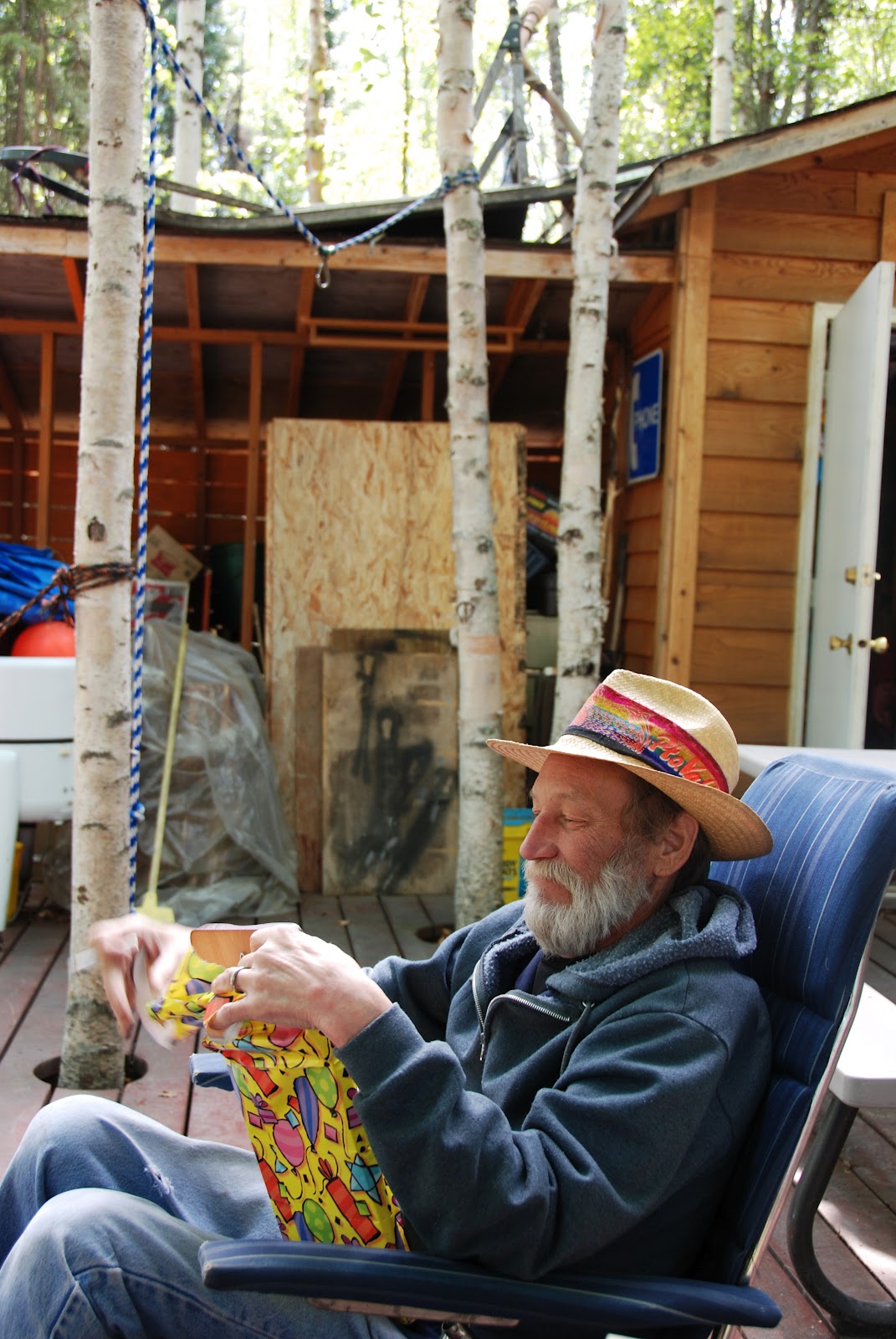
I flew to Alaska on June 13th to be with my brother on his 60th birthday--June 16th. We spent that weekend at their cabin 60 miles from Anchorage. I was gifted with a week of sun, 20 hours of daylight andd warm temperatures.

Their cabin is located on a glacial lake.  I spent two days clearing brush and marveling at twilight that lingered all night long.
Happy Birthday, Joe


                                                            Scenery was just amazing

Ho Ho Ho
Amazing scenery as we head back to Anchorage

We visited Alyeska---the biggest ski center in Alaska.  They'd had 940" of snow during the prvevious winter--100" at the end of May!

My brother, Joe, and I on the summit.

Turnagain Arm in the distance.  Alyeska gets high marks for views!

Tuesday, May 8, 2012

Blanco-Cálido

                                                            
La semana pasada fue muy pesada.  En el día del aniversario de la muerte de mi mamá, recibí un email de mi cuñada que mi hermano, José, ya enfermo, ha caido en demencia. Después de 45 años de alcohol, cigarros  y drogas, la salud de mi hermano está en peligro.

Necesitaba un receso de la ciudad.  De hecho, quería escapar a un lugar más tranquillo.
Me gusta mucho la ciudad de Taxco, especialmente cuando hay mucho sol y las temperaturas están en los 30˚!

Taxco fue fundada por Hernán Cortés en el año 1529.  Hoy, es una ciudad de 50,000 habitantes.  Fué construida en las faldas de cerros altos.  Es uno de mis lugares favoritos en el país.
Pasé toda la tarde al lado de la alberca.   El día fue caluroso con mucho sol.  Nubes blancas flotando en un cielo claro.  No quería hacer nada excepto disfrutar el clima, la alberca y la luz del sol.  Mi unícas acciones eran caminos al bar para comprar Coca Light.

En la terraza del hotel, vi una ciudad blanca, subiendo las faldas de los cerros.  En los patios de las casas había palmas, bugambilias y pinos cipres. En la cumbre, había una estatua de Cristo, sus brazos extendidos al estilo del Cristo en Río de Janeiro.

A las 1700, asistieron amigos y familiares  para celebrar una boda.  La recepción fue en el salón de fiestas del hotel.  Cuando llegaron los novios, los invitados los recibieron con aplausos y arroz en el aire. La novia estaba bella en un vestido largo de color blanco; el novio estaba guapo en un traje grís.
Pero, fue tiempo para comer.  Me duché y salí del hotel para subir las calles sinuosas de la ciudad al Zócalo, donde había restaurantes y calles muy antiguas.  Llegué a la catedral—Santa Prisca— con un estilo barroco. Es una de las mas famosas iglesias en México.

La noche era joven pero, porque era sábado, había borrachos en las calles y los bares. Qué pena! Yo pensé en mi hermano y las elecciónes que había hecho.  Podía escapar de la ciudad, pero no podía escaparme del hecho de que mi hermano es muy enfermo.
Cuando mi hermano era joven, era un chavo dorado—muy popular, deportista, atractivo, presidente de su clase.  Pero, tenía dificultades de aprendizaje y, desafortunadamente, no pudo mantener este dorado crecimiento.

Regresé al hotel, me senté en la teraza hasta la media noche.  Miré el dia que se convirtió en noche.  Siguió la boda, y la música de Strauss llenó el aire.  Los invitatos bailaron, el papá de la novia brindó por la pareja.
En verdad, la música me puso muy triste.  Hace muchos años, viví en Viena, y aprendía bailar el vals.  Durante esa época, hablé mucho con José.  Vivía en Colorado y nos veíamos a menos anualmente.  La música me record cuando era un hombre diferente.  Lloré—lágrimos cálidas.  Fue difícil confrontar el hecho de que mi hermano va a morir.

Las luces de la ciudad brillaban en la distancia, subiendo a las faldas del cerro.  En la cumbre, Cristo abrazaba a los habitantes de Taxco.
Cuando salí a la terraza, el cielo, en la negra oscuridad, estaba  lleno de estrellas.  En el oriente, una luna se levantaba. Y, en el oeste Venus estaba ocultandose.

El Domingo, pasé todo el dia en la alberca.  Tuve dos dias blancos cálidos.  Los dias estuvieron calurosos, con trozos de nubes.  La ciudad blanca de Taxco me calmó y la boda, a pesar del hecho de que no tengo mucha confianza en la ceremonia blanca, animó el fin de semana.
Mi corazón, triste por las noticias de mi hermano, fue alegrado por días perfectos— días soleados, la boda, la música, el camino a traves de las calles magicas y las luces.

Salí de Taxco en la noche y, durante los tres horas a DF, me preparé para la re entrada.
Yo sé que es importante visitar a mi hermano.  Sé no sera fácil pero, el las palabras de Eleanor Roosevelt, “Debes hacer lo que piensas que no puedes hacer.”


Gracias a Gerardo Silverio Rodriguez, Virginia Suarez y José Trinidad Garcia Martruez.

Wednesday, April 4, 2012

Semana Santa in Mexico City


Holy Week                                                                                                                                                             April 8, 2012                                                                                                                                                 Mexico City
Outside of Christmas, Semana Santa, or Holy Week, is the biggest holiday of the year.  It is a time for vacations and the beach, but for those who stay behind in the cities and towns, it´s a time of deep, culturally rich, spiritually-weighted, centuries-old traditions.

For me, Semana Santa started when Steve was in Mexico.  We’d gone to Acapulco and were there for Ash Wednesday. All day long people had the smudges of ashes on their foreheads. 
Watching, and participating in, the events of Semana Santa, my second in Mexico City, would take highlight.

THURSDAY / Holy Thursday / Jueves Santo

Officially, Semana Santa started on Palm Sunday, el Domingo de Ramas.  That day, street stalls in my part of the city were selling palms, woven into all sorts of shapes of the Resurrection—crosses, garlands of lilies, doves of the Holy Spirit, even Christ himself.  These palms would be brought to church, waved in jubilee and would then be blessed by the priest.

But Thursday, Holy Thursday, or Jueves Santo, was the true official start of two of the most significant days in the Catholic Latin calendar.  That morning, I had a text message from a local friend, who often illuminates me on things Mexican.  “The next two days,” he wrote, “are the most solemn and quiet for us Mexicans.  As Catholics we do not eat meat, and Holy Friday is the day to cleanse our passions.  We do not listen to music, do not talk too much, especially nothing trivial.  We prefer to be apart from others and think deeply about our life.”

Late that afternoon, I headed for the beautiful church in the center of Coyoacán.  I wanted a good seat for Holy Thursday services. 

At 5:00 pm, a procession of priests, altar boys and 12 men dressed as the 12 disciples walked down the center aisle of the church.  Shortly into the service, the priest individually washed the feet of each of the men—a standard part of Thursday services in Latin America.  This was followed by communion.

At this point the altar servers climbed high up on the altar.  One of them covered all the crucifixes; another took down the Consecrated Host from a golden chamber.  The pastor held it, wrapped in a special cloth.   Four men held a gold canopy over his head.  The priest led the incense-shrouded procession with all the altar boys and 12 disciples on a slow walk from the front of the church along one side and then down the middle aisle. 
It was all very powerful and quite beautiful, even if I didn’t fully understand what I was looking it.
But it was an early night.  I had serious plans for Good Friday, and it would be an early start to the day.

FRIDAY / Good Friday / Santo Viernes

The absolute epicenter for Semana Santa, not only for Chilangos, the residents of Mexico City, but for the country as well, is in a corner of the city known as Iztapalapa.  For 51 weeks of the year this delegación is absolutely no-gringo land.  It has a nasty reputation as the most dangerous of all places in the city and, quite honestly, there’s little to draw the casual visitor. But during Semana Santa the delegacicón comes to life as they relive, year after year, a 168 tradition.

In 1843, according to its history, the original inhabitants of Iztapalapa reenacted the Passion as an expression of their faith.  Then, it was a procession from one church to another, but over the years it has evolved into a nationwide spectacle with, as they say, a cast of thousands.
And so it was that I, my friend Willem of South Africa, my Spanish teacher, Virginia, and a local friend, Alexandra, arrived in Iztapalapa at 10:00 a.m. to take part in the day’s offerings.

We’d been advised to arrive early because more than 2,000,000 people would show up by day’s end.
We wandered from the Metro and, fifteen minutes later, arrived in the center of town.  We were stunned to see thousands of pilgrims, peregrinos, streaming through the streets, carrying crosses.  With rare exception they were men or boys of all ages. Each pilgrim carried his cross, some quite heavy, barefooted and dressed in a purple robe.  Almost all of them had a white sash around their waist and another sash over their shoulder.  These sashes had all sorts of religious symbols embroidered on them—crosses, rosaries, crowns of thorns, images of Jesus, churches. Crosses, some of them quite heavy, usually had a crown of thorns, interwoven with flowers, hanging from the center.

It was quite moving, actually, to see fathers with their sons, some as young as three years old, and carrying a cross appropriate to their height, doing this pilgrimage together.  At times three generations—grandfather, son and grandson—participated. It wasn’t uncommon to see mothers and their daughters accompanying the men in their family.

Later, I asked a local friend if he’d ever done anything like this.

“No,” he told me.  “This is only for those who live here in Iztapalapa.  I didn’t grow up here and it’s not part of my tradition.”

In the end I thought this procession through the streets was a very good things for fathers to do with their sons.  In a country where girls are idolized and where even the poorest of families will find the money to celebrate their 15th birthday—her quinceaños—with a huge party, there is nothing of equal weight for boys.
To my observant eyes, carrying a cross through the streets of Iztapalapa, with your father, participating in a 168 year old tradition, seemed like a very good thing to do.

Sometime around 11:00 a.m. there were regal sounds of trumpets and other instruments.  How fortunate we were to be in the right place at the right time.  The entire “cast of characters”—some 1,000 strong—marched down the street.  This took almost forty minutes.  Legions of Roman soldiers rode in on horseback.   Roman officials rode in on chariots. Mary, solemn and sad, dressed in black, came into the center surrounded by the disciples. Judas, hands tied, shouted curses.  Jesus rode a chariot, accompanied by an all-tuba band. Hundreds others made the procession as well—young and old, male and female—all dressed in clothing typical of 33 AD. 
It was quite the entry.

By 11:30 we’d been advised to find a place to observe the first part of the passion—Jesus in front of Pilate.  We were extraordinarily fortunate to find an elevated seat on an eight foot wall.  We weren’t exactly comfortable as we were sitting on the edges of huge cement flower pots, but we were dead-center to the action—Pontius Pilate’s palace—about 200 feet in front of us. 
And so for about 90 minutes we just waited.  Not that it was boring.  There were all sorts of things going on around us.  A rosary was being broadcast live from the nearby church.  Helicopters buzzed overhead.  (This was being broadcast live around the country and their presence was an interesting mélange of the 1st and 21st Century.)  Technicians tested equipment…”uno…dos..tres.  Uno…dos...tres.”

Below us, vendors plied the crowds selling all sorts of things—ice cream, baseball caps, soft drinks, candy, gum, water.  My favorite was crowns of thorns for 10 pesos.  That’s less than a dollar.  Kids, mostly, were scarfing them up, wearing them on their baseball caps.  Almost everyone was carrying small bouquets of manzanillas—the traditional flower of Good Friday, the flower, at least in Mexico, associated with the burial preparation of Jesus after his death on the cross.
This was really a great show.

By 1:00, when the trial began, there were literally thousands of people in front of us.  The crowd was thirty thick and those in the back could see nothing of the performance on stage.
But for us, though, we witnessed the Passion first hand.  Jewish officials demanding the life of Jesus, Roman officials wanting a reason, arguments back and forth. 

All this, of course, was done in rapid-fire Spanish and was totally incomprehensible.  Fortunately, we all knew the story, so we’d have to be content with just being part of this great drama—the largest Passion Play of its kind in Mexico.

Jesus was ultimately condemned, and scourged.   The long, cruel walk to Calvary was to follow.
This was our clue to give up our bird’s eye perch.  By now, we’d made “friends” with those around us.  We’d been warned to bring along food, which really hadn’t been necessary.  We’d been jettisoning the apples and sandwiches to those around us who’d seemed pleased by our altruism.

“A dónde vamos, ja? Where to now,” I asked our neighbors.  “Follow the people,” they said.
And follow we did.  Not that we had a choice.  We simply entered a dangerous river of people—a crowd so thick that one mistake could have meant disaster.  Our goal was to follow Jesus to the cross, but what we didn’t expect was how fast the river would move.  Periodically we’d be forced to stop when a Roman official, on horseback, barking stern commands, would push us to the side.  Once, Judas passed, this time screaming curses, and throwing gold coins into the crowd.  Had we followed him, we’d have seen him hang himself shortly after.

There came a point when following Jesus carrying his cross was just not possible.  There really wasn’t all that much to see, and it was dangerous trying to stay in the river of people—now a torrent racing down the narrow streets of Iztapalapa. 

We waited for the action to fully pass, let hordes of people go ahead, and moved forward when we felt it was safe to proceed.  We’d make our way to Calvary to witness the crucifixion.

Or at least that’s what we thought we’d do.  Not long after proceeding along the now-quiet street, we hit a barricade.  It was literally of wall of police, all linked together.  No one could pass.  No one.  I finally asked one of the police which way to go.  He directed me down the street, then up. 
And that’s what we did, but what we entered was a full-fledged Mexican carnival.  Rides for kids, Mexican carnival food (deep-fried plantains smothered in lechera and chocolate sauce, my favorite), kiosks selling all sorts of things.  This “carnival” stretched for almost ½ a mile.
In the matter of two minutes, we’d gone from the sacred to the profane.  Leave it to Mexicans to turn a religious spectacle into an opportunity to make money.  For several hours I’d been living, theatrically at least, in the 1st Century.  The story of Jesus’ death had come to life.  To see it cheapened like this upset me a great deal.

We managed to get ourselves through the maze of vendors and rides, finally got to the hill, but the Crucifixion had passed and the bodies had been taken down from the cross.  It had taken us that long to get from A to B.

Much later, though, I learned that we’d never have gotten to see it anyway.  Entry to Calvary had closed by 8:00 a.m.  People had spent the night before waiting to gain access.

We were only slightly disappointed.  It was impossible, we learned, to see it all.  We’d been fortunate to see the grand entry of characters, and to participate in the pilgrimage of men carrying crosses.  And our seats on the large flower pots overlooking Pilate’s palace had been enough.
he day had been beyond marvelous—a glorious, hot, brilliant blue day where we’d been witness to a 168 year old pageant that was shared by more than 2,000,000 others.

In the end, after I processed all I’d seen and experienced, I came to realize that this Friday probably wasn’t much different from the Friday Jesus was executed.  It had likely been a hot, sunny day in Jerusalem.  There was probably a festive air about the city with so many Jews in town for Passover.  Despite the violence attached to the Iztapalapan Passion, it was still a mighty festive day in that part of Mexico City.  Most everyone, it seemed, was out for a good time.  I’m sure it was the same in Jerusalem in 33 AD.  I can’t image vendors not taking advantage of the crowds in Jerusalem that day 2,000 years ago.  People were hot and hungry and, just like their Mexican counterparts, Israeli’s of the day took the advantage to make an extra shekel.
SATURDAY / Holy Saturday / El Sábado de Gloria

In Mexico, Holy Saturday is known as El Sábado de Gloria, The Saturday of Glory.  Early in the day I’d met some friends and we headed for a Saturday bazaar in San Angel.  Both of these women speak fluent Spanish and have degrees in Spanish.  I was intrigued by the devilish papier-Mache figures I was seeing at street stalls.  “It’s Judas,” Allyson told me.  “They’re only sold and displayed today.”  Some were tiny, but others were four and five feet tall.

That evening a small group of us was brought to a section of the city that most of us avoid.  It’s not the safest place in the city, and certainly a no tourist-zone.  But we were with a long-term resident of the city, and she was bringing us to one of the quirkiest events that take place in the city on the evening of El Sábado de Gloria.
We were on our way to La Quema de Judas, the Burning of Judas, an old European custom that found its way to Mexico centuries ago.

We were the only gringos in a notorious part of the city, but there was safety in numbers.
Tucked away behind the Merced market, down three side streets, sandwiched in between two industrial zones, was the street.  Strung up between two homes, on either side of the street, was a long rope, and hanging from the rope was the first Judas to be burned.  I say burned, but that is not really the right word.  Each papier maché figure was filled with an assortment of fireworks and explosives.  A proper Judas cannot simply blow up, but should explode in stages…leg by leg…arm by arm…followed by a fantastic finish of an exploding torso and head blown to confetti. Mexicans love to flex their satirical and artistic muscles by creating effigies of politicians, world events, and "diablos" in papier maché, then blowing them up in spectacular fashion. One might expect Judas himself, but it is the idea of a traitor, the liar, or one with two faces that is being publicly destroyed.  Indeed, there was more than one Felipe Calderón, Mexico’s increasingly unpopular president, blown up that night.

By dusk, the first Judases began exploding.  The crowd, close to a thousand, screamed with joy then cheered even louder when the effigy blew up.  More than once, the figure fell off the rope, crashed to the ground, but continued exploding, sending small fire bombs in the direction of spectators.

At the beginning, the six of us stayed relatively close to the fireworks, but by the time we left, four hours later, five from the group were a good 40 feet from where they started.  I, on the other hand, video camera in hand, stayed close to the drunks in the crowd, taping the entire spectacle.  I’d run back to the group, a huge grin on my face.  This was just so, so cool.

By 10:30, only the big boys were left.  Huge, 12 feet diablos, with frightening faces and limbs, were  blown up.  The entire process would take up to three minutes for them to fizzle, burn then explode into a million pieces.

We were out of there by 11:00, all of us super-energized by what we’d seen.  This was definitely way, way off the tourist map.

What a way to end the day, to wrap up Semana Santa in Mexico City.  It was hard to get to sleep that night.

SUNDAY /Easter / Pascua

I arrived home from the Quema de Judas just before midnight.  I crawled into bed shortly and was startled awake at 12:00 a.m. with a huge display of fire crackers somewhere near my apartment.  It was almost as if whoever did wanted to shout out, “He has risen.”  To me, it seemed a joyous display of the Easter message.

By 8:00 a.m., the house I live in, which had been very quiet during the days of Semana Santa, was a flurry of activity.  The staff had taken Friday and Saturday off, the most important days of the Easter weekend.  My landlady was in NYC, and was coming home later in the day.  Today was just another Sunday, as Easter is in the Latin World.  There was a lot of work to be done to get the house ready for her return.

On the streets, garbage was being collected.  Stores that had been closed for two days reopened.
I left early for La Casa where I attended 11:00 meeting.  At 1:00, the volunteers, all Americans, and accustomed to an Easter dinner, gathered.  It was a quiet dinner, only a large handful of us, but it was a custom shared by us all and something we wanted to do.  The rest of Mexico went about its normal Sunday business.  Theologically, it all ended on Friday; man’s sins had been forgiven on Santo Viernes.  Sunday was just additional proof that Jesus was God.

That night, I thought back to the power of this Holy Week/Semana Santa.  I thought I did it all with a Latin Easter three years ago in Bolivia, but this…this just topped everything, and I know exactly where I’ll be next April—right back in Iztapalapa, but this time from Palm Sunday right through Sunday, when the full drama of Easter comes to life—Jesus is resurrected from the makeshift tomb he’s been in since Friday.

I can’t wait!

Friday, March 30, 2012

One Hail of a Birthday

Mexico City
March 30, 2012

It would be hard to top last year’s “Social Security” birthday when I climbed a 12,000 foot volcano outside of Mexico.  So, not trying to outdo myself, I followed a lead from the New York Times Travel Section and made a reservation at a hacienda/hotel 90 minutes away from Mexico City in Tlaxcala, Mexico’s smallest state, a state blessedly free of the violence that have beset other places.

Early in the day, I followed the Times’ directions, and caught a bus to Santa Maria Tlaxcala.  I fully expected the find the hacienda a short taxi ride away, but that was not the case.  One taxi driver wanted to charge me 300 pesos.  “Es muy largo, señor.”  It’s a long way away.  So I went back into the bus station, and caught a smaller bus to the town of Apizaco—20 minutes away.  Again, I fully expected to find the hacienda a short taxi ride away, but that was not the case.
When I exited the station, a steady rain was falling.  I pulled up the hood of my sweatshirt, walked out into the streets and went from corner to corner and bus to bus, but no one could direct me to where I wanted to go. 

And then…I began to hear another sound.  I looked up and saw that rain had turned to hail.  Now, that was a first.  It hailed for at least fifteen minutes and the ground was covered in a sea of white!  White!  I spend good money to get away from the white stuff.  I’ve had snow on my birthday, but never hail.
By now I was frustrated.  It was noon and I should have been at the hotel by now, enjoying the pool and its grounds.  So…I did what I always do when I can’t get from A to B: I hailed down a cab.  “I’m looking for the Hacienda Soltepec,” I told him. “Do you know where it is?”

“Ah, si, señor…” 
Are you absolutely certain?

“Si, señor.”  But to be on the safe side he called the dispatcher’s office to get confirmation.
And so off we went…leaving the city of Apizaco and the hail-covered streets behind us we headed into the deep, yet lovely, countryside of Tlaxcala—a landscape full of wide open fields, cattle grazing, and small volcanoes in the distance.  The day had cleared and a warm sun shone above us.  But I was suspicious.  We just didn’t seem to be going anywhere.  Again… “Are you certain?”  By now we were on a first name basis and he knew it was my birthday.

Finally, after passing little streams, and tiny villages, and after traversing down a dirt road for twenty minutes, we arrived.  But the hacienda hardly looked like a first class hotel. We drove down the long driveway, and an assortment of people met us. 
“Si, señor, está es la hacienda Soltepec, pero no es un hotel.  Hay dos Haciendas Soltepec!

"Yes, sir, this is the hacienda Soltepec, but it’s the one you want.  There are two, and the other is more than an hour away from here. "
By now the charm of bumping along the back roads of Taxcala had worn off.  I got on my phone and had Miguel call the hotel—something I should have done at the onset of this adventure.

And so we drove the sixty minutes back to Apizaco, over the dirt road, past the villages, past the streams.
Finally, shortly before 3:00 pm, a full three hours after I hailed down this taxi, we arrived at the other Hacienda Soltepec.  I feared for the price.  He’d initially quoted me 200 pesos, then changed it to 400, but when I got ready to pay, the cost was 600!  $50.00.

OK.  I went back in time to some of my father’s best advice: "Be glad you have the money to pay for these things, Dan,”  he once told me. And so I did.  Handed over 600 pesos and absolutely refused to let this deter my day.
The hacienda didn’t disappoint.  It had been touted as being one the twenty best hacienda resorts in the country. 

Two hundred years ago this part of Mexico had well over 1,000 enormous ranches, and the largest ones had massive homes known as haciendas which housed the owner, his family, and the hundreds of workers needed to maintain the property.  Hacienda Soltepec was celebrating its bicentennial.  It had been converted from a rural school to a first class hotel more than fifty years ago and was often used as a film prop and had been featured in a number of Mexican television shows.
I spent what was left of the afternoon over a leisurely lunch, then a long work-out in the gym, and a long swim in the heated pool.  Dinner, of some way-too-spicy itty-bitty birds, capped the day.

It had been, well…a different kind of birthday. I’d expected full sun and a long day poolside, but it not only thundered and lightening, but hailed as well.  That was a first, and that was OK.
I’d expected to stay put in the same locale for twenty four hours, but had an unexpected three hour tour of the Tlaxcalan countryside.  And that was OK.

I’d expected to climb the nearby volcano, but once in the hacienda,  I never stepped foot outside until I checked out.  And that was OK.
Why bother? It’s not every day I stay in a 200 year old hacienda, and it’s not every day I turn 63.

It had been one hail of birthday.  And that was OK, too.