Thursday, October 23, 2014

Iberia and Beyond 2: Madrid, Toledo, Segovia and Barcelona

Madrid, Spain
October 23, 2014

For a week, Glenda and were crazy tourists in Madrid. I'd arrived a day earlier and get settled into an apartment we'd rented for the week. I gave myself a luxury I rarely do and sat in the apartment’s bathtub for over an hour. I felt filthy from four weeks of different beds, hotels and various apartments. The next day, the 18th, I met Glenda at the airport. She'd arrived, but her luggage hadn't. All of this was fine by me. I needed a day off after the frenetic traveling of the preceding month.

Sunday, we set off for the center of the city and just explored. I'd been to Madrid before, years ago, but the city was lost to memory. My 1982 journal did not speak well of my time in Spain's capital because it truly did like the city 30+ years later. I loved its architecture and its parks. In many ways it was as if I were visiting the city for the first time.

For two days we navigate Madrid on the Hop-On/Hop-Off bus, stopping often to visit parks and churches, but in truth we never really see the principal sites—The Royal Palace and the Prado Museum—until the end of the week. I never do well in places like this. They're so jammed-packed with history and things to see that I just go into overload almost immediately. And this is what happened at the Prado. After four hours of one world masterpiece after another, I said to Glenda... “I'll meet you in front of Boticelli's 'Three Graces.'” I just sat there and preferred people-watching to art.

Midweek, I took the day off, had a haircut, prepared dinner and just stayed in the whole day. Glenda took for the Escorial. Both of us had a great day.

Thursday, we went to Avila and Segovia. I'd wanted to take the train to Segovia, spend the day there, taking my time to see the city and enjoy what it had. Instead, I joined a tour which I should have known in advance would be a disappointment. And it was. We were hustled from one place to another without any opportunity to really enjoy where we were.

Que pena, as the Spaniards would say. What a shame. It was a glorious day full of cool blue sunshine. We had climbed in altitude and by this time in mid-October the leaves were at full peak color. Towering elms glowed yellow against the blue sky. How I wish I'd been able to just sit, soak up this gorgeous autumn day instead of being dragged along on a tour. Lesson learned. No more!

A week to the day I arrived we left Madrid and took the train to Barcelona. Madrid had left a wonderful impression on me and I could see myself returning, but for a longer stay.

A week had not been enough.


Saturday, October 18, 2014

Iberia and Beyond 2--Granada, Spain

Granada, Spain
October 16, 2014
Latitude 37.18 N

After the heat of Seville and tourist crunch of Cordoba, I wanted a side-order of cool and quiet and Granada promised to do just that.

The city lies at the foot of  Sierra Nevada Mountains. It was also a smaller city than either Seville or Cordoba, and while it was packed with tourists, for some reason the usual urban stir and bustle was anything but frenetic.

It was also made phenomenally more enjoyable by yet another warm home stay--this time with Hugo who opened up one bedroom in his small home for visitors.  He genuinely cared for his guests
, made tea for me and even escorted me to the taxi on my last day.

I loved Granada--its mosaic cobbled streets, its leafy green parks and tree-fringed streets.  But most of all I loved the Alhambra.

Who wouldn't!  How many tales have been spun around this fabled series of palaces?

Instead of words, I will let this photographic essay tell my story.


Tuesday, October 14, 2014

Iberia and Beyond 2--A Cynic at Large in Cordoba, Spain

Cordoba, Spain
October 12, 2014
Latitude 37° 88' N

It was Columbus Day weekend and Americans weren't the only ones observing the holiday.  It was also a long weekend in Spain as they, too, honored the man who founded the New World and began the expansion of the Spanish Crown onto two new continents.

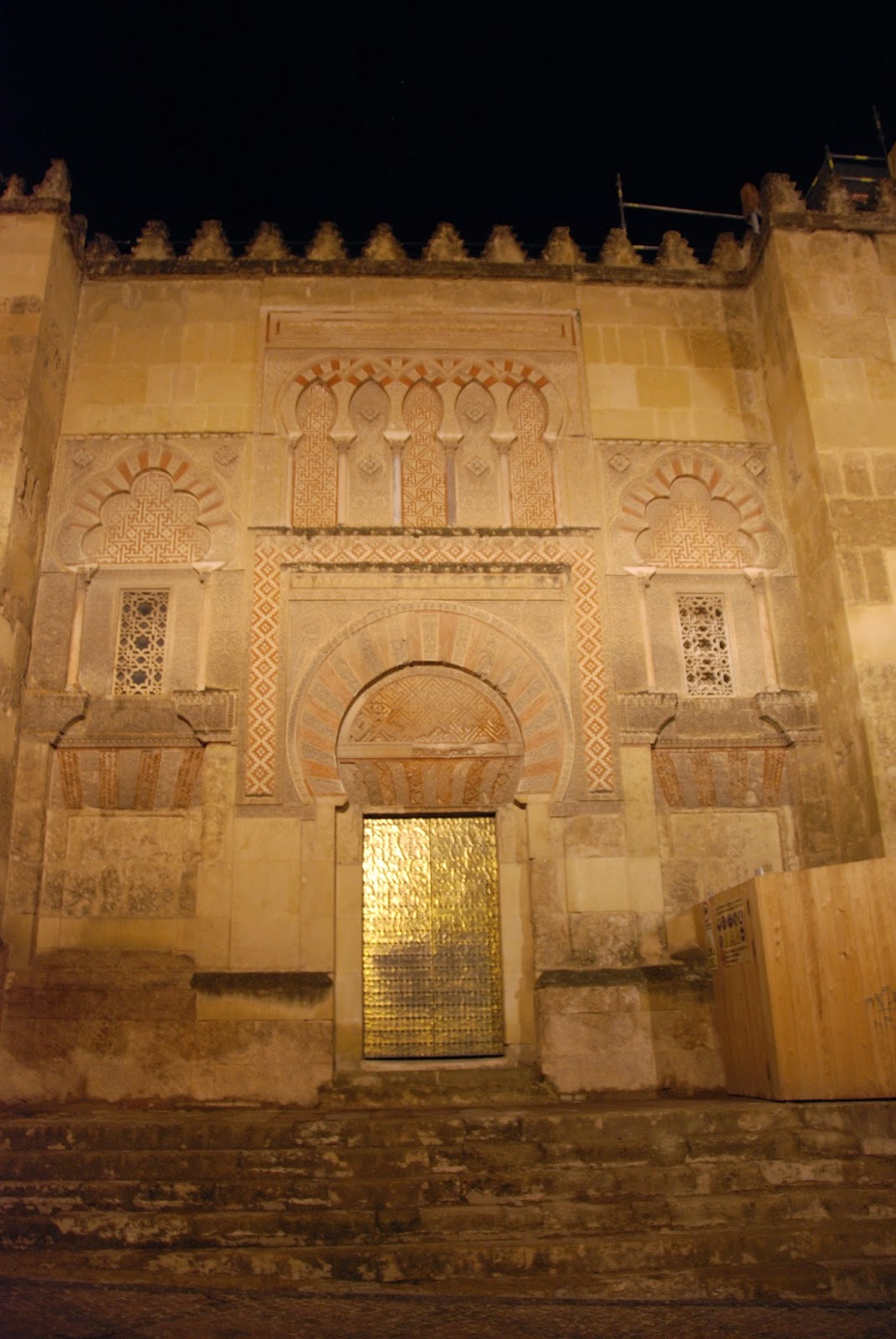
I was in Cordoba to visit the Mezquita--an almost perfect fusion of refined Islamic architecture and Renaissance artistry.  But I was not prepared for the crowds that swamped the medina-like historic center of the city.  Its twisty, curving streets were chock-a-block with  tourists--hordes off the steppes of China, countless groups of Japanese and throngs of Spanish families in town for the weekend.


There were lines everywhere--lines to buy a ticket into a place, lines to enter the place you just bought a ticket for, lines, even, for queuing up for the perfect photographic shot.

It was depressing from the start.

My only real goal for the day was the Mezquita--Cordoba's premier church/mosque/church--that charted the evolution of  Western and Islamic art over a 1,000 year span and which has a fascinating history.  First it was a church built in the 600's honoring St. Vincent, a 7th century martyr.  In 785 Muslims from North Africa  invaded the city and converted the church to a mosque that, over centuries, was expanded and enlarged and enlarged again into a massive 124,000 square foot prayer hall, the most lavish in the Islamic world.


 In 1236  Cordoba was recaptured by the Catholic king Ferdinand.  The mosque was rededicated as a church and by the 1500's work was underway to incorporate a High Renaissance cathedral within the prayer hall.

Three cheers for the architects who didn't destroy one Islam's greatest architectural achievements.

Once inside, I was stunned by the sheer immensity of mosque cum church. A veritable “forest” of 856 columns, most recycled from Roman ruins, supported extraordinary horseshoe arches in warm shades of cream and terracotta. Surrounding the four sides of the mosque were 37 tiny chapels dedicated to every saint imaginable including one with a painting of Mexico's Virgin of Guadalupe.

Some of the chapels had small silver ossuaries containing human skulls and others had small sarcophagi, relics of the “Good Death” where entrance to heaven was easier if you were buried within a church.

Highly stylized Renaissance paintings depicted a never-ending number of virgins and martyrs dripping in blood, trance-like prophets and aging apostles. One painting depicted a female martyr tied to a stake, her torso naked showing surprisingly perky breasts. Images of St. Stephen and another of Jesus and the beloved apostle, John, were almost homoerotic. Religious iconography masking as Renaissance soft porn.

Despite my awe, it was almost impossible to enjoy the place.  Nothing was sacred, no spot untouched by a human being's presence.  People seemed to pour out of the woodwork. Whole neighborhoods, it seemed, of Tokyo had emptied out into Cordoba and most of them were at the Mezquita on this particular Sunday afternoon. People were lined up to have their pictures taken in front of just about everything. Spanish mothers put their very small and very loud children on tiny altars and had them pose. Asians stood in a line to have their photos taken in front of the silver streaked altar of the cathedral. A young Spanish couple, seemingly oblivious to to everyone else, sat in a pew at the back of one of the chapels and made out. A teenage girl, in shorts way too short for anywhere but the beach, struck a sexy pose in front of the many altars.

No place seemed sacred. The one chapel that clearly said “Silencio, por favor. This is a place of prayer” was filled with tourists needing to sit down, relax and chat. Japanese tourists who probably couldn't read Spanish yakked away while taking selfies.

Everyone had a camera—Smart phones, point-and-shoots, SLR's. Everyone wanted to shoot the same thing at the same time so there was a perennial queue in front of just about every astounding thing, of which there were many.

All of this just wore on me until every one of my cynical cells of religiosity tingled with annoyance. It didn’t help that I was constantly seeing amazing works of arts created by Europe's best silversmiths of the 14th, 15th and 16th century. Gorgeous candelabras, massive reliquaries, astounding silver lecterns, a ten foot I-don't know-what-it's-called that holds a consecrated hosts, and every sort of ecclesiastical bling possible dripped out of almost every chapel and on the altar of the cathedral.  

The problem with all this is that I'd been to the silver mines in Potosi, Bolivia where, under the Spanish crown, more than 6,000,000 indigenous were enslaved and died to mine the metal to make these things. I knew too well the ravages of Spanish/church sanctioned colonization.

All of this, plus the massive hordes of tourists, just piled on itself to make this a far-less-than-spiritual excursion. I grew more and more cynical as the afternoon progressed.

Despite all of this I was still unable to leave the Mezquita. I'd circle the massive prayer hall, reexamine its tiny chapels, investigate yet again another over-the-top mythologized Renaissance painting of flying angels and a seemingly endless pantheon of Christian sub-deities that make up Middle Ages Catholic Christendom,  photograph yet again another set of the cream and terracotta arches in the forest of columns that made up the original prayer hall. I knew I was standing is a work of genius that was unfathomably beautiful and that it was something I may never see again.


But these places are never good for me spiritually. It's impossible for me to go inward when there's this much distraction. And it made more so at the Mezquita. There was an almost yin/yang juxtaposition of architectural style—the refined and clean lined Islamic and the wildly over-the-top Renaissance.

And I knew, too, the origins of all the sliver that produced these magnificent pieces of religious art.I'd been to the silver mines in Potosi, Bolivia where 6,000,000 Indigenous were enslaved and died under the Spanish to mine the metal to produce these works.

Oh, I knew the difference between the Church and the People of God.  It's doubtful any Spaniard in the 16th century had any idea what horrors were being enacted by its Crown and its Church.  No one can blame anyone but those in power.  Still, it's one of those inconvenient truths the church never addresses, and I have a problem with that.

I know that some would say that this art honors God, and maybe for them that's true.  For me, though, the human is far more important than an object that is meant to honor God. No life lost to slavery is worth the art it produced.

The cynic in me won out that day. And that cynicism stayed with me again and again as I stepped into magnificent churches with magnificent silver art.

In the end I finally did leave—just as museum security was shooing everyone out. I walked out into the bright light of an Andalusian Sunday afternoon. The late afternoon sun glowed warmly on the ochre colored blocks of the Mezquita.  Looking back as I returned home, I turned my head for one last look.  It was stunning and a perfect last image of work of art.


Monday, October 13, 2014

Iberia and Beyond 2--Seville, Spain

Seville, Spain
October 10, 2014
Latitude 37°22' N

It's amazing how simply crossing a river, when that river separates two countries, within seconds brings the traveler into a new culture, with a different history, different traditions and different sets of values.

Thus it was that I left Faro, Portugal on the afternoon of October 8th and bussed a mere three hours to the exquisite city of Seville--the first in a triad of Moorish towns I'd visit before heading to Madrid.

For three days I wandered this lovely city on  the banks of one of Spain's longest rivers, the Guadalquivir.  My first day was sunny and hot and I took advantage of it to circle  the city on the Hop-On, Hop-Off tourist bus, getting off periodically to sit in peaceful, tree-fringed plazas or walk the narrow cobble stoned streets of the old city.  By early afternoon everything was bathed in brilliant Andalusian sunlight.  How lucky I was to view the city's cathedral as this light drenched the ochre stones that masons had used to build this more-than-impressive church.


By late afternoon I took shelter in the city's elegant Luisa Maria Park.  Horse drawn carriages  clip-clopped down the leafy  boulevards flanked by a European variety of maple, just turning to autumnal brown on this early October afternoon.


Friday was the beginning of the long American Columbus Day weekend, but it was also a national holiday for Spaniards, too.  They honored the man and his accomplishments just as we did.  It was a perfect opportunity to step inside the cathedral, view his tomb and enjoy the world´s largest Gothic Cathedral as well as the world's third largest.  Of all the splendors I saw in Seville--and there were many--this stands out at the best.


Just the statistics alone were staggering.

Supporting columns, round as redwoods, rose 138 feet to ceilings gilded and ornate.

From official start to official finish, it took a monumental 527 years to complete, yet the bulk of the work was done between 1401 to 1528. 

Behind a massive golden grill was the intricately designed altar--the life´s work of sculptor Pieter Dancort who never lived long enough to see its completion..  The altar was a sea of gilt with over 1,000 biblical figures carved in detail.  Known as the Capilla Mayor, it's the biggest of its kind in the world.


The cathedral was built on the former sit of a mosque to show the city's enormous wealth.  Legend has it that the brainchild behind the Cathedral said ¨Let's constructed a church so large, future generation will think we were mad.¨

Well, they succeeded.

At 450 feet long and 330 feet wide, with 15 doors and 80 separate chapels, it's a monument that staggers the imagination.  It was so big that it was only possible to photograph small sections of it.

The steeple is all that remains of a mosque that stood on its site prior to the Reconquest of Spain.  The minaret had been designed with 32 zigzagging ramps--wide enough for a horse to navigate.

But on this day it was just tourists who slogged to the top.  Their reward: a 360 degree view of the city, including the Alcazar, various 15th Century monasteries and a kaleidoscope of Medieval buildings below.

Inside, though, despite the ornate chapel, silver altars and gold covered angels; despite the pantheon of carved saints, prophets, and fathers of the church; despite jaw dropping artistic magnificence was the tomb of Christopher Columbus.


Well, part of his bones at least.  The other portion is still in Santo Domingo in the Dominican Republic.  What a perfect way to spend this 1st day of the long Columbus Day weekend.

The mausoleum was easily 15 feet high--the tomb itself carried on the backs of four giant bronze figures.  Overhead, larger-than-life was a painting of St Christopher.

This was just the icing on the delicious cake that was Seville.  I was already ready to return for Holy Week.  It's here in Seville that the week takes on his most dramatic feel.

Another time!