Sunday, November 11, 2012

Back to School

Punhaka, Bhutan
November 9, 2012
Altitude: 4,300'

It's not often I want to go back into the classroom, but that's what I did on the morning of November 9th.


Yesehy's wife, Choden, whom I'd met earlier, is a secondary English teacher and I'd asked her if it was possible to visit her class. She was more than happy to have a foreigner meet her students, letting them hear properly spoken English and giving them the chance to ask questions. I was told that they see a lot of tourists, but never really get the opportunity to talk to any.

So at 9:00 a.m.we arrived at the Khuruthen Middle/Secondary School in the small city of Punhaka.

The Bhutanese school system is patterned after the Indian system which is patterned on the British system. Mid November begins the end of the school year and final exams. School will officially be over on December 17th and resume in early February.

I would be in two classes this day. Chowden, as well as a young Canadian woman from Ontario, who also teaches English, would be my hosts.

My first class was 6th Standard--a shy and pleasant group of 40 11-13 year old students packed into a small classroom. Chairs were uncomfortable, most without backs. It was clear that education in Bhutan did not have the funding more developed countries had.


Each student was dressed in identical school uniforms. Boys wore the gho and the girls the kia--traditional clothing that everyone was required to wear at work or in official functions.

When I walked in the classroom, the students immediately stood up and sad in unison..."Good morning, Sir." I was a bit taken aback. I'd not seen something like this since my days as Saint Peter's more than fifty years ago. We'd always stand when the priest walked in and said the same thing. Actually, it was kind of nice to see.

I introduced myself, told them I lived in the United States,but also in Mexico. They told me that Barrack Obama and just been reelected and that there had been a big storm in New York, but they knew nothing of Mexico, so I took this as an opportunity to teach them a bit about my adopted country.


Bhutan has three official languages--two indigenous languages and English as the common demoninator. Children began to learn it as soon as they entered school at age six.

These middle schoolers were good. Really good. They had excellent comprehension skills and were able to ask me reasonably intelligent questions. They wanted to know about my culture, food, sports and holidays. They also wanted to know my age. "I'm 63," I told them. There were a few gasps and I'm not sure why. I figured I was a pretty old guy for a Bhutanese.

For three years I taught Spanish and marvelled at how little American kids could actually do in the language. Here in Punhaka I was having a conversation with students whose language abilities exceeded those of graduating Seniors.

The second class--a small group of 25 15 year olders, were far more inquisitive. With them I spent more time on Mexico, speaking some Spanish. Actually, Bhutan and Mexico share some common traits. Both Mexico City and most of inhabited Bhutan is above 6,000' and both Mexico and Bhutan lie on the 27th parallel, so the weather is very similar. Fruits and vegetables have much in common and,like Mexicans, the Bhutanese love their food hot, spicy and full of chillis.

It had been a wonderful experience. When I was still teaching and travelling during the summer with Glenda, I always avoided this type of things. She, on the other hand, always embraced these opportunities and I was always happy to photodocumenting her storytelling to Indonesians, Koreans and Thais.

This time it was my time to embrace it.

"Adios mis amigos," I told them in Spanish. "Fue un placer y un privilegio." I think it was the first time they'd heard Spanish.

"Goodbye my friends. It was a pleasure and a privilege."

And it really was.


Ling Gyser Festival--Jakar, Bumthang, Bhutan

Jakar, Bumthang, Bhutan
November 6, 2012
Altitude: 9,058'

It was the morning of the US Presidential election and there was a knock on my door. It was 7:15 a.m. and 61 degrees in my room and I didn't want to crawl out from under my warm down comforter.

We were high in the Bumthang Valley of Bhutan.  The fire that had burned so warmly the night before in the room's fireplace had dwindled to ashes. 

I shivered as I opened the door to find Yeshey, my guide and driver.  "Good morning , Sir.  Today is an auspicious Buddha day.  There is a new temple opening today and there will be dances and ceremonies for two days.  Would like to do that instead of what we planned?"

Auspicious indeed, I thought.  Auspicious for the Buddha.  Auspicious for me and auspicious, too, I hoped for President Obama.

"Of course, Yesehy."  I always grab at opportunities like this.

Two hours later we arrived at the temple, in Chumey Valley about 30 minutes from Jakar.  Hundreds of local people were there.  I found a seat and joined the multitudes as the dances began.

This was the Ling Gyser Festival with dances and music that traced its routes to Tibet more than 400 years ago.  All the Bhutanese knew the story of the warrior-king, Ling Gyser--that would unfold as its part of the cultural folklore.  I, on the other hand, would need a guide through the entire performance.


It was a day of brilliant deep blue and clean, clear sky.  The sun blazed hot and I was go have on sunglasses as well as a cap.

Emerging first from the temple were the four protective deities of Bhutan, each represented as warriors and dressed in elaborate costumes.  Each deity has a specific purpose.  Chenmizan, from the west, guards Bhutan against demons and earthly treats.  Yulkhorsun, from the east, represents harmony--the Buddhist concept of the middle path.  Namthose, from the north, provides wealth and prosperity.  And finally, Phagchepo, from the south, guards against enemies. 

They seated themselves at the four corners of the staging area while the Buddha emerged from the temple. He was followed by the second Buddha and his two consorts.  Their presence would be felt for all witnessing this pageant.

The story that unfolded for the next six hours retold the story of the three Tibetan invasions in 1644, 1648 and 1649.  Had I not had Yesehy and others around me to explain what I was seeing, it would all have been just a colorful spectacle.

To purify the ceremony, a large urn was placed in the center of the square. The urn was filled with pine boughs and incense. With great ceremony, one of the warriors lit the pine boughs. Billowy white fragrant smoke filled the air, scattering any demons who might be present. 

The urn was removed, a "target" was placed where the urn had been.  The Bhutanese national sport is archery, and its origins date back centuries, and the target would hold supreme importance during this reenaction.

First to enter were then warriors--lavishly dressed in long brocade robes, ornate helmets and multi-colored boots.  Each warrior was outfitted with a bow and arrow.  The dance was a slow, methodical circle dance with each warrior mimicking the shooting of their arrow.  After about ten minutes, they formed a line.  Each warrior approached the target and pierced it with his arrow.  Finally, in the end, the warrior representing the king did the same--thus "defeating" the 1st Tibetan invasion.

Following this was a slow but joyous dance of Thanksgiving.  Twenty dancers--male and female--carried banners of red, yellow, green, white and blue.  Their dance reflected the joy in this first Tibetan defeat of 1644.

This marked the end of the first part of the pageant. For more than two hours I'd sat cross-legged watching this magnificent performance.  But it was noon and time for lunch.  Yeshey had arranged with the hotel to pack a hot picnic for us.  There was roast pork, potatoes, rice, vegetables and tea.  We found ourselves a place near the river and enjoyed this special meal.  A friend of his was there--a young man from the area who was studying in Calcutta--and I asked him to join us.  He was able to explain more of what I had seen and would see in the afternoon.  I commented to both of them that the landscape we were were looking at--lofty pines, high mountains and blue, blue sky reminded me of the Sierras of Northern California.

The vast majority of people present had brought lunch, fully planning to spend the day.  The monks of the temple, on the other hand, had prepared a simple meal that was given freely to many local people who'd come empty handed.

When I got back to the square, it was still early.  I found a seat dead-center to the show, my back against a stupa.  I was early, but I was curious about a long, snaking line of people to my right.  I stood up, walked to the front of it, and noticed that each person approached the man responsible for constructing the temple.  According to local belief he was the reincarnation of a Tibetan monk who'd come to Bhutan in the 8th century.  Each person bowed, made a financial offering and received a blessing.  The line never seemed to end.

 Two subsequent dances replicated the first.  Swords and shields were used in the second and colorful banners, that became spears as they were rolled up, were used in the third dance.

At the end of the third dance, each warrior furled his banner, wrapping the flag around the spear, symbolizing victory over the 1649 invasion.

The most dramatic dance followed.  The "target," which had been present throughout all the dances, represented the enemy.

At this point, two monks approached the "target" and attached two white scarves--a representation of peace among Tibetans.  A third monk then poured kerosene on it.  The two previous monks returned with burning torches, lit the target, thus representing the final subjugation of the enemy.

Officials quickly removed the burning debris while two warriors,, the King, and the two dancers engaged in a highly staged, dramatic dance of joy.  The Kingdom of Bhutan was safe.  The enemy was on the high plateau.  Each dancer--31 in all--danced off the square, climbed the steps to the temple, bowed, and disappeared.

I was almost let down by the time this glorious pageant had ended.  I also noticed that I was the only Westerner present. The small group of other tourists had left at lunch.  We lingered a bit and I was able to get photos of the beautiful chlidren who'd sat near me. 


This was the first of the two day inauguration of the new temple.  The next day would be day of dedication, blessing the temple, the monks, and the people who participated.  For me, day one would have to suffice.

Yeshey and I set back to Jakar.  I had a thousand questions and peppered him all the way back to town. 

Poor man.  I really think he got flustered.  All the who's, the what's and the why's were too overwhelming.  He did his best, but shortly after getting back to the hotel he handed me a book--a compendium of sort--a kind of ""Bhutanese Buddhism for the Idiot."  It helped a lot.

Later, at dinner, I was the only guest.  The chef's wife sat with me and gently walked me through my many questions.

"You were a fortunate man," she told me.  "I was a guide for many years and I have never seen this festival.  In fact, this is the first time it was performed in Bhutan, thus explaining why the prime minister of the country had been present. 

By the time I got to bed, polling booths in the USA were just opening.  I wouldn't know until the next day that Barrack Obama had been elected. 

I could not have planned on a day like this. It had been an auspicious day--auspicious for the Buddha, auspicious for our President, and very auspicious for me.


Hiking the Phobjika Valley of Central Bhutan

Gangteng, Bhutan
November 5, 2012
Altitude: 9,425'

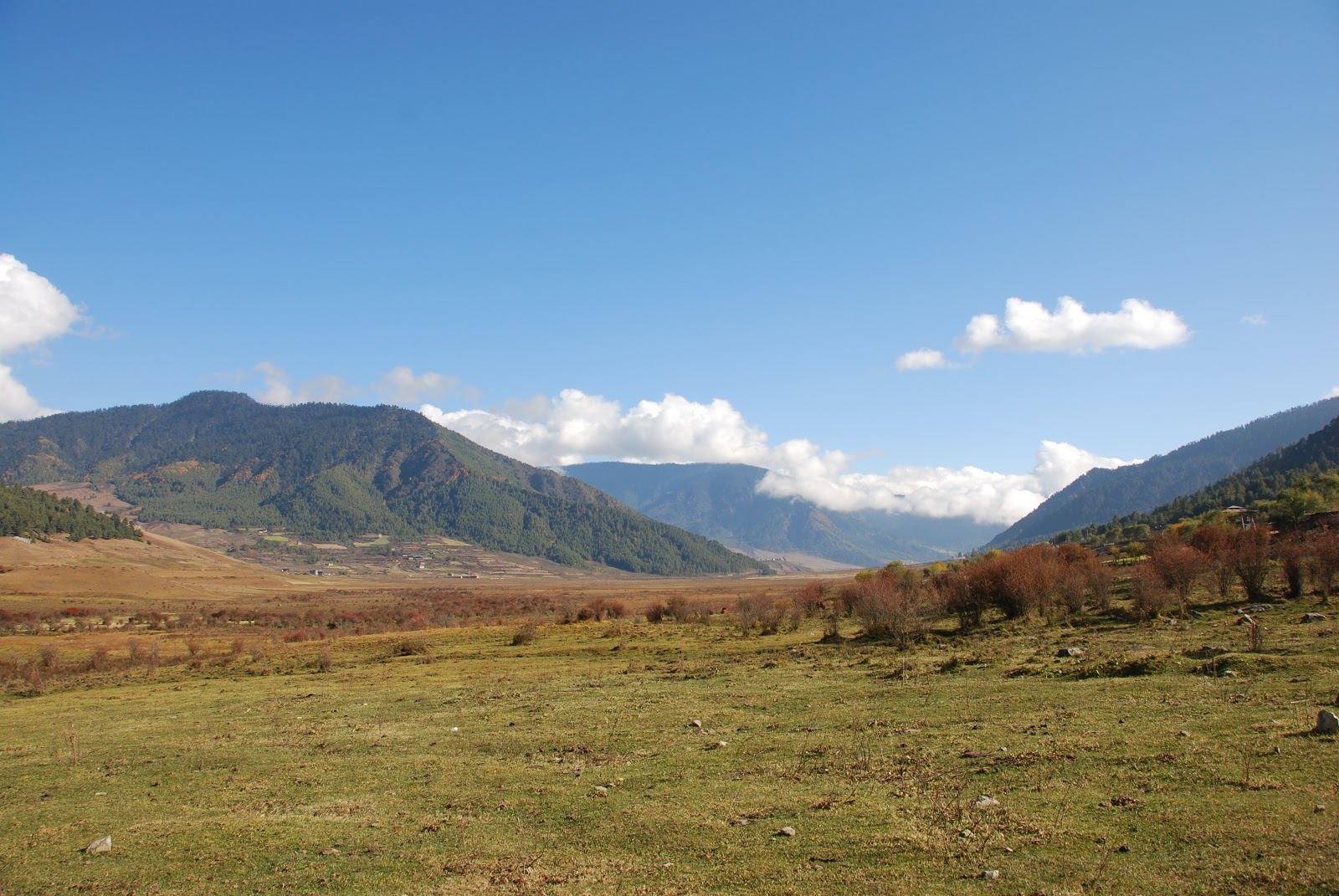
It was my third night in Bhutan. Much earlier in the day we'd left the sultry, fertile Punhaka Valley to the much higher Phobjika Valley, at 9000'. We had climbed steadily through forests of rhododendrons and the ubiquitous Bhutanese blue pine--tall and lovely. Twice, we'd travelled over high mountain passes--one with a spectacular view of the Himalayas at 10,000'and another, Pele La Pass, at 11,204'. Like Tibet, thousands of prayer flags were strung between trees--their prayers fluttering to God thanking him for a safe ascent and a safe descent. Almost immediately, upon our descent, the vast, glacial Phobjika Valley came into view.


It was late afternoon, and the sun had already set behind the hotel where we'd spend the night. No sooner had a settled into my lovely pine-panelled room when the electricity failed.

It wasn't much later than 5:30 p.m. I pulled a chair out of the room, settled myself onto the balcony, watching the last spalashes of light ascend the southern ride of the vlley. My thermometer read 59 degrees.I'd just have to wait for the electricity to come back on.

I desperately wanted a shower. Several hours earlier I'd left the village of Ganten and had hiked from the monastery in the village, through the village, down a pine forested hillock into the central valley where I followed a country lane for several hours.


The monastery had been a treat. It was Sunday, and the prayer halls were filled with monks and young novices--red-robed, spinning hand held prayer wheels and chanting. Theri chants were inspersed with the slow beat of a drum--five slow beats, then three in rapid succession followed by the clanging sounds of cymbels.

"Om mani padme hum," they chanted. "Om mani padme Hum."

They were invoking the powerful benevolent attention and blessings of Chenrezig, the Tibetan embodiment of compassion.

The monks chanted separate prayers while the lama--the priest--recited another. It was absolutley hypnotizing.

Yeshey told me that they were praying for the dead, asking the deities to bless the deceased with a happy afterlife and for a good reincarnation.

But the valley beckoned. I'd been in a car too long and the trek looked enticing. I told Yesehy that I wanted to walk to the hotel. He reluctantly showed me a cluster of building--specks really--several miles away. I'd been in the car too long, at times spooked my roads that were as narrow as ten feet across, switchbacking down mountains with nary of guard rail in sight. Had we slipped off the road it was, at times, hundreds of feet to the bottom. I really wanted to walk!

I put on my boots, grabbed my hiking poles and took off and slipped through the village. How nice it was to drop into a lush blue pine forest. Immediately, two black dogs began to accompany me. They were fast than I. At times they'd look back, wait for me, then resume when I joined up to them. They were pleasant companions and stayed with me almost all the way.

Soon, the macadam road turned to a track of hard dirt and stone. Above me, on both sides of the valley, tall 12,000' mountains stood sentinel. Climbing the slopes was a deciduous variety of cypress that blazed in full autumn yellow. All around me were small apple orchards.  Apples had been harvested and the trees were bare of leaves.

The track had little traffic. I'd pass a settlement of a few homes--all designed in the unique Bhutanest architechtural style with murals of flowers or Bhuddist iconography painted on the side.

There was an autumn flavor in the air.  Fields were full of yellow mustard, bright red barley and green turnip leaves. We were at the 27th parallel, so despite the altitude, the days were still warm enough for crops. I'd been told earlier that the mustard flower was usd to make oil and that the turnip leaves would be dried, stored through the winter, and used in stews and soups.


Tall white prayer flags fluttered in the afternoon breeze. More than once I'd pass clusters of of 108 flags--each flag narrow and attached to a 15' pole of bamboo, with Buddhist prayers stamped on them. Yeshey had told me that a family would erect them after a love one died. The prayers would blow supplication to the deities in the never ending breeze of this glorious valley.


Indeed, in Bhutan Buddhism is inscribed into the very landscape of the country--much like decorative crosses that dot the landscape of rural Quebec or France. Prayer flags, prayer wheels and chortens (the Butanese form of a stupa) were everywhere.

By now my hike brought me to a series of small farms. The dogs and I shared the track with a team of cows walking down the road. I have no idea where they were going, but the bells around their neck, the metal inscribed with Buddhist scripture, was bucolic music. In one farm, a woman was milking a cow, and in another a family was arranging bright red chillis on the roof of their home to dry in the brilliant sun of the high plateau. Yak cheese was formed into small square cubes then strung on long strips of thread then stretched between doors and windows. People wre preparing for winter when food would be more scarce.

Homes were fenced by a series of poles planted into the ground, then criss-crossed with rough hewn planking mixed in with bamboo running horizontally.

People were tending their chores--picking vegetables, preparing dinner, tending to the few animals they had.

Several times I passed chortens--small shrines--that housed religious relics or the ashes of a Buddhist saint. And more than once, using energy from brooks running off the mountaisn, I'd see prayer wheels genetated by the free power of water. For me it was mesmorizing. Prayer wheels are always a part of temples, and it's been my custom to spin them, but I'd never seen ones generated by water power.


Closer to the guest house my walk took me through a long, half mile planting of willows--their leaves a soft and warm yellow at this time in November.

Many times I'd stop to gaze out at the wide glacial valley. I could only imagine the forces that generated this 10,000 years ago when glaciers made their way north. In the center of the valley, yet close enough for me to see, were pairs of rare black-necked cranes who'd come to this valley from their summer home on the high Tibetal plateau. They were not only protected, but had become an integral part of Bhutanese folk culture, and were much loved.


By now the sun was slipping behind the mountains and there was a decided chill in the air. I accelerated my stride and got to the hotel just before dark. Yeshey, I think, was relieved to see me. I'm sure leaving tourists alone for too long is frowned upon the agencies that hire him.


When I turned into the guest house, the dogs looked puzzled. They didn't follow, turning around, instead, and heading back to Ganteng.

I was dusty and dirty from the long hike. I think it was when one of the boys who worked in the hotel came by with a candle that I lost hope.

"I'm sorry, sir," he told me. "We don't have electricity tonight. I will light this candle for you."

Candles? No shower...at least not a hot one?

Well, I'd learned a long time ago to roll with the adventures travel often brings. I managed a very cold sponge bath, changed into something cleaner, and got to a candle-lit dining room in time for dinner.

I had to admire the staff. They'd prepared a delcious meal under very difficult cirsumstances.

Without lights, sleep came early. By first light, I was fully awake. My thermometer read 47 degrees. Thank heavens for good Bhutanese down comforters in all rooms. I'd used two of them.

Still, there was no electricity, but I could hear the quiet bustle of the staff who up earlier than usual I imagine.

By 7:00 am there was a knock on my door. "For you, Sir," the young man said as handed me a large Chinese thermos full of hot water. "For bathing, Sir."

"Thank you," I told him. I silently thought I'd need to tip this boy more than usual. 

Instead of seeing that as some travel obstacle, it had become an adventure--the wonderful hike from the village to the guest house, the candle lit dinner, a cold night tucked under two warm blankets and then...the magic of warm water the next morning.

Gangteng had been great!


Bhutan: In the Beginning

Thimpue, Bhutan
November 5, 2012
Altitude: 7,710'

About twenty minutes into the flight from Kathmandu to Paro, there was a real sense of excitement on board.  We were flying northeast, we were passing a dramatic view of the Himalayas.  We passed Mt. Everest and Lotse before passing another dramatic stretch of the Indian Himalayas--all mountains over 23,000'.  Just before landing we caught a glimpse of Bhutan's highest peak
--Jhomolhari. Druk Air Flight 401 is easily the most dramatic flight int he world.

What an introduction to Bhutan!  I think because of this flight, and because, at lest for the majority of us, Bhutan was very high on the travel destination list of place to go in the world.  It certainly was for me.

Once through customs, I exited the terminal to see my driver/guide holding a sign: "Daniel Ladue."  I'd arrived and I was excited.

Bhutan!  I'd jumped through a lot of hoops to get this far, and had budgeted far more than usual.  The was the beginning of a ten day journey that would bring me from the eastern populated region of the country to the center.

Long ago I stopped creating travel expectations and I'm rarely disappointed.  I just knew that Bhutan would not disappoint.

But it was late in the day and I'd lost another hour and sunset was but two hours away. 

Yeshey, my driver/guide, allowed me to alter any travel plans that he had.  I wanted to see the Thimpue weekend market.  Dried yak cheese, strings of pig intestines.  I just hoped that wouldn't be on the menu that evening.  I also told Yeshey that each day I wanted to hike and that I'd be satisfied with one museum instead of many.  He was more than flexible.

That evening I had a taste of the kind of hotel I'd be staying in.  All hotels had been chosen in August and there were all three to five stars.  Of course, for the privilege of entering Bhutan I had to pay a steep price of $290.00 a day, but that included hotels, my driver, all meals and all entrance fees.

When I entered the dining room that evening there was bust one couple.  I asked if I might join them.  They were more than inviting.
We were on the cusp of the US Presidential Elections and more than once I'd been asked my opinion.  There was a widespread fear that that the President would not be reelected.

People were often guarded.  They were fully aware of how divisive American polictics had become. One an even sugested that this could be the seeds of a civil war, but I didn't quite think it was that radical.

Wolfgang and Inka, from Germany, were the same.  Once they learned I wasn't a Republican, they loosened up. 

"What is it you people want?" Inka asked me.  Your country is willing to wage two wars, go trillions of dollars in debt, but yet there is a battle to prevent people from having health care." 

I had answers, but they were only my opinions.  Both of these people were old enough to have grown up during WW II and their view of world politics was far different from others.  I had to respect them.  This would not be the first conversation I'd have of this sort during my week in Bhutan.

Our first day brought us out of the Paro Valley.  We passed apple orchards and tall, lovely forests of Blue Pine and then we climbed through a moist forest of rhodendrons, alder, hemlock and fir, past huge chortens--Buddhist monuments containing the relics of a saint and strategically placed tp protect travelers.  We were on our to Dochu La Pass at 9,968'.  

Buddhism in Bhutan has a strong Tibetan influence.  Strings and strings of multicolored prayer flags blew in the steady breeze. We stopped for tea and the view from the tea house, over a long line of 18,000 mountain peaks, was astounding.

As we descended, we left high altitude vegetation and the landscape changed. It became increasingly tropical.  There were fields of sugar cane, stands of mangoes, wheat fields and corn fields.  Because of the altitude, this was the end of the harvest season.  By the time we dropped into the sultry, fertile Punhaka Valley, we'd dropped 5,000'.  The road was sinuous and sindy.  There were no guard rails separating the road and drop offs of 1,000'.  We were essentially on a single lane highway and rop offs of thousands of feet weren't uncommon.  Signs cautioned driver:

"Drink whiskey.  Make risky."
"Sharp curves.  Keep your nerves."

"Take care.  Don't dare."

But I seemed to be in good hands with Yeshey, plus I've been on so many hair-raising roads in my life that I've somehow learned to manage my fears.  I also knew that God was steps away.  I always know that there are times you just have trust and let go.

As we came off the pass, monasteries began to appear on the surrounding hills.  Fast flowing streams--clean and clear--flowed off the mountains.  At times there would be black and red prayer wheels--cylinders really--with printed prayers inside which were "said" each time it turned.  The ones by the rivers were housed in a small shrine and the wheels turned effortlessly hydro-electrically.

By mid afternoon we stopped by the banks of the Mo Chuu River--a glorious glacial fed river that ran milky green and cold.  Yeshey knew that each day had to involve some hiking.  He pointed to a temple high above the river--Chimi Lkakhang.  We set off almost at once.

It was a pleasant walk past terraced rice paddies, past poinsettia trees in full bloom, past children selling fresh, delcious guavas.

From the temple, we had impressive views of lower Himalayan peaks--all still well above 13,000'--primeval valleys and tiny villages high on mountains sides.

By the time we left, the sun had slipped behind the mountains.  We hiked down and make our way Punhaka for the night.  This was Yeshey's hometown and he was able to spend the night with his family.

As was the case every night at dinner, once my American accent was discerned the conversation always led to the upcoming election.  "What happens in the US has a ripple affect around the world," said a Singaporian woman.  "We are very concerned."

And I had to agree.

The next morning we headed in Wangdue Province which brought us over another Pass--Pela La--the highest we'd cross at 11,115'.  I was very happy for two things: the altimeter Steve gave me for Christmas and the red cells I still had in my body from living at 7,000' in Mexico City.  I never had a problem.

Herds of yaks grazed at the highest elevations.  As we dropped, I felt, for a moment, that I was in the Adirondacks as we passed evergreen forests, past rivers that fizzled and frothed.  It was beautiful.  Once lower, we were now, officially at least, in the Central Bhutan where we'd spend the better part of our time.

At lunchtime, at the confluence of two rivers, we came upon a massive stupa--a Buddhist monument--and a monastery.  How fortunate for me.  There was a three day gathering of monks, novices and devotees going on.  They had gathered to to pray for world peace.

By now Yeshey knew that I'd want to stop.  There were, essentially,two groups of people--many sitting on the ground eating a lunch fed to them by the monks and others gaining merits by circumnavigating the stupa, many of them holding hand held prayer wheels thus doubling their merit.  I was the only tourist and more than once the monks offered me lunch.  It was a simple meal of rice and vegetables, but I was far more interested in seeing what I could see than eating.

But what an hour I had.  And all in the name of world peace.  I had to admire that.

But Yeshey was himself hungry and getting me to the next meal always seemed a high priority to him.  My god, though...  each meal, in a first class restaurant, was enough for three people.

These early days were magical.  I as high in the Himalayan Kingdom of Bhutan and around each new bend in the road was another wonder.

It was going to be a phenomenal week!


Photos of Qatar


Add caption
Add caption
Add caption

The Corniche

A beautiful minaret

Tea time
Shopping in the Souk

Doha from the Corniche


Thursday, November 1, 2012

A Full Moon Over Doha!

Doha, Qatar
October 29, 2012
Altitude: 66'

The first time I went to Europe was in the summer of 1976.  I was 27 and this would be the "dream trip" I'd wanted for along time.  Despite all my preparation, I was ill-prepared for the reality of solo travel in France and beyond.

After I was dropped off at the airport, after I checked in, after my parents bid be Bon Voyage, after I cleared security, a surprising panic set in.

Two flights were leaving that evening for Paris.  One left a mere thirty minutes befor mine.  "God," I whispered, "Take that flight and meet me in France.  With you on the ground before me I'll be OK."

He did meet me, and he did make smooth my travels.  And to this day I still whisper that same prayer.  OK, maybe not to Mexico, but certainly to new and "exotic" locales.

And that's what I did on the evening of October 29th.  For whatever reason--fatigue from an 11 hour flight, entry into a new country (decidely foreign)--I was spooked.

I silently asked him to take the first shuttle bus that had just left the aircraft.  When it stopped at the arrivals terminal, I was the only one got off.  Everyone else was heading for a connecting flight.  Once at Quatari immigration things were swift and I was at the hostel in no time.

Just after I arrived I meet Jolie, a woman about my age from Italy, on her way to Thailand who, like me, was using Doha as a stop over for a few days.  We made plans to spend the next day and tour the city together.

Over breakfast, she struggled with English.  Finally, she asked me  "Parlez vous Francais?"  "I'm sorry," I said, "Pero hablo Espanol."  And so we were a team--and Italian and an American, using Spanish as the common language.  All those studies have certainly paid off.

After breakfast we set off for Souk Waqif--a sprawling Middle Eastern shopping area whose roots date back centuries.  The souk dates back to the 1700's and is one of the oldest in the Arabian Gulf.  It's 60,000 square feet with more than 1,200 stores lined along winding lanes.

It was still early but heaps of Quataris were shopping.  We just wandered, turning down one lane and be in an alley selling only men's Arab clothing--the al bish--the traditional white cloak and its headdress, the al qutra.  When they wore this, only their eyes were exposed.  Another lane only sold antiques, music or fabric.


At times the air was rich with the smell of frankincense, coffee mixed with the piercing smell of cardamon or the scents of Arab perfumes.

Qatari women, unlike their Saudi counterparts, shopped singly or in groups.  All were dressed in the traditional darra'a--only their eyes exposed.

It was all, well...right out of Aladdin.  I half expected a genie to appear at any moment or round a corner and find magic carpets for sale.

By mid afternoon we stopped for lunch.  We had a wealth of choices--Iraqi, Lebanese, Moroccan, Syrian, Egyptian.  Thankfully there wasn't a McDonald's in sight.

But there was more to Doha than this souk.  Despite the heat--a humid 90 degrees--we grabbed a cab and spent the rest of the afternoon in the city center, much of which wraps around the large, crescent shaped Doha Bay.

I loved the skyline--a mix of ultramodern, futuristic, architecture.  "Cold," said Jolie.  "It just feels cold, lifeless."  And I had to agree. Despite the uniqueness of the buildings, the center lacked a warmth that other cities have.   But, then again, this was a city that was preparing for the future, and it was still a works in progress.  After roaming around for two hours we'd pretty much exhausted one super-modern high rise after another.

 
By now it was late afternoon and the sun was getting ready to set. We made our way out of the glassy, futuristic center of the city to the Corniche--a ten kilometer pedestrian walkway that stretched all along Doha Bay--from the Museum of Islamic Art at one end to the luxury hotels at the other.

Families were picnicking on the grassy knolls, Phillipina nannies chatted in small groups, joggers ran in the cool of early evening. 

All day long I'd wanted to take a ride on a dhow--the traditional boats that people used for centuries for travel and fishing in the Arabian Gulf. I wanted to ride the waters of the bay, catch a sea breeze and see the city after dark.

Because this was the time of Eid Mubarak, one of several huge Islamic holidays, something akin to Christmas in the giving of gifts and visiting friends and relatives.  Kids were out of school and families were in abundance on the Corniche.  Several dhows were offering 20 minute rides, so I joined two large groupings of families.  It was me the Westerner and twenty or so Qataris.

Just as the boat set sail, I turned eastward and there, rising slowly next to one of Doha's futuristic buildings, was a full Harvest moon climbing into the desert sky.  It literally took my breath away!

Our small boat set sail--a short twenty minute cruise on Doha Bay.  We got far enough off shore to have a full view of the city's post-post modern skyline, bright with neon blues, greens, and reds.  Their lights reflected beautifully on the calm waters of the sea.


I wanted to give God a great big round of applause, but I just didn't think it appropriate.  Kids were dancing on the deck of the ship.  I was the only tourist.  I could just hear them muttering...Crazy tourist!  Instead I silently whispered a prayer of thanks for a very fine end to a very fine day.

Later, we wandered back to Souk Waqif.  The stifling humidity of the day had been replaced by a soft, light breeze.  We found a seat at an Iraqi restaurant and watched the world go by.

It had been a rare day--a day full of sights, sounds and smells that reminded me I was far, far from home.  I knew I was in Qatar, but I could not shake the idea that I was in a theme park.  The souk, new, but made to look old, could easily have been at Epcot Center.  And the center of Doha--well, it could easily be in a Disney park entitled "The World of Tomorrow."

Still, it had been a wondrous day and I wasn't sorry to get back to the hotel, take a shower, crawl into bed and let good air conditioning lull me to sleep.

Getting There is Half the Fun--Montreal, Quebec to Doha, Qatar

Doah, Quatar
October 30, 2012
Altitude: 66'

Whoever said that "getting there is half the fun" hasn't flown Qatar Airways Flight QR928  from Montreal to Doha, Qatar.  When I bought the ticket, I couldn't imagine who would be on this flight.  But it was a full one, full of Indians and Pakistanis and Sri Lankans and the full Asian melting pot that's become Quebec of the 21st century.

It was also full of screaming children, and a large handful of white Westerners and more people in ethnic dress than I'd seen in a long time.

Welcome to Flight QR928!

Steve brought me to the airport late afternoon on Sunday the 28th.  Until then the whole trip had been an abstract.  But half way up I said to him, "It's really happening."  I'd not wanted to think about it too much.  Like many of my long-haul trips, I always get a bit anxious about what's in store.

But I was off, and the flight was, too...promptly at 11:40 pm.  We flew directly north under a clear October night, past Quebec City, past Labrador, past the far northern polar communities of Kimmirut and Qukiqtarjuaq.  We skirted the eastern shore of Baffin Island.  By then the double whammy Xanax/Ambien cocktail had taken full affect.  I was exhausted and slipped off to sleep. 

I'd wake periodically--once over the fiords of Norway and another time over the eastern end of Turkey.  Seven hours after takeoff, though, I was full awake--as were the legions of screaming babies.

We flew past Baghdad, and then past Tehran. By now the view from my window was an endless stretch of sand, and dry, sinuous rivers as we flew over the Arabian desert.

But I was trapped in an airplace--albeit a sleek Boeing 777.  Paul Theroux once wrote that he disliked flying.  "Whenever I'm in one...I always suspect that the land we are flying over is rich and wonderful and that I'm missing it all."

I did feel that way.  I tried to imagine life in the tiny villages I saw dotting the desert landscape.  I tried to imagine standing at the one point where the Tigres and Euphrates Rivers meet--the cradle of civilization we'd learned about in 6th grade Social Studies.  I tried to imagine strolling through the streets of a safe Baghdad or Tehran before their worlds erupted in violence.

I'd flow this route before--sort of--on a Royal Jordanian Singapore to Amman red-eye.  It was August 1990, Kuwait had just been invaded by Iraq, and I'd been dangerously sick in Singapore and actually checked myself out of the hospital to make the flght.  I wanted nothing more than to get home. What with me being an American in a Muslim country and half out of my mind with fever, I thought it best to get out of Jordan as fast as I could, but that is another story in itself.

An hour before landing, we passed Kuwait and over Mesopotamia.  Oh the stories that could have unfolded had this been a land crossing. Instead, I was trapped in a by-now dirty cabin listening to the white noise of whooshing air filters, and the never ceasing cry of babies.

I was more than delighted when we touched down at 5:40 pm local time--11 hours, seven minutes and 6,472 miles later.

Shuttles met us at the plane.  I was the only person to get off and enter the arrivals terminal.  Everyone else was enroute to a connecting flight somewhere further east.

By now I was spooked.  Well...actually I was spooked a lot earlier.  As I have often done, I silently whispered a prayer.  OK, God...you get on the first shuttle bus and get there a few steps before me.

I had no visa, but getting one at the airport was easy. "Welcome to Quatar, Sir. I hope you enjoy your stay," said the immigration official.  It seemed like a warm welcome. 

I'd booked a room at The country's only youth hostel and the taxi driver got me there without incident.  "Mr. Daniel?" asked the man at reception.  "Welcome."

I was tired, but not exhausted.  It wasn't late, but darkness had set in by 5:00 pm.  I'd lost Monday, what with the long flight, and the fact that I'd slept seven hours thanks to the cocktail and the fact that we flew east through a short night and then a short day and by the fact that the windows on the flight were always closed. I was in the usual time warp that flights like this can do.

Shortly after I arrived, I met the only other guest in the hostel--a woman from Italy.

But that is a totally different story.

I was safely in the Middle East and the adventure had begun!


Sunday, October 28, 2012

The Adventure Begins! Off to South Asia

Plattsburgh, New York
October 28, 2012

Someone once said that “there is no moment of delight in any pilgrimage like the beginning of it,” And he’s right.

I write this on the afternoon of October 28th—just a few hours before heading to Montreal for the beginning of a seven week, Himalyan adventure. I leave— quietly this time—at 11:40 pm on a direct, 12 hour Quatar Airlines flight from Montreal to Doah. (For a variety of reasons, I’ve ceased telling too many people my travel plans.) Who would have thought there’d be enough traffic to warrant three direct flights a week to the Middle East from Montreal?

I touch down in Doah at 6:00 pm on Monday, check into a hotel, then spend a full Monday and half Tuesday touring the principality.

On the 31st I fly on to Kathmandu, Nepal, then on to Paro, Bhutan on November 2nd. There, I’ll have a car and driver for ten days, returning to Nepal on the 11th. At that point I’ll be in no rush to leave a country that ranked Number 1 in the World Trip of 1998-1999, and the one country I vowed would be the first country I returned to after I retired. So much for the fact that it’s taken six years to fulfill that goal!
In November of 1998, fourteen years ago this month, I was hiking from Jomson, Nepal back to Pokhara—a distance of about 60 miles--when I had a nasty accident mid-point on the trek. After emergency surgery to repair the huge laceration in my right foot, I had to come out on a horse. Not so this year! I have every good intention to finish that hike—this time on two feet!

But then again I may just take it easy, relish long views of the Himalayas, take short hikes, enjoy fine, cloudless days and try not to pack too much into a day.

By early December I will have crossed the border into India where I’ll spend time in the holy Hindu city of Varanassi, then on the Agra and the Taj Mahal and ultimately to New Delhi where I’ll fly to Mumbai to catch my flight back to Montreal on December 19th.

And so…the journey begins. It’s been a long time since I’ve travelled outside my comfort zone.

The Himalayas are a good place to begin once again.

Friday, July 13, 2012

Northern Exposure--A Week In Alaska


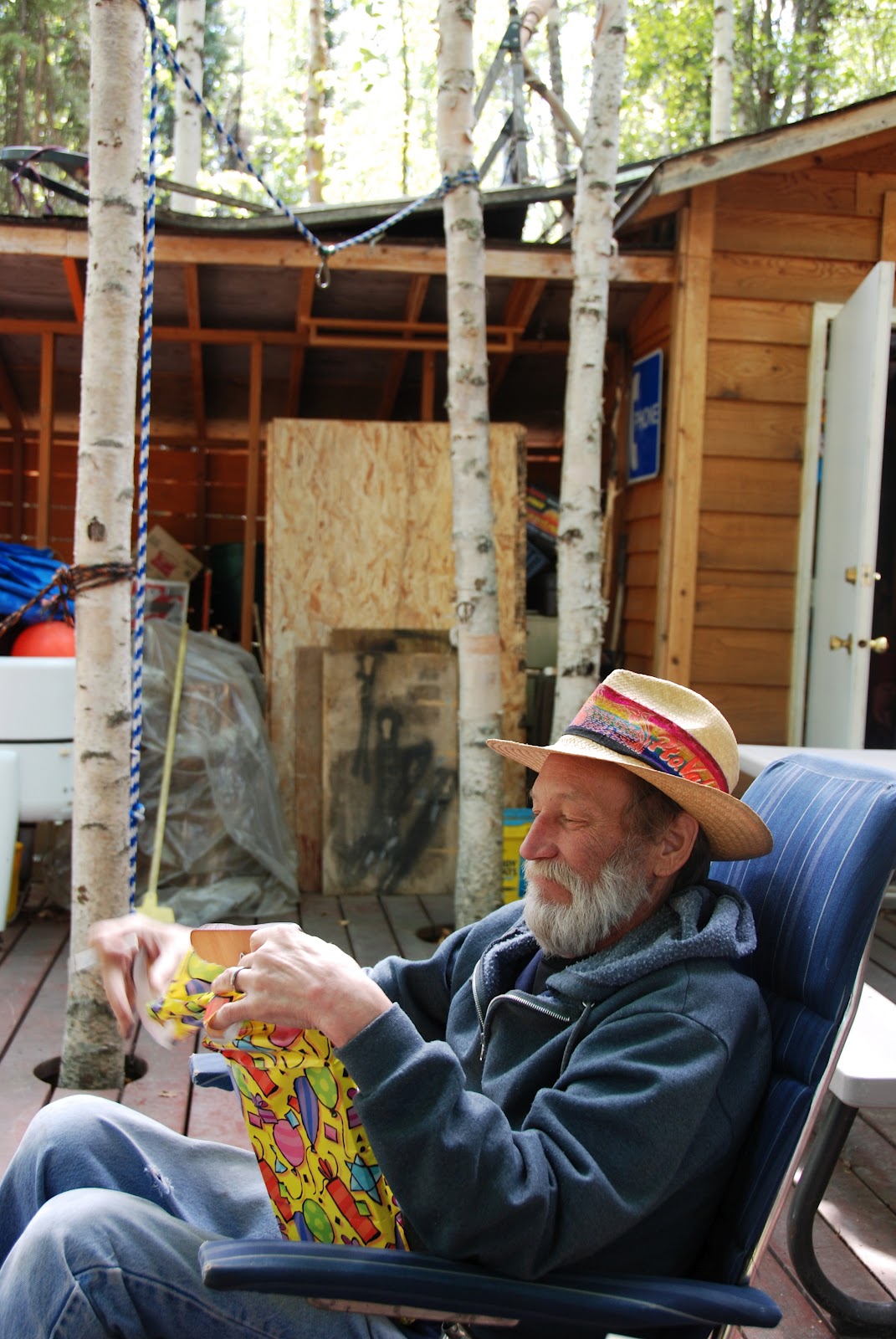
I flew to Alaska on June 13th to be with my brother on his 60th birthday--June 16th. We spent that weekend at their cabin 60 miles from Anchorage. I was gifted with a week of sun, 20 hours of daylight andd warm temperatures.

Their cabin is located on a glacial lake.  I spent two days clearing brush and marveling at twilight that lingered all night long.
Happy Birthday, Joe


                                                            Scenery was just amazing

Ho Ho Ho
Amazing scenery as we head back to Anchorage

We visited Alyeska---the biggest ski center in Alaska.  They'd had 940" of snow during the prvevious winter--100" at the end of May!

My brother, Joe, and I on the summit.

Turnagain Arm in the distance.  Alyeska gets high marks for views!