Thursday, November 1, 2012

Getting There is Half the Fun--Montreal, Quebec to Doha, Qatar

Doah, Quatar
October 30, 2012
Altitude: 66'

Whoever said that "getting there is half the fun" hasn't flown Qatar Airways Flight QR928  from Montreal to Doha, Qatar.  When I bought the ticket, I couldn't imagine who would be on this flight.  But it was a full one, full of Indians and Pakistanis and Sri Lankans and the full Asian melting pot that's become Quebec of the 21st century.

It was also full of screaming children, and a large handful of white Westerners and more people in ethnic dress than I'd seen in a long time.

Welcome to Flight QR928!

Steve brought me to the airport late afternoon on Sunday the 28th.  Until then the whole trip had been an abstract.  But half way up I said to him, "It's really happening."  I'd not wanted to think about it too much.  Like many of my long-haul trips, I always get a bit anxious about what's in store.

But I was off, and the flight was, too...promptly at 11:40 pm.  We flew directly north under a clear October night, past Quebec City, past Labrador, past the far northern polar communities of Kimmirut and Qukiqtarjuaq.  We skirted the eastern shore of Baffin Island.  By then the double whammy Xanax/Ambien cocktail had taken full affect.  I was exhausted and slipped off to sleep. 

I'd wake periodically--once over the fiords of Norway and another time over the eastern end of Turkey.  Seven hours after takeoff, though, I was full awake--as were the legions of screaming babies.

We flew past Baghdad, and then past Tehran. By now the view from my window was an endless stretch of sand, and dry, sinuous rivers as we flew over the Arabian desert.

But I was trapped in an airplace--albeit a sleek Boeing 777.  Paul Theroux once wrote that he disliked flying.  "Whenever I'm in one...I always suspect that the land we are flying over is rich and wonderful and that I'm missing it all."

I did feel that way.  I tried to imagine life in the tiny villages I saw dotting the desert landscape.  I tried to imagine standing at the one point where the Tigres and Euphrates Rivers meet--the cradle of civilization we'd learned about in 6th grade Social Studies.  I tried to imagine strolling through the streets of a safe Baghdad or Tehran before their worlds erupted in violence.

I'd flow this route before--sort of--on a Royal Jordanian Singapore to Amman red-eye.  It was August 1990, Kuwait had just been invaded by Iraq, and I'd been dangerously sick in Singapore and actually checked myself out of the hospital to make the flght.  I wanted nothing more than to get home. What with me being an American in a Muslim country and half out of my mind with fever, I thought it best to get out of Jordan as fast as I could, but that is another story in itself.

An hour before landing, we passed Kuwait and over Mesopotamia.  Oh the stories that could have unfolded had this been a land crossing. Instead, I was trapped in a by-now dirty cabin listening to the white noise of whooshing air filters, and the never ceasing cry of babies.

I was more than delighted when we touched down at 5:40 pm local time--11 hours, seven minutes and 6,472 miles later.

Shuttles met us at the plane.  I was the only person to get off and enter the arrivals terminal.  Everyone else was enroute to a connecting flight somewhere further east.

By now I was spooked.  Well...actually I was spooked a lot earlier.  As I have often done, I silently whispered a prayer.  OK, God...you get on the first shuttle bus and get there a few steps before me.

I had no visa, but getting one at the airport was easy. "Welcome to Quatar, Sir. I hope you enjoy your stay," said the immigration official.  It seemed like a warm welcome. 

I'd booked a room at The country's only youth hostel and the taxi driver got me there without incident.  "Mr. Daniel?" asked the man at reception.  "Welcome."

I was tired, but not exhausted.  It wasn't late, but darkness had set in by 5:00 pm.  I'd lost Monday, what with the long flight, and the fact that I'd slept seven hours thanks to the cocktail and the fact that we flew east through a short night and then a short day and by the fact that the windows on the flight were always closed. I was in the usual time warp that flights like this can do.

Shortly after I arrived, I met the only other guest in the hostel--a woman from Italy.

But that is a totally different story.

I was safely in the Middle East and the adventure had begun!


Sunday, October 28, 2012

The Adventure Begins! Off to South Asia

Plattsburgh, New York
October 28, 2012

Someone once said that “there is no moment of delight in any pilgrimage like the beginning of it,” And he’s right.

I write this on the afternoon of October 28th—just a few hours before heading to Montreal for the beginning of a seven week, Himalyan adventure. I leave— quietly this time—at 11:40 pm on a direct, 12 hour Quatar Airlines flight from Montreal to Doah. (For a variety of reasons, I’ve ceased telling too many people my travel plans.) Who would have thought there’d be enough traffic to warrant three direct flights a week to the Middle East from Montreal?

I touch down in Doah at 6:00 pm on Monday, check into a hotel, then spend a full Monday and half Tuesday touring the principality.

On the 31st I fly on to Kathmandu, Nepal, then on to Paro, Bhutan on November 2nd. There, I’ll have a car and driver for ten days, returning to Nepal on the 11th. At that point I’ll be in no rush to leave a country that ranked Number 1 in the World Trip of 1998-1999, and the one country I vowed would be the first country I returned to after I retired. So much for the fact that it’s taken six years to fulfill that goal!
In November of 1998, fourteen years ago this month, I was hiking from Jomson, Nepal back to Pokhara—a distance of about 60 miles--when I had a nasty accident mid-point on the trek. After emergency surgery to repair the huge laceration in my right foot, I had to come out on a horse. Not so this year! I have every good intention to finish that hike—this time on two feet!

But then again I may just take it easy, relish long views of the Himalayas, take short hikes, enjoy fine, cloudless days and try not to pack too much into a day.

By early December I will have crossed the border into India where I’ll spend time in the holy Hindu city of Varanassi, then on the Agra and the Taj Mahal and ultimately to New Delhi where I’ll fly to Mumbai to catch my flight back to Montreal on December 19th.

And so…the journey begins. It’s been a long time since I’ve travelled outside my comfort zone.

The Himalayas are a good place to begin once again.

Friday, July 13, 2012

Northern Exposure--A Week In Alaska


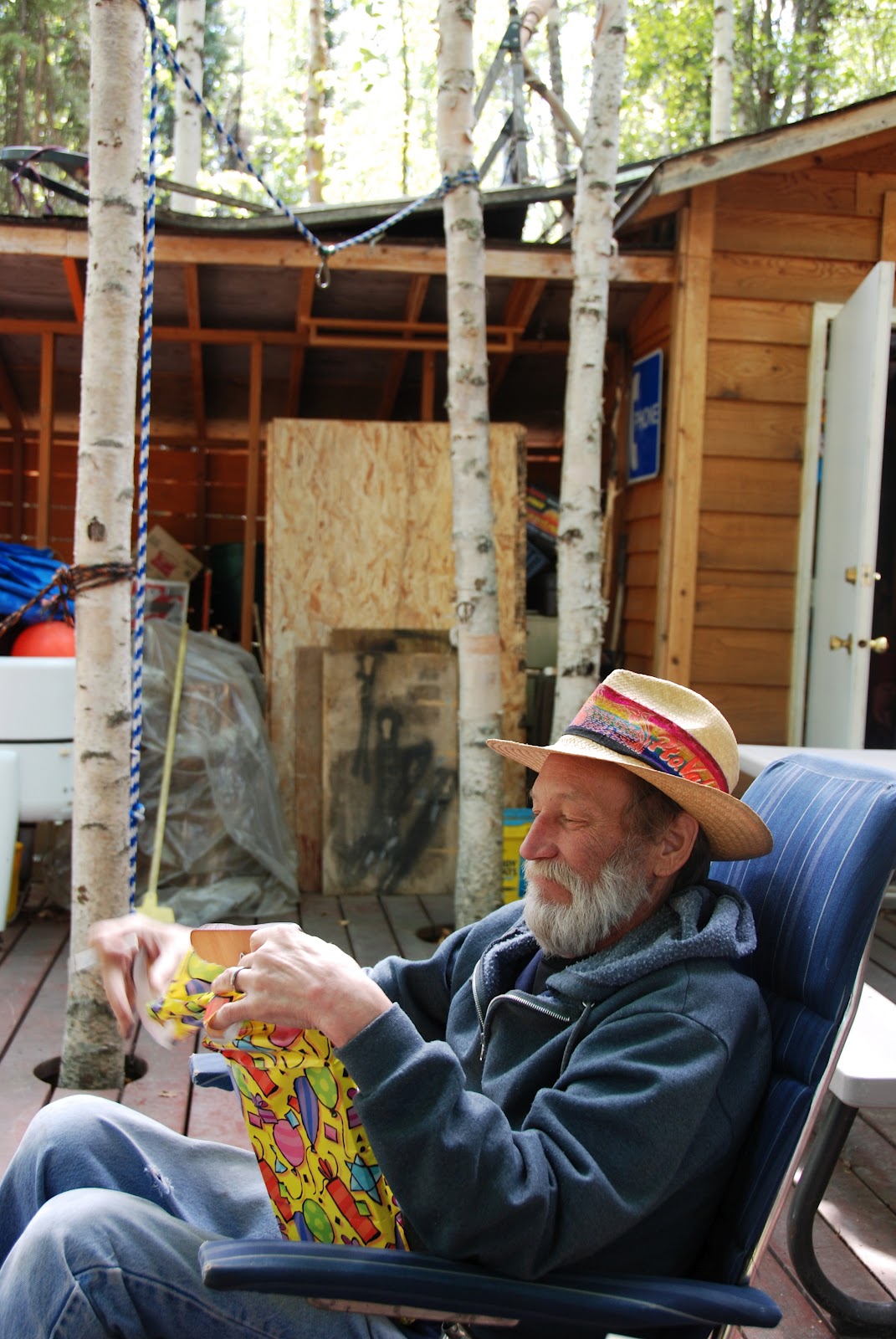
I flew to Alaska on June 13th to be with my brother on his 60th birthday--June 16th. We spent that weekend at their cabin 60 miles from Anchorage. I was gifted with a week of sun, 20 hours of daylight andd warm temperatures.

Their cabin is located on a glacial lake.  I spent two days clearing brush and marveling at twilight that lingered all night long.
Happy Birthday, Joe


                                                            Scenery was just amazing

Ho Ho Ho
Amazing scenery as we head back to Anchorage

We visited Alyeska---the biggest ski center in Alaska.  They'd had 940" of snow during the prvevious winter--100" at the end of May!

My brother, Joe, and I on the summit.

Turnagain Arm in the distance.  Alyeska gets high marks for views!

Tuesday, May 8, 2012

Blanco-Cálido

                                                            
La semana pasada fue muy pesada.  En el día del aniversario de la muerte de mi mamá, recibí un email de mi cuñada que mi hermano, José, ya enfermo, ha caido en demencia. Después de 45 años de alcohol, cigarros  y drogas, la salud de mi hermano está en peligro.

Necesitaba un receso de la ciudad.  De hecho, quería escapar a un lugar más tranquillo.
Me gusta mucho la ciudad de Taxco, especialmente cuando hay mucho sol y las temperaturas están en los 30˚!

Taxco fue fundada por Hernán Cortés en el año 1529.  Hoy, es una ciudad de 50,000 habitantes.  Fué construida en las faldas de cerros altos.  Es uno de mis lugares favoritos en el país.
Pasé toda la tarde al lado de la alberca.   El día fue caluroso con mucho sol.  Nubes blancas flotando en un cielo claro.  No quería hacer nada excepto disfrutar el clima, la alberca y la luz del sol.  Mi unícas acciones eran caminos al bar para comprar Coca Light.

En la terraza del hotel, vi una ciudad blanca, subiendo las faldas de los cerros.  En los patios de las casas había palmas, bugambilias y pinos cipres. En la cumbre, había una estatua de Cristo, sus brazos extendidos al estilo del Cristo en Río de Janeiro.

A las 1700, asistieron amigos y familiares  para celebrar una boda.  La recepción fue en el salón de fiestas del hotel.  Cuando llegaron los novios, los invitados los recibieron con aplausos y arroz en el aire. La novia estaba bella en un vestido largo de color blanco; el novio estaba guapo en un traje grís.
Pero, fue tiempo para comer.  Me duché y salí del hotel para subir las calles sinuosas de la ciudad al Zócalo, donde había restaurantes y calles muy antiguas.  Llegué a la catedral—Santa Prisca— con un estilo barroco. Es una de las mas famosas iglesias en México.

La noche era joven pero, porque era sábado, había borrachos en las calles y los bares. Qué pena! Yo pensé en mi hermano y las elecciónes que había hecho.  Podía escapar de la ciudad, pero no podía escaparme del hecho de que mi hermano es muy enfermo.
Cuando mi hermano era joven, era un chavo dorado—muy popular, deportista, atractivo, presidente de su clase.  Pero, tenía dificultades de aprendizaje y, desafortunadamente, no pudo mantener este dorado crecimiento.

Regresé al hotel, me senté en la teraza hasta la media noche.  Miré el dia que se convirtió en noche.  Siguió la boda, y la música de Strauss llenó el aire.  Los invitatos bailaron, el papá de la novia brindó por la pareja.
En verdad, la música me puso muy triste.  Hace muchos años, viví en Viena, y aprendía bailar el vals.  Durante esa época, hablé mucho con José.  Vivía en Colorado y nos veíamos a menos anualmente.  La música me record cuando era un hombre diferente.  Lloré—lágrimos cálidas.  Fue difícil confrontar el hecho de que mi hermano va a morir.

Las luces de la ciudad brillaban en la distancia, subiendo a las faldas del cerro.  En la cumbre, Cristo abrazaba a los habitantes de Taxco.
Cuando salí a la terraza, el cielo, en la negra oscuridad, estaba  lleno de estrellas.  En el oriente, una luna se levantaba. Y, en el oeste Venus estaba ocultandose.

El Domingo, pasé todo el dia en la alberca.  Tuve dos dias blancos cálidos.  Los dias estuvieron calurosos, con trozos de nubes.  La ciudad blanca de Taxco me calmó y la boda, a pesar del hecho de que no tengo mucha confianza en la ceremonia blanca, animó el fin de semana.
Mi corazón, triste por las noticias de mi hermano, fue alegrado por días perfectos— días soleados, la boda, la música, el camino a traves de las calles magicas y las luces.

Salí de Taxco en la noche y, durante los tres horas a DF, me preparé para la re entrada.
Yo sé que es importante visitar a mi hermano.  Sé no sera fácil pero, el las palabras de Eleanor Roosevelt, “Debes hacer lo que piensas que no puedes hacer.”


Gracias a Gerardo Silverio Rodriguez, Virginia Suarez y José Trinidad Garcia Martruez.

Wednesday, April 4, 2012

Semana Santa in Mexico City


Holy Week                                                                                                                                                             April 8, 2012                                                                                                                                                 Mexico City
Outside of Christmas, Semana Santa, or Holy Week, is the biggest holiday of the year.  It is a time for vacations and the beach, but for those who stay behind in the cities and towns, it´s a time of deep, culturally rich, spiritually-weighted, centuries-old traditions.

For me, Semana Santa started when Steve was in Mexico.  We’d gone to Acapulco and were there for Ash Wednesday. All day long people had the smudges of ashes on their foreheads. 
Watching, and participating in, the events of Semana Santa, my second in Mexico City, would take highlight.

THURSDAY / Holy Thursday / Jueves Santo

Officially, Semana Santa started on Palm Sunday, el Domingo de Ramas.  That day, street stalls in my part of the city were selling palms, woven into all sorts of shapes of the Resurrection—crosses, garlands of lilies, doves of the Holy Spirit, even Christ himself.  These palms would be brought to church, waved in jubilee and would then be blessed by the priest.

But Thursday, Holy Thursday, or Jueves Santo, was the true official start of two of the most significant days in the Catholic Latin calendar.  That morning, I had a text message from a local friend, who often illuminates me on things Mexican.  “The next two days,” he wrote, “are the most solemn and quiet for us Mexicans.  As Catholics we do not eat meat, and Holy Friday is the day to cleanse our passions.  We do not listen to music, do not talk too much, especially nothing trivial.  We prefer to be apart from others and think deeply about our life.”

Late that afternoon, I headed for the beautiful church in the center of Coyoacán.  I wanted a good seat for Holy Thursday services. 

At 5:00 pm, a procession of priests, altar boys and 12 men dressed as the 12 disciples walked down the center aisle of the church.  Shortly into the service, the priest individually washed the feet of each of the men—a standard part of Thursday services in Latin America.  This was followed by communion.

At this point the altar servers climbed high up on the altar.  One of them covered all the crucifixes; another took down the Consecrated Host from a golden chamber.  The pastor held it, wrapped in a special cloth.   Four men held a gold canopy over his head.  The priest led the incense-shrouded procession with all the altar boys and 12 disciples on a slow walk from the front of the church along one side and then down the middle aisle. 
It was all very powerful and quite beautiful, even if I didn’t fully understand what I was looking it.
But it was an early night.  I had serious plans for Good Friday, and it would be an early start to the day.

FRIDAY / Good Friday / Santo Viernes

The absolute epicenter for Semana Santa, not only for Chilangos, the residents of Mexico City, but for the country as well, is in a corner of the city known as Iztapalapa.  For 51 weeks of the year this delegación is absolutely no-gringo land.  It has a nasty reputation as the most dangerous of all places in the city and, quite honestly, there’s little to draw the casual visitor. But during Semana Santa the delegacicón comes to life as they relive, year after year, a 168 tradition.

In 1843, according to its history, the original inhabitants of Iztapalapa reenacted the Passion as an expression of their faith.  Then, it was a procession from one church to another, but over the years it has evolved into a nationwide spectacle with, as they say, a cast of thousands.
And so it was that I, my friend Willem of South Africa, my Spanish teacher, Virginia, and a local friend, Alexandra, arrived in Iztapalapa at 10:00 a.m. to take part in the day’s offerings.

We’d been advised to arrive early because more than 2,000,000 people would show up by day’s end.
We wandered from the Metro and, fifteen minutes later, arrived in the center of town.  We were stunned to see thousands of pilgrims, peregrinos, streaming through the streets, carrying crosses.  With rare exception they were men or boys of all ages. Each pilgrim carried his cross, some quite heavy, barefooted and dressed in a purple robe.  Almost all of them had a white sash around their waist and another sash over their shoulder.  These sashes had all sorts of religious symbols embroidered on them—crosses, rosaries, crowns of thorns, images of Jesus, churches. Crosses, some of them quite heavy, usually had a crown of thorns, interwoven with flowers, hanging from the center.

It was quite moving, actually, to see fathers with their sons, some as young as three years old, and carrying a cross appropriate to their height, doing this pilgrimage together.  At times three generations—grandfather, son and grandson—participated. It wasn’t uncommon to see mothers and their daughters accompanying the men in their family.

Later, I asked a local friend if he’d ever done anything like this.

“No,” he told me.  “This is only for those who live here in Iztapalapa.  I didn’t grow up here and it’s not part of my tradition.”

In the end I thought this procession through the streets was a very good things for fathers to do with their sons.  In a country where girls are idolized and where even the poorest of families will find the money to celebrate their 15th birthday—her quinceaños—with a huge party, there is nothing of equal weight for boys.
To my observant eyes, carrying a cross through the streets of Iztapalapa, with your father, participating in a 168 year old tradition, seemed like a very good thing to do.

Sometime around 11:00 a.m. there were regal sounds of trumpets and other instruments.  How fortunate we were to be in the right place at the right time.  The entire “cast of characters”—some 1,000 strong—marched down the street.  This took almost forty minutes.  Legions of Roman soldiers rode in on horseback.   Roman officials rode in on chariots. Mary, solemn and sad, dressed in black, came into the center surrounded by the disciples. Judas, hands tied, shouted curses.  Jesus rode a chariot, accompanied by an all-tuba band. Hundreds others made the procession as well—young and old, male and female—all dressed in clothing typical of 33 AD. 
It was quite the entry.

By 11:30 we’d been advised to find a place to observe the first part of the passion—Jesus in front of Pilate.  We were extraordinarily fortunate to find an elevated seat on an eight foot wall.  We weren’t exactly comfortable as we were sitting on the edges of huge cement flower pots, but we were dead-center to the action—Pontius Pilate’s palace—about 200 feet in front of us. 
And so for about 90 minutes we just waited.  Not that it was boring.  There were all sorts of things going on around us.  A rosary was being broadcast live from the nearby church.  Helicopters buzzed overhead.  (This was being broadcast live around the country and their presence was an interesting mélange of the 1st and 21st Century.)  Technicians tested equipment…”uno…dos..tres.  Uno…dos...tres.”

Below us, vendors plied the crowds selling all sorts of things—ice cream, baseball caps, soft drinks, candy, gum, water.  My favorite was crowns of thorns for 10 pesos.  That’s less than a dollar.  Kids, mostly, were scarfing them up, wearing them on their baseball caps.  Almost everyone was carrying small bouquets of manzanillas—the traditional flower of Good Friday, the flower, at least in Mexico, associated with the burial preparation of Jesus after his death on the cross.
This was really a great show.

By 1:00, when the trial began, there were literally thousands of people in front of us.  The crowd was thirty thick and those in the back could see nothing of the performance on stage.
But for us, though, we witnessed the Passion first hand.  Jewish officials demanding the life of Jesus, Roman officials wanting a reason, arguments back and forth. 

All this, of course, was done in rapid-fire Spanish and was totally incomprehensible.  Fortunately, we all knew the story, so we’d have to be content with just being part of this great drama—the largest Passion Play of its kind in Mexico.

Jesus was ultimately condemned, and scourged.   The long, cruel walk to Calvary was to follow.
This was our clue to give up our bird’s eye perch.  By now, we’d made “friends” with those around us.  We’d been warned to bring along food, which really hadn’t been necessary.  We’d been jettisoning the apples and sandwiches to those around us who’d seemed pleased by our altruism.

A dónde vamos, ja? Where to now,” I asked our neighbors.  “Follow the people,” they said.
And follow we did.  Not that we had a choice.  We simply entered a dangerous river of people—a crowd so thick that one mistake could have meant disaster.  Our goal was to follow Jesus to the cross, but what we didn’t expect was how fast the river would move.  Periodically we’d be forced to stop when a Roman official, on horseback, barking stern commands, would push us to the side.  Once, Judas passed, this time screaming curses, and throwing gold coins into the crowd.  Had we followed him, we’d have seen him hang himself shortly after.

There came a point when following Jesus carrying his cross was just not possible.  There really wasn’t all that much to see, and it was dangerous trying to stay in the river of people—now a torrent racing down the narrow streets of Iztapalapa. 

We waited for the action to fully pass, let hordes of people go ahead, and moved forward when we felt it was safe to proceed.  We’d make our way to Calvary to witness the crucifixion.

Or at least that’s what we thought we’d do.  Not long after proceeding along the now-quiet street, we hit a barricade.  It was literally of wall of police, all linked together.  No one could pass.  No one.  I finally asked one of the police which way to go.  He directed me down the street, then up. 
And that’s what we did, but what we entered was a full-fledged Mexican carnival.  Rides for kids, Mexican carnival food (deep-fried plantains smothered in lechera and chocolate sauce, my favorite), kiosks selling all sorts of things.  This “carnival” stretched for almost ½ a mile.
In the matter of two minutes, we’d gone from the sacred to the profane.  Leave it to Mexicans to turn a religious spectacle into an opportunity to make money.  For several hours I’d been living, theatrically at least, in the 1st Century.  The story of Jesus’ death had come to life.  To see it cheapened like this upset me a great deal.

We managed to get ourselves through the maze of vendors and rides, finally got to the hill, but the Crucifixion had passed and the bodies had been taken down from the cross.  It had taken us that long to get from A to B.

Much later, though, I learned that we’d never have gotten to see it anyway.  Entry to Calvary had closed by 8:00 a.m.  People had spent the night before waiting to gain access.

We were only slightly disappointed.  It was impossible, we learned, to see it all.  We’d been fortunate to see the grand entry of characters, and to participate in the pilgrimage of men carrying crosses.  And our seats on the large flower pots overlooking Pilate’s palace had been enough.
he day had been beyond marvelous—a glorious, hot, brilliant blue day where we’d been witness to a 168 year old pageant that was shared by more than 2,000,000 others.

In the end, after I processed all I’d seen and experienced, I came to realize that this Friday probably wasn’t much different from the Friday Jesus was executed.  It had likely been a hot, sunny day in Jerusalem.  There was probably a festive air about the city with so many Jews in town for Passover.  Despite the violence attached to the Iztapalapan Passion, it was still a mighty festive day in that part of Mexico City.  Most everyone, it seemed, was out for a good time.  I’m sure it was the same in Jerusalem in 33 AD.  I can’t image vendors not taking advantage of the crowds in Jerusalem that day 2,000 years ago.  People were hot and hungry and, just like their Mexican counterparts, Israeli’s of the day took the advantage to make an extra shekel.
SATURDAY / Holy Saturday / El Sábado de Gloria

In Mexico, Holy Saturday is known as El Sábado de Gloria, The Saturday of Glory.  Early in the day I’d met some friends and we headed for a Saturday bazaar in San Angel.  Both of these women speak fluent Spanish and have degrees in Spanish.  I was intrigued by the devilish papier-Mache figures I was seeing at street stalls.  “It’s Judas,” Allyson told me.  “They’re only sold and displayed today.”  Some were tiny, but others were four and five feet tall.

That evening a small group of us was brought to a section of the city that most of us avoid.  It’s not the safest place in the city, and certainly a no tourist-zone.  But we were with a long-term resident of the city, and she was bringing us to one of the quirkiest events that take place in the city on the evening of El Sábado de Gloria.
We were on our way to La Quema de Judas, the Burning of Judas, an old European custom that found its way to Mexico centuries ago.

We were the only gringos in a notorious part of the city, but there was safety in numbers.
Tucked away behind the Merced market, down three side streets, sandwiched in between two industrial zones, was the street.  Strung up between two homes, on either side of the street, was a long rope, and hanging from the rope was the first Judas to be burned.  I say burned, but that is not really the right word.  Each papier maché figure was filled with an assortment of fireworks and explosives.  A proper Judas cannot simply blow up, but should explode in stages…leg by leg…arm by arm…followed by a fantastic finish of an exploding torso and head blown to confetti. Mexicans love to flex their satirical and artistic muscles by creating effigies of politicians, world events, and "diablos" in papier maché, then blowing them up in spectacular fashion. One might expect Judas himself, but it is the idea of a traitor, the liar, or one with two faces that is being publicly destroyed.  Indeed, there was more than one Felipe Calderón, Mexico’s increasingly unpopular president, blown up that night.

By dusk, the first Judases began exploding.  The crowd, close to a thousand, screamed with joy then cheered even louder when the effigy blew up.  More than once, the figure fell off the rope, crashed to the ground, but continued exploding, sending small fire bombs in the direction of spectators.

At the beginning, the six of us stayed relatively close to the fireworks, but by the time we left, four hours later, five from the group were a good 40 feet from where they started.  I, on the other hand, video camera in hand, stayed close to the drunks in the crowd, taping the entire spectacle.  I’d run back to the group, a huge grin on my face.  This was just so, so cool.

By 10:30, only the big boys were left.  Huge, 12 feet diablos, with frightening faces and limbs, were  blown up.  The entire process would take up to three minutes for them to fizzle, burn then explode into a million pieces.

We were out of there by 11:00, all of us super-energized by what we’d seen.  This was definitely way, way off the tourist map.

What a way to end the day, to wrap up Semana Santa in Mexico City.  It was hard to get to sleep that night.

SUNDAY /Easter / Pascua

I arrived home from the Quema de Judas just before midnight.  I crawled into bed shortly and was startled awake at 12:00 a.m. with a huge display of fire crackers somewhere near my apartment.  It was almost as if whoever did wanted to shout out, “He has risen.”  To me, it seemed a joyous display of the Easter message.

By 8:00 a.m., the house I live in, which had been very quiet during the days of Semana Santa, was a flurry of activity.  The staff had taken Friday and Saturday off, the most important days of the Easter weekend.  My landlady was in NYC, and was coming home later in the day.  Today was just another Sunday, as Easter is in the Latin World.  There was a lot of work to be done to get the house ready for her return.

On the streets, garbage was being collected.  Stores that had been closed for two days reopened.
I left early for La Casa where I attended 11:00 meeting.  At 1:00, the volunteers, all Americans, and accustomed to an Easter dinner, gathered.  It was a quiet dinner, only a large handful of us, but it was a custom shared by us all and something we wanted to do.  The rest of Mexico went about its normal Sunday business.  Theologically, it all ended on Friday; man’s sins had been forgiven on Santo Viernes.  Sunday was just additional proof that Jesus was God.

That night, I thought back to the power of this Holy Week/Semana Santa.  I thought I did it all with a Latin Easter three years ago in Bolivia, but this…this just topped everything, and I know exactly where I’ll be next April—right back in Iztapalapa, but this time from Palm Sunday right through Sunday, when the full drama of Easter comes to life—Jesus is resurrected from the makeshift tomb he’s been in since Friday.

I can’t wait!

Friday, March 30, 2012

One Hail of a Birthday

Mexico City
March 30, 2012

It would be hard to top last year’s “Social Security” birthday when I climbed a 12,000 foot volcano outside of Mexico.  So, not trying to outdo myself, I followed a lead from the New York Times Travel Section and made a reservation at a hacienda/hotel 90 minutes away from Mexico City in Tlaxcala, Mexico’s smallest state, a state blessedly free of the violence that have beset other places.

Early in the day, I followed the Times’ directions, and caught a bus to Santa Maria Tlaxcala.  I fully expected the find the hacienda a short taxi ride away, but that was not the case.  One taxi driver wanted to charge me 300 pesos.  Es muy largo, señor.”  It’s a long way away.  So I went back into the bus station, and caught a smaller bus to the town of Apizaco—20 minutes away.  Again, I fully expected to find the hacienda a short taxi ride away, but that was not the case.
When I exited the station, a steady rain was falling.  I pulled up the hood of my sweatshirt, walked out into the streets and went from corner to corner and bus to bus, but no one could direct me to where I wanted to go. 

And then…I began to hear another sound.  I looked up and saw that rain had turned to hail.  Now, that was a first.  It hailed for at least fifteen minutes and the ground was covered in a sea of white!  White!  I spend good money to get away from the white stuff.  I’ve had snow on my birthday, but never hail.
By now I was frustrated.  It was noon and I should have been at the hotel by now, enjoying the pool and its grounds.  So…I did what I always do when I can’t get from A to B: I hailed down a cab.  “I’m looking for the Hacienda Soltepec,” I told him. “Do you know where it is?”

Ah, si, señor…” 
Are you absolutely certain?

Si, señor.”  But to be on the safe side he called the dispatcher’s office to get confirmation.
And so off we went…leaving the city of Apizaco and the hail-covered streets behind us we headed into the deep, yet lovely, countryside of Tlaxcala—a landscape full of wide open fields, cattle grazing, and small volcanoes in the distance.  The day had cleared and a warm sun shone above us.  But I was suspicious.  We just didn’t seem to be going anywhere.  Again… “Are you certain?”  By now we were on a first name basis and he knew it was my birthday.

Finally, after passing little streams, and tiny villages, and after traversing down a dirt road for twenty minutes, we arrived.  But the hacienda hardly looked like a first class hotel. We drove down the long driveway, and an assortment of people met us. 
Si, señor, está es la hacienda Soltepec, pero no es un hotel.  Hay dos Haciendas Soltepec!

"Yes, sir, this is the hacienda Soltepec, but it’s the one you want.  There are two, and the other is more than an hour away from here. "
By now the charm of bumping along the back roads of Taxcala had worn off.  I got on my phone and had Miguel call the hotel—something I should have done at the onset of this adventure.

And so we drove the sixty minutes back to Apizaco, over the dirt road, past the villages, past the streams.
Finally, shortly before 3:00 pm, a full three hours after I hailed down this taxi, we arrived at the other Hacienda Soltepec.  I feared for the price.  He’d initially quoted me 200 pesos, then changed it to 400, but when I got ready to pay, the cost was 600!  $50.00.

OK.  I went back in time to some of my father’s best advice: "Be glad you have the money to pay for these things, Dan,”  he once told me. And so I did.  Handed over 600 pesos and absolutely refused to let this deter my day.
The hacienda didn’t disappoint.  It had been touted as being one the twenty best hacienda resorts in the country. 

Two hundred years ago this part of Mexico had well over 1,000 enormous ranches, and the largest ones had massive homes known as haciendas which housed the owner, his family, and the hundreds of workers needed to maintain the property.  Hacienda Soltepec was celebrating its bicentennial.  It had been converted from a rural school to a first class hotel more than fifty years ago and was often used as a film prop and had been featured in a number of Mexican television shows.
I spent what was left of the afternoon over a leisurely lunch, then a long work-out in the gym, and a long swim in the heated pool.  Dinner, of some way-too-spicy itty-bitty birds, capped the day.

It had been, well…a different kind of birthday. I’d expected full sun and a long day poolside, but it not only thundered and lightening, but hailed as well.  That was a first, and that was OK.
I’d expected to stay put in the same locale for twenty four hours, but had an unexpected three hour tour of the Tlaxcalan countryside.  And that was OK.

I’d expected to climb the nearby volcano, but once in the hacienda,  I never stepped foot outside until I checked out.  And that was OK.
Why bother? It’s not every day I stay in a 200 year old hacienda, and it’s not every day I turn 63.

It had been one hail of birthday.  And that was OK, too.

Medical Mis-Adventures--Part 3--Mexico City, 2012

Wednesday, January 11th

It’s my 6th day in Mexico City.  Early winter.  Soft, warm days; cold nights.  On the way to La Casa de los Amigos I realize I’ve eaten something that’s not settling well in my stomach.  I’m going to make it into the center, but the long metro ride isn’t doing much for my intestines.
When I get to La Casa, I just about race to the bathroom.  And then again 30 minutes later.

I reach into my pocket to get some money, but realize I’ve left home empty handed.  I ask the woman at the desk.  She lends me 200 pesos and I make my way to the pharmacy on the corner to buy some Imodium.  That gets me through the day.
I have little appetite, and what I do eat goes right through me.  Food poisoning, I think.  I’m no stranger to this!

Thursday, January 12th
For some reason, Steve is at home and not in school.  I text him and tell him I’m sick.  Really sick.  I can only get out of bed to go to the bathroom, which I’ve done all morning.  And even that’s an effort.

We agree to Skype.  I keep the computer in bed with me. 
“You’re scaring me,” Steve said.  I’m scaring myself, because I know I’m super sick but I’ve got absolutely no energy to get up, shower, organize myself.  I know I have to get to the doctor, so I text my friend Allison at La Casa and ask her if she’s be willing to go to the doctor with me.

I get out of bed.  Shower, I think to myself.  This is an effort.
Now you have to shave.  Put on socks.  Pants.  I’m having this running dialogue with myself.  I have no energy and am exhausted by the time I’m done.

I call a taxi and meet him downstairs and forty minutes later I’m in the center of the city.  I meet Allison, and her Honduran boyfriend, and they go to the doctor with me.
I’m grateful to them as I just don’t have the inertia to try to communicate with the doctor who speaks no English.

She diagnoses Gastroenteritis, prescribes meds. I take another taxi home and sleep all afternoon and evening.
Friday, January 13th

Things are a bit better.  The meds are doing their work and I have more energy.  I manage to go into the city and do a bit of work, but am exhausted by mid-afternoon.
That evening, my friend Gerardo calls and asks if he can come by to prepare a meal.  I’m certainly not eating, so I say yes.  This is no small thing that he does.  It takes him an hour and a half to get to Coyoacán, where I live.  This city is a monster and getting from A to B can be an ordeal.

But I do eat, and I appreciate the company, and am grateful that someone here cares. He leaves for work, I go to bed.  It looks as if my body is turning around.
Saturday, Sunday, Monday, January 14th to January 16th

I feel better, but not what you’d call “well.”
Saturday I stay close to home, but venture to Los Viveros, the nursery near my apartment, to buy some plants.  What should take 10 minutes, takes close to 30, with a long break in the middle each way.

That evening I decide to go to the movies.  I’m almost back to “normal,” so indulge in popcorn and a huge vat of Diet Coke. 
Three hours later, home, my fragile stomach starts in with cramps.  Horrible cramps for more than two hours.  It’s the only time in my life I have a small inkling of what a woman goes through in labor.  My stomach is twisted and turned and I’m in a lot of pain.  I’m actually afraid, until they stop almost as quickly as they started.

The rest of the weekend passes well, and I’m slowing slow signs of recovery, but not as fast as I’d like.
Tuesday, January 17th

I leave my apartment, head into the city and start the 11:00-1:00 weekly meeting of La Casa volunteers..  I’m not feeling all that great, but what transpires in those two hours is simply astounding.  I slip into remission.  It’s the only time in my life that I have ever used that word to describe something like this.  I can feel myself sliding down, sinking into an abyss of sickness that is frightening me.  I can’t think.  I have no strength and it’s taking everything in me to stay present.
By the end of the meeting I can’t go home.  I ask for a bed and sleep for two hours.  I’m no better, but at least I have enough strength to go downstairs, call a taxi and get home where I sleep the rest of the afternoon.

That evening, my angel-friend texts me.  “Can I prepare you dinner?”  He comes with chicken, soup and rice, none of which I can eat.  I sit at the table, but my head is on the placemat.  I eat a bite of chicken and another of rice.  Just the smell alone nauseates me.  I can’t eat and I can’t even sit up straight at the table.
Reluctantly, he leaves at 9:00 pm.  He works nights, so I tell him I’ll text him every time I wake up. Which I do, a lot, because my intestines are in a full-fight battle and I’m in the bathroom every hour.  Surprisingly, though, I do sleep, and my reports through the night are encouraging.

Wednesday, January 18th
I’m up by 8:00, sicker than I’ve ever been in my life.  At least lying in bed I had the illusion that I felt alright, but the trips to the bathroom have increased.  There is radical diarrhea. For every liter of water I take in, two liters is coming out. I’m honestly frightened.

No one is in the house.  The landlady had left for LA early in the morning, and I’m alone in Coyoacán without a health plan.  I don’t even know where to find a hospital in then neighborhood.  I begin to experience a deep loss of hope.  There is absolutely no way I can get into the center of the city, and I have to acknowledge that I’m gravely ill.  What’s happening is beyond normal.
So I reach out.  I email an acquaintance from Plattsburgh who lives in Mexico City.  I know she’s constantly connected to the Internet via her Smart Phone. 

“Amy,” I tell her.  “I’m very sick.  Can you direct me to an English speaking doctor?”
What I didn’t know is that she picks up the email in Boston, immediately contacts her husband who’s a CEO for a multi-national in Mexico City, who then contacts his secretary who contacts the driver.  Within minutes Amy emails me back and says, “Marco’s on his way.  Be ready in an hour.  He’ll bring you to the hospital.”

I pick up the apartment, pull together things and put them in a day pack.  Somehow I have the foresight to pack my credit card and passport.  I email a few people at home to pray for me—my Aunt Gloria, my pastor at church, Ed and Rita Graf.  I’m afraid, but less afraid knowing that I’m on my way to medical help.
Then I wait.  I’m overwhelmed—not only with the kindness that’s directed at me, but that I’m going to be ok.  I start to cry—tears of relief and tears of gratitude. 

Maria, Scott’s secretary, is in constant communication.  “Marco’s 30 minutes away.”  “Marco’s ten minutes away.”
Then Marco calls, I go downstairs and he picks me up and we head up and out of the city to Interlomas and Hospital Angeles.  He gets me into the ER.  My Spanish is perfectly fine for checking in, but not good enough to describe the nuance of my illness.

Not to worry.  Two interns appear, both of whom speak very good English.  Scot had also called his internist, Dr. Taché, who shows up thirty minutes later.  These guys are good.  They can see that I’m dehydrated and they immediately order the first IV.  “We suspect something more,” said the good Dr. Taché.  Can you give us a stool sample? “
Dah, I think.  That’s all I’ve been able to do for the past 36 hours. 

I easily do what they ask.  I’m suspecting ghiardia.  It won’t be the first time.
Then I wait.  At least I’m waiting in a good place.

An hour later the interns and the doctor return with an initial diagnosis—ghiardia.  They prescribe a two more IV’s—hard core Flagyl, a super concentrated antibiotic that kills the bacteria causing this specific infection, and Pepto-Bismol to soften the effects of such a strong antibiotic on an already challenged intestinal system.
“We want you to spend the night,” said the doctor. 

I suspected that, and I’m glad for it.  I don’t want to be home alone in this condition.
Within minutes the “men in black” come by.  The accountants.  Whatever prompted me to bring passport and credit card? I have to prove my identity and whether I can pay for this service.

I’m wheeled upstairs.  This is no ordinary hospital, and certainly not the hospital that the average Mexican has access to.  My room is a suite with a fine view of Santa Fe.  These are highly desirable neighborhoods and real estate prices reflect it.  The day is lovely and it’s nice to check out the high end apartment towers nearby.
I’m a bit worried that this is going to cost more than the cap on my credit card, so I call home, call the Credit Union, call Visa. 

That evening I receive a text from Gerardo: “Estoy en la Catedral en el Zocalo. Estoy pidiendo a Dios por tu salud. Animo hora por media hora para tu salud.” I’m in the Cathedral in the center of the city praying to God for your health. “  How am I blessed with such a good local friend?
Doctor Taché checks in several times, as do the interns.  “We’re not totally satisfied,” he tells me.  “We suspect even more.  But cultures take time and we won’t know until tomorrow.”

I spend as pleasant an afternoon as possible.  And I’m feeling better.  What with the hydration fluids and antibiotics, by nighttime I already feel on the mend.
Thursday, January 19th

I’m quite content to spend the day in the hospital, and my instinct’s telling me I’m not going going home. I have my iPod and both phones—my Mexican phone and my New York phone.  There’s lots of communication and I feel connected to people at home and in Mexico City.
I watch movies, ask the nurses if I can take a walk.  They unhook the IV’s and I stroll around the hospital.  I sneak downstairs and buy a Diet Coke which I’m not allowed to have.  I take a look at the cars in the parking lot—BMW’s, Mercedes, a Porsche.  This hospital’s designed for those who have.

Those who don’t have do have access to medical via government insurance, but it’s nothing like this.  I thought back a year when I escorted a friend to his local hospital for out-patient surgery.  He came out twenty minutes later telling me that surgery had been canceled because the wall to the surgical unit had collapsed. 
Mid afternoon Dr. Taché and his interns visit.

He confirms the results of the cultures--E-coli and salmonella.
E-coli and salmonella?  These on top of ghiardia?  No wonder my stomach was so mightily assaulted.  They tell me that I’m going to spend another night, which is just fine with me. 

I do get a bit worried about how much all of this is going to cost.  I have good insurance, but this is a cash deal and I’m worried I won’t have enough to pay.
But it’s ok.  Whatever it costs to get better is a much smaller price than death, which was the only other option.

Friday, January 20th
I am feeling so much better.  I’m served lunch, then Dr. Taché and his interns come by.  They ask how I’m feeling, tell me I’ve progressed well and tell me I can go home.

It’s timeWhat I’ve come to realize is that the doctor has been keeping in daily contact with Scott and Amy, so I’m not surprised when Maria contacts me to tell me Marco can pick me up when I’m ready.
I ask for an English speaking accountant, as I want to go over each item in the 14 page document of expenses.  All seems to be fine.

And, to my utter surprise, the total bill is in the $5,000.00 range. 
$5,000.00.  In 1995 I wasn’t feeling well at school, ended up in the ER and the hospital for the night, and the bill 17 years earlier was $7,000.00.  My aunt later told me that she had a four hour stay in the ER last summer and her insurance paid out $4,000.00.  $1,000.00 an hour!

I get home mid afternoon, stay very close to home, as I do all weekend.  I’m better, and that’s the important thing, but it’s going to take a long time for appetite and energy to return.
Postscript:

For days after I was released from the hospital the only things I could eat were apples, ham slices and potato chips.  Obviously my body was crying out for something that it lacked.
I was only in the city six full days when i came down with the first symptoms.  Where did i get this tirad of infection?  I asked one of the interns, a young Mexican woman who'd grown up in Syracuse.  "It was just your bad luck," she said.  That seemed the best answer I'd ever get.
It would take a full three weeks beyond the hospital before my appetite and energy levels were returned to normal levels. 

In the end, I could see how people die.  I came close to it.  If someone is frail to begin with, an illness of this gravity would wear them out.  If someone lives far from emergency services, what would they do?
My body was assaulted.  On the morning that I went into the hospital, fluid was coming out of my organs.  It was only a matter of time before I would have gone into shock.

This happens every day among the poor.  My multiple privileges were never lost on me: escorted to the hospital in a bullet proof vehicle; top notch medical care that I was able to pay cash for; follow-up meds and appointments to make sure I stayed well.
I am grateful still for the angels in this drama: my local friend Gerardo who never abandoned me; Scot and Amy who made sure I got to their hospital and to their doctor; friends and family at home who stayed close and who prayed for me.

I write this more than three months after all this occurred.  I can honestly tell that not a day has gone by when I haven’t thought of this.  I wish I could say that my body fully recovered, but t here is something wrong with my stomach/intestinal system.  It’s just not been normal since January.
But I am grateful!   Grateful beyond mere words for all that was done for me and for the fact that I recovered and moved forward.

It is always best to think of the glass has half full.