Saturday, October 18, 2014

Iberia and Beyond 2--Granada, Spain

Granada, Spain
October 16, 2014
Latitude 37.18 N

After the heat of Seville and tourist crunch of Cordoba, I wanted a side-order of cool and quiet and Granada promised to do just that.

The city lies at the foot of  Sierra Nevada Mountains. It was also a smaller city than either Seville or Cordoba, and while it was packed with tourists, for some reason the usual urban stir and bustle was anything but frenetic.

It was also made phenomenally more enjoyable by yet another warm home stay--this time with Hugo who opened up one bedroom in his small home for visitors.  He genuinely cared for his guests
, made tea for me and even escorted me to the taxi on my last day.

I loved Granada--its mosaic cobbled streets, its leafy green parks and tree-fringed streets.  But most of all I loved the Alhambra.

Who wouldn't!  How many tales have been spun around this fabled series of palaces?

Instead of words, I will let this photographic essay tell my story.


Tuesday, October 14, 2014

Iberia and Beyond 2--A Cynic at Large in Cordoba, Spain

Cordoba, Spain
October 12, 2014
Latitude 37° 88' N

It was Columbus Day weekend and Americans weren't the only ones observing the holiday.  It was also a long weekend in Spain as they, too, honored the man who founded the New World and began the expansion of the Spanish Crown onto two new continents.

I was in Cordoba to visit the Mezquita--an almost perfect fusion of refined Islamic architecture and Renaissance artistry.  But I was not prepared for the crowds that swamped the medina-like historic center of the city.  Its twisty, curving streets were chock-a-block with  tourists--hordes off the steppes of China, countless groups of Japanese and throngs of Spanish families in town for the weekend.


There were lines everywhere--lines to buy a ticket into a place, lines to enter the place you just bought a ticket for, lines, even, for queuing up for the perfect photographic shot.

It was depressing from the start.

My only real goal for the day was the Mezquita--Cordoba's premier church/mosque/church--that charted the evolution of  Western and Islamic art over a 1,000 year span and which has a fascinating history.  First it was a church built in the 600's honoring St. Vincent, a 7th century martyr.  In 785 Muslims from North Africa  invaded the city and converted the church to a mosque that, over centuries, was expanded and enlarged and enlarged again into a massive 124,000 square foot prayer hall, the most lavish in the Islamic world.


 In 1236  Cordoba was recaptured by the Catholic king Ferdinand.  The mosque was rededicated as a church and by the 1500's work was underway to incorporate a High Renaissance cathedral within the prayer hall.

Three cheers for the architects who didn't destroy one Islam's greatest architectural achievements.

Once inside, I was stunned by the sheer immensity of mosque cum church. A veritable “forest” of 856 columns, most recycled from Roman ruins, supported extraordinary horseshoe arches in warm shades of cream and terracotta. Surrounding the four sides of the mosque were 37 tiny chapels dedicated to every saint imaginable including one with a painting of Mexico's Virgin of Guadalupe.

Some of the chapels had small silver ossuaries containing human skulls and others had small sarcophagi, relics of the “Good Death” where entrance to heaven was easier if you were buried within a church.

Highly stylized Renaissance paintings depicted a never-ending number of virgins and martyrs dripping in blood, trance-like prophets and aging apostles. One painting depicted a female martyr tied to a stake, her torso naked showing surprisingly perky breasts. Images of St. Stephen and another of Jesus and the beloved apostle, John, were almost homoerotic. Religious iconography masking as Renaissance soft porn.

Despite my awe, it was almost impossible to enjoy the place.  Nothing was sacred, no spot untouched by a human being's presence.  People seemed to pour out of the woodwork. Whole neighborhoods, it seemed, of Tokyo had emptied out into Cordoba and most of them were at the Mezquita on this particular Sunday afternoon. People were lined up to have their pictures taken in front of just about everything. Spanish mothers put their very small and very loud children on tiny altars and had them pose. Asians stood in a line to have their photos taken in front of the silver streaked altar of the cathedral. A young Spanish couple, seemingly oblivious to to everyone else, sat in a pew at the back of one of the chapels and made out. A teenage girl, in shorts way too short for anywhere but the beach, struck a sexy pose in front of the many altars.

No place seemed sacred. The one chapel that clearly said “Silencio, por favor. This is a place of prayer” was filled with tourists needing to sit down, relax and chat. Japanese tourists who probably couldn't read Spanish yakked away while taking selfies.

Everyone had a camera—Smart phones, point-and-shoots, SLR's. Everyone wanted to shoot the same thing at the same time so there was a perennial queue in front of just about every astounding thing, of which there were many.

All of this just wore on me until every one of my cynical cells of religiosity tingled with annoyance. It didn’t help that I was constantly seeing amazing works of arts created by Europe's best silversmiths of the 14th, 15th and 16th century. Gorgeous candelabras, massive reliquaries, astounding silver lecterns, a ten foot I-don't know-what-it's-called that holds a consecrated hosts, and every sort of ecclesiastical bling possible dripped out of almost every chapel and on the altar of the cathedral.  

The problem with all this is that I'd been to the silver mines in Potosi, Bolivia where, under the Spanish crown, more than 6,000,000 indigenous were enslaved and died to mine the metal to make these things. I knew too well the ravages of Spanish/church sanctioned colonization.

All of this, plus the massive hordes of tourists, just piled on itself to make this a far-less-than-spiritual excursion. I grew more and more cynical as the afternoon progressed.

Despite all of this I was still unable to leave the Mezquita. I'd circle the massive prayer hall, reexamine its tiny chapels, investigate yet again another over-the-top mythologized Renaissance painting of flying angels and a seemingly endless pantheon of Christian sub-deities that make up Middle Ages Catholic Christendom,  photograph yet again another set of the cream and terracotta arches in the forest of columns that made up the original prayer hall. I knew I was standing is a work of genius that was unfathomably beautiful and that it was something I may never see again.


But these places are never good for me spiritually. It's impossible for me to go inward when there's this much distraction. And it made more so at the Mezquita. There was an almost yin/yang juxtaposition of architectural style—the refined and clean lined Islamic and the wildly over-the-top Renaissance.

And I knew, too, the origins of all the sliver that produced these magnificent pieces of religious art.I'd been to the silver mines in Potosi, Bolivia where 6,000,000 Indigenous were enslaved and died under the Spanish to mine the metal to produce these works.

Oh, I knew the difference between the Church and the People of God.  It's doubtful any Spaniard in the 16th century had any idea what horrors were being enacted by its Crown and its Church.  No one can blame anyone but those in power.  Still, it's one of those inconvenient truths the church never addresses, and I have a problem with that.

I know that some would say that this art honors God, and maybe for them that's true.  For me, though, the human is far more important than an object that is meant to honor God. No life lost to slavery is worth the art it produced.

The cynic in me won out that day. And that cynicism stayed with me again and again as I stepped into magnificent churches with magnificent silver art.

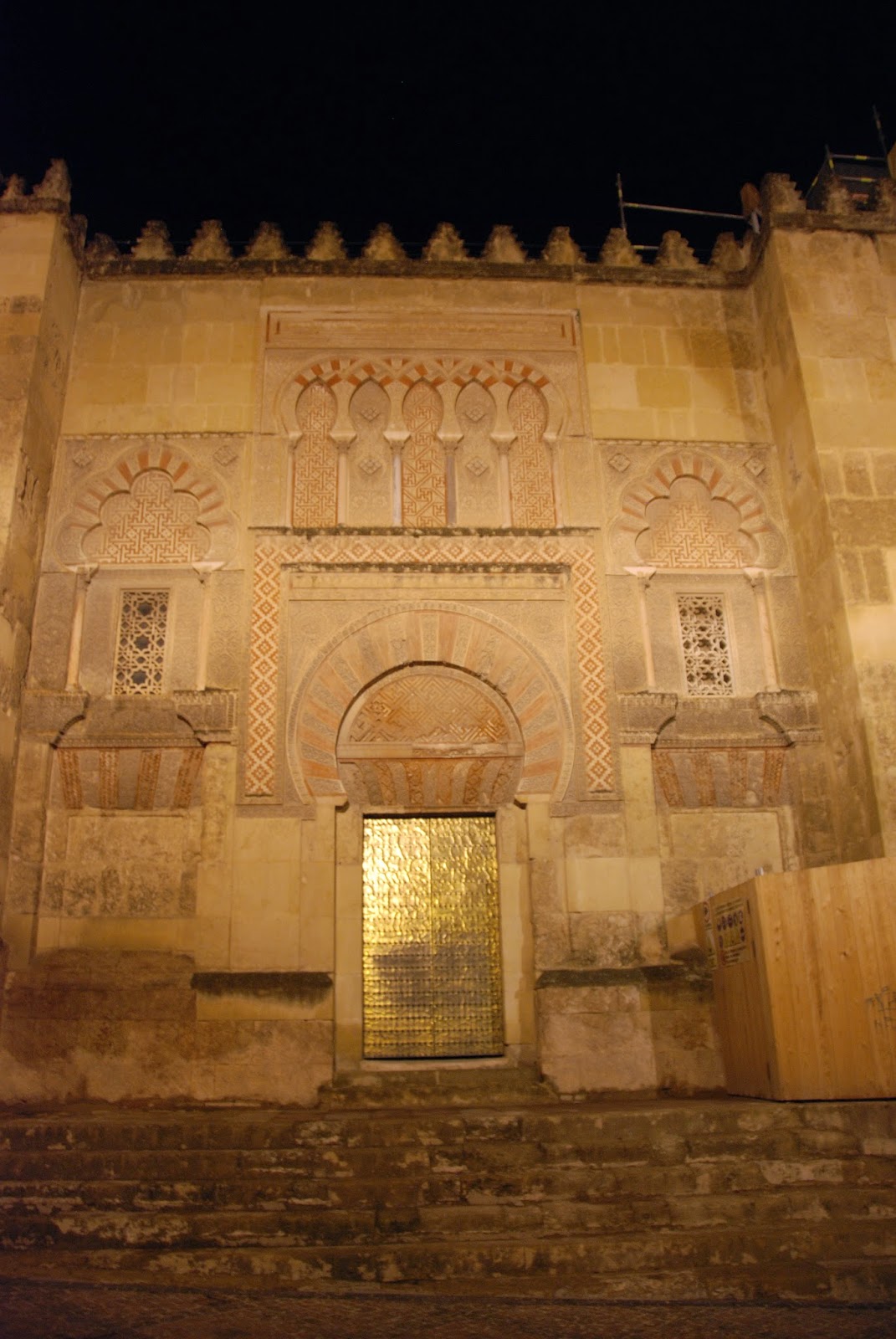
In the end I finally did leave—just as museum security was shooing everyone out. I walked out into the bright light of an Andalusian Sunday afternoon. The late afternoon sun glowed warmly on the ochre colored blocks of the Mezquita.  Looking back as I returned home, I turned my head for one last look.  It was stunning and a perfect last image of work of art.


Monday, October 13, 2014

Iberia and Beyond 2--Seville, Spain

Seville, Spain
October 10, 2014
Latitude 37°22' N

It's amazing how simply crossing a river, when that river separates two countries, within seconds brings the traveler into a new culture, with a different history, different traditions and different sets of values.

Thus it was that I left Faro, Portugal on the afternoon of October 8th and bussed a mere three hours to the exquisite city of Seville--the first in a triad of Moorish towns I'd visit before heading to Madrid.

For three days I wandered this lovely city on  the banks of one of Spain's longest rivers, the Guadalquivir.  My first day was sunny and hot and I took advantage of it to circle  the city on the Hop-On, Hop-Off tourist bus, getting off periodically to sit in peaceful, tree-fringed plazas or walk the narrow cobble stoned streets of the old city.  By early afternoon everything was bathed in brilliant Andalusian sunlight.  How lucky I was to view the city's cathedral as this light drenched the ochre stones that masons had used to build this more-than-impressive church.


By late afternoon I took shelter in the city's elegant Luisa Maria Park.  Horse drawn carriages  clip-clopped down the leafy  boulevards flanked by a European variety of maple, just turning to autumnal brown on this early October afternoon.


Friday was the beginning of the long American Columbus Day weekend, but it was also a national holiday for Spaniards, too.  They honored the man and his accomplishments just as we did.  It was a perfect opportunity to step inside the cathedral, view his tomb and enjoy the world´s largest Gothic Cathedral as well as the world's third largest.  Of all the splendors I saw in Seville--and there were many--this stands out at the best.


Just the statistics alone were staggering.

Supporting columns, round as redwoods, rose 138 feet to ceilings gilded and ornate.

From official start to official finish, it took a monumental 527 years to complete, yet the bulk of the work was done between 1401 to 1528. 

Behind a massive golden grill was the intricately designed altar--the life´s work of sculptor Pieter Dancort who never lived long enough to see its completion..  The altar was a sea of gilt with over 1,000 biblical figures carved in detail.  Known as the Capilla Mayor, it's the biggest of its kind in the world.


The cathedral was built on the former sit of a mosque to show the city's enormous wealth.  Legend has it that the brainchild behind the Cathedral said ¨Let's constructed a church so large, future generation will think we were mad.¨

Well, they succeeded.

At 450 feet long and 330 feet wide, with 15 doors and 80 separate chapels, it's a monument that staggers the imagination.  It was so big that it was only possible to photograph small sections of it.

The steeple is all that remains of a mosque that stood on its site prior to the Reconquest of Spain.  The minaret had been designed with 32 zigzagging ramps--wide enough for a horse to navigate.

But on this day it was just tourists who slogged to the top.  Their reward: a 360 degree view of the city, including the Alcazar, various 15th Century monasteries and a kaleidoscope of Medieval buildings below.

Inside, though, despite the ornate chapel, silver altars and gold covered angels; despite the pantheon of carved saints, prophets, and fathers of the church; despite jaw dropping artistic magnificence was the tomb of Christopher Columbus.


Well, part of his bones at least.  The other portion is still in Santo Domingo in the Dominican Republic.  What a perfect way to spend this 1st day of the long Columbus Day weekend.

The mausoleum was easily 15 feet high--the tomb itself carried on the backs of four giant bronze figures.  Overhead, larger-than-life was a painting of St Christopher.

This was just the icing on the delicious cake that was Seville.  I was already ready to return for Holy Week.  It's here in Seville that the week takes on his most dramatic feel.

Another time!


Photos of Portugal

...to be added in december 2014...

Monday, October 6, 2014

Iberia and Beyond 2--Alcobaca, Bathala, Nazare, Tomar and Evora

Faro, Portugal
October 8, 2014
Latitude 37.0333° N

Once out of Lisbon, life quieted down.  And so did the number of tourists.

I'd settled into the small medieval town of Alcobaça and into a hostel where I'd be the only guest for the three nights I was there.  All of which was fine by me.  As much as I'd enjoyed the company of Ana and her family, solitude was just fine, too.

For three days I ambled around the Estremadura countryside in quest of two 13th century High Gothic churches/monasteries, well-preserved Medieval towns and wide Atlantic beaches.

I would not be disappointed.

Once settled in, I explored Alcobaça's magnificent 12the Century Monastery of Saint Mary of Ãlcobaça--a massive edifice that dominated the town.

Inside, the nave was more than 300 feet long but only 70 feet wide.  Somewhere, I'd read that it had been modeled after an abbey in France.

But, at least for me, the best part of the church were the two intricately carved 14th Century tombs--the church's greatest possessions.

Despite extensive damage by Napoleon's troops in 1811, the tombs still showed the finely detailed story of Christ's passion--all carved out of marble.

That evening I strolled the lantern-lit tangle of the city's windy and ancient back streets.  It was the last day in September, but still felt like a comfortable summer's night.

The next day I used the region's extensive network of of bus lines to bring me to Bathala--a town that still conjures up fierce national pride among the Portuguese people because of the a critical battle for autonomy which occurred there years ago.

My goal was the Monastery of Santa Maria of Victory--an extraordinary abbey built to commemorate the 1385 Battle of Aljubarrota--a battle that shared striking similarities to our own Battle of Plattsburgh.


The battle was a decisive victory over the Spanish.  Like the Americans 530 years later, the Portuguese were heavily outnumbered and yet, through a stroke of military good luck, the local army won, thus establishing, for the first time, Portuguese independence.

Construction of the church began three years later and was completed by 1434.

It was all High Gothic and embellished with gargoyles in the shape of fantastical beasties.  A fabulously designed 15th Century stained-glass window cast the interior in a magical light on this hot and sunny first day of October.

What a phenomenal achievement of architecture.  Solid rock had been carved into forms as delicate as snowflakes and pliable as twisted rope.

I stopped in my tracks when I first approached the abbey.  Hot sunlight flooded the ochre-limestone blocks.  The church bristled with flying buttresses, Late Gothic stained glass windows, octagonal chapels and doorways layered with angels, saints, apostles and prophets.  It took my breath away, much like the Taj Majal did the first time I saw it many years ago.

Inside, warm light poured into the church from deep-hued stained glass windows.  A later addition also include an octagonal chapel--lofty and star-vaulted--housing the tombs of Portugal's first king, his sons and Prince Henry the Navigator.

Inside, the Royal Cloisters were breathtaking--tangles of  detailed stone carvings, entwined with vegetation, exotic flowers, ropes, pearls and shells--again all carved out of stone.

The abbey was truly a monument to faith and national pride and a testament to man's great creative genius.

Bathala was a lovely town, made more so the dearth of tourists and the magnificence of what I'd seen. It was an easy to town to linger in for a bit, especially on this hot, cloudless blue day.

In the middle of the week I needed a break.  From Alcobaça I cruised the back roads of the area on my way to Nazare, one of Portugal's prime beach towns.

On my way there, we tooled through rolling hillside villages that offered fine views of well kept homes with picturesque tiled roofs and gardens of bright flowers.

Once in Nazare, I spent a wasteful, yet very necessary, day doing as little as possible in this pretty cliff-backed town along a lovely white beach  One thing I did not do was plunge into the chilly Atlantic.  This part of Portugal is much like coastal California in the summer--hot air temperatures, but frigid waters for swimming.

By Day 4 I packed up and travelled east to the Medieval time-capsule town of Tomar with its rambling 12th Century Convent of Christ safely tucked behind the crenelated walls of the Crusader fortress.

It was my good fortune, once again, to stay with another Ana, this time in her 17th Century home just below the crenelated walls of the fortress above.  With its thick walls, huge bedroom and spacious garden with orange, lime and persimmon trees, I felt right at home.

That afternoon I  headed up the hill to the convent where the Knights Templar held court from the 12th to the 16th Century.  Room after room was a surprise----other-worldly chapels, sinuous and spiralling staircases and splendid cloisters.


Clearly the most famous feature of of the monastery/convent was the chapel's western window--a celebration of Portugal's role in the Age of Discovery.  Snaking ropes, seaweed and cork boat s atop of which floated the Cross of the Order of Christ, all of this carved in detail out of local marble.

I spent another day in  the region doing very non-Medieval things: a tour to Fatima including the  homes of the children and apparition sites.  Two hours were spent  circling a quarry where 170,000,000 million year old  dinosaur tracks had been found a number of year ago.  The trip was made especially nice because of a young couple from BC and their two children who'd come up from Lisbon for the day.

But Tomar had come to an end.  This was the only place that  I'd been to in Portugal where  I'd like to have put down roots-  Perhaps it was Ana's hospitality or her great digs, but Tomar reached out and took hold  of me.

But leave I did and my journey to Evora brought me through Lisbon once again.

I loved lounging on the train, watching the Portuguese countryside roll by.  We passed tall stands of of dusty-Green eucalyptus and grove after grove of olives. Tiny, old villages with homes landscaped with hydrangea and orange trees and white pines buzzed by.

My first image of the this delightful Medieval town  began almost an hour before I'd arrived.  It was late afternoon and a warmth glowed off the fabulously quiet landscape of cork trees that stretched on for miles.  I was crossing the sun drenched and golden plains of the Alentejo--Portugal's almost southernmost province.

At sunset I arrived in Evora and watched the sun, yellow and warm, crawl behind 700 year old buildings.  It was a fine way to wait for a cab that would bring me to the hotel

The next day, Sunday and my only full day in the city, I wandered the cobbled streets--too clean and tidy, I thought. It almost had a Disney feel about the place.  I was reminded of a visit to Quebec City several years when the same thing happened.  The city had cleaned itself up so well that it almost looked artificial.

The day would be sufficient to take in the sites--the cathedral and the finest still-standing Roman ruin in all of Iberia--a 2nd Century temple to Diana.

But I'd seen heaps of old buildings in the previous weeks and what I really had my heart set on was a visit  to 7,000 year old megaliths that dotted the countryside around Evora.  Indeed, these were some of  the oldest remains of civilization in the world.  The Evora Complex are some of the oldest and largest stone circles in all of Europe--older even than Stonehenge--and one of the oldest records of mankind.
I hired a taxi and shrugged off the expense.  How often do you get a chance to see something like this? Our first site was The Cromlech of the Almendres.  More than 90 large rounded stones were placed in a deliberate pattern that probably built for ceremonial purpose or as a primitive astronomical observatory.

Not important.  What was important was how delightful it was to wander around this rather ethereal place. I just wish I'd had my own car which would have allowed me to linger longer in these astounding sites.

By now my time in Portugal was coming to an end.  I'd spent ten days living in the Middle Ages and in magical places--Bathala, Alcobaça, Tomar and Evora with their extraordinary monasteries with a whole booty of  13th and 14th Century treasures.  I'd drifted in and out of hidden courtyards and curvy, shadow-filled lanes.  Buses transported me up and over rolling hillsides and through quaint villages sprinkled with  with white-washed houses and Stone-walled taverns.

And while I missed, a lot of other marvelous places, I still left Portugal with a pleasant taste in my mouth.  There was still a great left more to see and that is always a sign that a country's visit was a good one.


Iberia and Beyond 2--Lisbon, Sintra and Queluz

Lisbon, Portugal
September 29, 2014
Latitude 38.7138°

It was exactly my first full day in Lisbon and I'd made my way to the Monastery of Saint Jerome--San Geronimos in Portuguese.  It's a major tourist site in the city and perhaps Lisbon's most famous buildings.  It was high on my list of place to see.

What I'd not planned on was two cruise ships being in port on the same day.  Early clues had told me it was going to a busy, busy day!

When I got to the entrance of the monastery the line was long and aggressive.  People were pushing their way in.  Old ladies, hordes of camera toting Japanese and legions of your every day variety of tourist.

So, I backed off.  This was not how I wanted to spend my first day.  I had two months in front of me and this place could wait a bit.

Instead, I entered the 14th century church, toured its gorgeous interior where tree-trunk columns grew to a spider web of a ceiling.  A golden light cast from high stained glass windows cast a warm light on the altar and on the elegant tomb of Vasco da Gama.

I gave the church an hour or so, and figured to hordes would have abated.

But I was wrong.

Just as I was leaving the church, an overly aggressive Asian tourist began to race past me and literally pushed me out of the way.

Instinctively, my right arm went out and slammed into his gut--not something I normally do.

"I was first," I muttered.

He stopped cold.  For a moment I though we were on the verge of some new Sino-American conflict.

We stared at each for a long second or two, but he backed down, let me past and that was that!

What a way to start this nine week trip!

The line was still horrifying, so I just gave up on the idea of seeing this site on day 1.  It was still early in the day, and there was still plenty of time for the cruisers to be in port.  But I knew they'd leave in due time.  God forbid they miss that night's buffet line!

So I regrouped.  I had five full days in Lisbon so there was no need to endure this sort of crunch.  Instead, I spent my day in two lovely botanical garden--a respite form the cruise ship tourists and a gentler approach to seeing this lovely city. I was still tired from a transatlantic flight and lack of sleep for 40 hours.

In subsequent days I deliberately got lost in the labyrinthine Moorish time capsule of the Alfama with its tangled alleyways, skinny terracotta roofed houses and orange-tree shaded patios.  I'd sit for half an hour, read, let daily life pass me by, watch Lisbon's ubiquitous red or yellow trams trundle up the steep and narrow streets.  This was "old" Lisbon and its streets had seen legions of Roman soldiers and foot-tramping Crusaders.

I was reminded of another day, two years ago,  when I followed a similar trail through the sinuous streets of Kathmandu.  It brought back pleasant memories.

And so the days passed quickly.  A weekend day trip to Sintra was a bit of a bust--far too crowded to enjoy its imposing castles and fairy-tale like setting.  I did take a bus trip that brought me round the Sintra area and to Cabo da Roca--the western most po9nt of Europe.  It was a hot, sunny Saturday afternoon and the place was packed, but standing atop the precipitous cliffs that plunged down to a piercing blue sea was a marvelous way to end the day.  I made a huge mental note that if I came back this way I'd spend far longer than an afternoon in the special area outside Lisbon.

On Sunday I needed some quieter diversion, so I made my way to Queluz, just outside of Lisbon center, to the former summer palace of Portuguese Royalty of the 17th and 18th Century.

Well, I wasn't disappointed. It was eerily quiet and I and few other tourists seemed to be the only people there.  I'd seen this place before, but not in Portugal.  It was patterned after Versailles in Paris and the Peterhof in St. Petersburg.  But unlike both of those places, it was a treat to roam to its elegant rooms without others breathing down my neck.  Room after room was filled with original furnishing from that time period.  How it was all salvaged is a mystery.

Outside, the oak-lined formal gardens were just beginning to turn early shades of autumnal brown and yellow.

Overriding my stay in Lisbon had been my very good fortune to stay at the home of Ana Balthazar, who I'd found online at airbnb.com.  Along with her two sons and another guest from South Africa, it was a pleasure to stay in her 6th floor apartment building.

For $28.00 a night in a truly residential neighborhood, I got a comfortable bed, a view of the Tagus River, good people to come "home" to every night and, best of all, a free ride from the airport when I arrived at 7:00 a.m. from Montreal.  More than once she invited me to share dinner with her family and repaid the favor with Portuguese take out.  It couldn't have been better.

I was reminded of my stay in Eastern Europe many years ago when I'd go home with local women who met tourists at the train station and were renting out rooms in their homes.  I was never disappointed and to this day some of my richest travel experiences have been given from some of those kind folks.

By week's end I finally  did get back to the Saint Jerome Monastery.  Blessedly, there were no cruise ships in port.  I was duly wowed by the  fusion of creative vision and moneys procured from discoveries by the early Portuguese explorers that produced this splendid monument--a foretaste of splendors to come.

Early in the evening of my last full day in Lisbon,  I was eating a quiet dinner at a street side restaurant when a bride walked by with a few of her girlfriends.  Dusk was setting over the capital, I glanced upward and saw a brilliant crescent of new moon.  A good sign I thought.  Fifteen minutes later I heard the distant strains of Ave Maria.  I thought of my mother who told me so many times how this had been sung at her wedding (and would later be sung at her funeral).  What a nice way to end the day...a silver crescent of new moon and a hymn with so many emotional connections.

My stay here had  been a good one--rich and full and wanting of more--and this silvery moon bode well for a continued good journey.

And while I would miss Ana and the multiple distractions Lisbon had to offer, I was looking forward to quieter days but equally enriching days ahead.


Tuesday, September 23, 2014

Iberia and Beyond 2: Here We Go

Plattsburgh, NY
September 23, 2014
Latitude 46.69 N

I am calling this trip Iberia and Beyond--2.  Thirty two years ago I travelled in Spain and Portugal and my journal from that time was called Iberia and Beyond. All trips in my younger days had names. That summer--1982--I flew to Spain, traveled into France and Andorra, then returned to Spain where I then went to Portugal and Morocco.

This trip is a bit less ambitious, but will take twice the time.  There is no longer a need to travel at warp speed--which is very nice.

Tonight I off for Lisbon and two weeks in Portugal. From there I cross into Spain for three weeks visiting the Moorish gems of Seville, Granada and Cordoba. On October 18th, I'll meet Glenda in Madrid where we spend a week before boarding the SS Norwegian Epic in Barcelona on October 26th for a two week Atlantic crossing. From Miami I fly on to Mexico City for two weeks, with a five day interlude to my favorite Mexican beach town—Zipolite. I'll arrive home just in time for Thanksgiving—the first time I've been home in late November in three years.

If you're reading this, wish me God speed.


Thursday, August 21, 2014

The Summer of 1974

In the summer of 1974 I was 25 years old and had just finished my third year of teaching. In late June of that year I embarked on my first truly solo adventure that would, in the end, define travel for the rest of my life.

I had a one-way ticket from Montreal to Jasper, Alberta, a wallet full of travelers' checks and a well-worn copy of an ancient National Geographic article about the Canadian Rockies.

My father dropped me off at Windsor Station a few days after the school year ended and at 5:00 pm, on a late June afternoon, I took off, alone, on the then Canadian National daily Montreal-Vancouver run.

In 1974 I was a far different traveler than I am today. I'd packed enough picnic fare—hard boiled eggs, banana bread, baked chicken—to last me the forty eight hours it would take to get to Western Canada.

There are many aspects of this trip that are lost to memory, but what I do remember is that Jasper was my goal. I'd not really thought much about what I'd do after that, nor did I give any thought to getting home. I was able to live very much in the travel moment and not worry too much about what would happen tomorrow.

I was totally ill-prepared for this trip. Forty years ago there were not guide books, no blog posts, no Internet sites. I should have known to bring a warm jacket, but I didn't. Instead, I had a long sleeve flannel shirt and a thin cotton hoodie, one pair of jeans and one pair of shorts,

I did have, though, good hiking boots, warm socks, a fine backpack, a warm sleeping bag and a more-than-sufficient cook set.

Three days after leaving Montreal I arrived in Jasper, Alberta. I had a tent, a good sleeping bag and an open sense of adventure. Somehow, I found a free campsite on the fringe of town that was located on the banks of a river and loaded with other young people. A place like that might not exist today. There were o terrorists roaming the countryside and well all felt safe. Cities set up places like this for young people. It was a good time.

There were not facilities, no showers. Maybe there was a port-a-potty but that another one of those things I don't remember. All of this was perfectly fine with me. I was 25, it was the 70's. There was still a residue of hippie in me to embrace this sort of thing.

I fell in love with Jasper almost immediately. I bought a hiking guide, hooked up with other hikers, and spend days and days roaming the trails of Jasper National Park.

Once, with four recently graduated high school kids, we hiked deep into a nearby valley, pitched out tents on small islands and in too-fast-running river. It rained. We hunkered in. Looking back on it, it was such a foolish thing to do. The river could have flooded and we'd have been washed away.

But we were young and invincible and, honestly, I don't think any of us even thought of this possibility. I'm sure “flash flood” had never entered our vocabulary.

We'd seen bears earlier when we'd hiked other trails. All of us were from urban areas and didn't have a clue, but we knew enough to let the bears know we were coming. When we were on the trail the five us, one at a time, would shout...”Stay away bears!! Stay away bears.” We did this all day long ever four or five minutes. “Stay away bears!” It probably did the job.

Days later, after leaving these guys, and hitchhiking to Yoho National Park, I hiked into a gorgeous mountain lake that still had vestiges of ice on its fringes. It was early July and weather was perfect. I'd spend my days hiking over snow fields, climbing to look outs much higher up that where I was tenting. Mountain goats roamed the steep slopes above me. The days were brilliantly blue. Often, in the distance, I could hear avalanches tumbling down summer mountain sides.

I stayed so long in Yoho National park that I ran out of food. Taking a lead from other hikers, I hiked down the opposite side I'd ascended, found a resort and begged the restaurant staff to sell me some food. I came back with eggs, bread and a few bottles of Pepsi—even then. :)

I have no idea how many days I stayed in this gorgeous place, but I finally had to force myself away from the Canadian Rockies. The Summer I was there was simply perfect and one day rolled into the next-days spent hiking, meeting new people, enjoying the grand beauty this place had to offer.

From Yoho, I hitch hiked from there to Vancouver. The journey wasn't direct of course. Because I was always part of another hiking group and because we were young, our drivers often invited us to stay in their home. Thus I saw part of Alberta and BC I'd never have seen otherwise.

I lingered a few days in Vancouver, sleeping in a youth hostel nearer the beach. It was here that one of three anti-American sentiments was directed at me. Several of us were sitting on the beach one evening when a few aggressive, possibly drunk, Canadians wanted to know where we were from. I was still an innocent traveller and we told them the USA. They started to pick a fight, hurled anti-American sentiments at us. Luckily we got left with no ensuing damage.

After Vancouver I took a boat to Victoria, where I sailed yet again to Seattle and stayed with our family friend, Lucille Rabideau who'd moved back to Washington two years earlier. In Seattle I had a bed and three meals a day and a roof over my head. It was wonderful.

A few days later I moved on to Portland, Oregon then hitch hiked to Surf City—many miles to the west. Surf City, then, was a place of miles long, cold beaches, few homes and quiet isolation. I imagine it's quite different today.

It was 1974 and there were fewer regulations in place. I found a sand dune, and set up camp. At night I'd unroll my sleeping bag, make a “pillow” out of clothes and snuggle in under the starts. At dawn I'd wake, the sleeping bag's surface wet with dew. I'd let it dry out, then repack it. I spent my days roaming the beach, hanging with other young people who were camped out in the dunes.

I stayed almost a week. Once a day I'd wander into the local diner and order lunch—and use their bathroom to take a “shower.” I wasn't so much as dirty as I was salty, and this once a day bathing was enough to keep me clean. Once I met a local family who offered to bring me to their home and let me use their shower. I gladly accepted.

Each day I'd stroll for miles on the beach. The water was too cold for swimming, but there was plenty to look at in the water—crabs and starfish. In small eddy's cold water marine animals made their home.

I'd climb sand dunes that looked like small mountains. One sand dune was popular for hang gliding and I'd watch person after person fly off the hill. One woman tried, and immediately fell, rolling down the dune. An ambulance was called. She did no move. I've often wondered what happened to her

Evenings were spent around a campfire. Someone had caught fresh salmon and we cooked it over the open fire. It was one of the few times in my life when I enjoyed fish.
Twenty years later, in the summer of 1994, Steve and I returned to Surf City. For me it was a journey back to a place that had meant a lot of me twenty years earlier. We stayed in a motel. Very little had changed. We walked the beach and the trails that had been built in the sand dunes. I pondered how I could possibly have spent week living in my sleeping bag, sleeping in a sand dune. It was a wonderful journey back to the past.

From Surf City I hitched a ride to the Highway 1 and almost got arrested doing so—not for hitchhiking, but for walking on the wrong side of the road.

A State Trooper stopped me.

“Let me see some ID, please.”
Check

“Mr. Ladue, do you realize you're walking on thew wrong side of the road?”
“But, sir...where I live I'm doing the right thing.”

“Occupation?”
“Teacher”

“Height?”
“5' 8”, I guess.”

“Weight?”

etc., etc., etc.

I got a warning, in duplicate, which I still have.

Once on the coastal highway a beat up old pick up from the 1950's picked me up. On board were a motley crew of other hitchhikers, all heading south. Everyone smoked pot. The driver would occasionally get out and ask someone to take over. God only knows how stoned these drivers were. The things we do when we're young!

The ride lasted many hours until I got off in the city of Brookings, on the border of northern California. Another guy, Mike, got off with me. Together, we found ourselves a place on the beach, set up camp, prepared meals by night. Each evening he'd pull out his guitar and other campers would join us.

During the day I'd make my way into Brookings to “shower” as some restaurant and pick up a few supplies. Life was extraordinary simple.

We left Brookings, crossed into California, and hitchhiked south. By now July was coming to an end. A whole month had passed living in my tent or under the stars. It had been wonderful.

Mike had been born and raised in LA and was on his way home to visit family for the summer. We were both 25 and both of us were teachers, we so had a lot in common. He introduced me to the redwoods, and later to a group of friends living in Berkley and Davis where we stayed for a few days.

From Davis I flew on to LA for $29.00. Thank heavens for good travel journal keeping. I'd never know that figure today.

I knew some folks from the church I was in Plattsburgh who'd been stationed at the Air Base there and had relocated back to California.

I stayed with them for about a week, sleeping on the sofa, being awakened one morning and told to leave the house because there was an earthquake. I can still see the entire neighborhood standing in the middle of the street, in their pj's or underwear.

Their church had a day trip to Universal Studios and Disneyland and I took advantage of both opportunities. It was in Glendale, where they lived, that I first got introduce to Baskin-Robbins ice cream. Everyday I'd walk down to the shop and bring back enough for all of us.

By now it was getting towards the end of August and I really had to think about getting home. I'd flown by the seat of my pants the entire journey and had never really thought much about the return trip home. But school was going to start in two weeks and I really had to get back to Plattsburgh.

My LA friend suggested we go to the airport that night, bags packed, and surf the airlines to see what was available. Which is what I did. I had a credit card, and bought a LA—Cincinnati red-eye that stopped in Denver and Chicago. From Cincinnati I bought another ticket to Albany and then from Albany to Plattburgh. Imagine trying that today!

From the airport in Plattsburgh I walked all the way home. I was back “on the road” one last time. I entered my apartment that had been shut up since I'd left in June. The daisies I'd picked on a beautiful June day were dried out in a waterless vase. The paint job I'd started in the kitchen was still unfinished.

Immediately I went in to trip withdrawal. All those splendid summer days were now behind me.

School started a week later and life returned to normal.

For months after I returned I'd show my slides to anyone who'd sit through them. I did it so often that I'd memorized my narrative.

Occasionally, in some form of “out west” nostalgia, I'd pull out my cook stove, sit on the floor of my living room and cook a typical Summer of 1974 dinner—instant rice and package of soup mix and a peanut butter and jelly sandwich. Sometimes I'd even take out my sleeping bag, place the mattress pad , and sleep on the floor.

My journal records names of people I met, people who's lives transected mine for a short period, people who came and went that fantastic summer 40 years ago.

Have you had a good life, Robert A. Oliver? Where are you now Ellen Schaeffer? Did you fulfill your dreams Paul Wolger? Sadly, my journal barely surfaces the context in which I knew you, but our time together was good enough for me to record our time together.

Forty years have passed. I never once made contact with anyone from my journal, nor I have heard from them.

But all these people life on is what I learned during that summer—connect, enjoy each other's company, disconnect, move on. It's the way of travel then and it's the way of travel now.

What I did learn in that summer so long ago has held e in good stead in all subsequent travels.

My ability to leave Plattsburgh alone, navigate new countries, roll with the unexpected, change plans at a minute's notice and adapt to all sorts of different situations were all skills I learned, unknowingly then, during that eight week trip.

It was truly a landmark summer--one I still remember--even more so this summer, its 40th anniversary. I had traveled to the center of my soul and ht summer has lingered in a corner of my memory for a very long time.

I will never travel that way again—not that I can't, but more that I don't want to. What's good for a 25 year isn't necessarily look for a 65 year old.

Still, it's nice to image how easy it was to sleep in city parks or in sand dunes along the Oregon coast.

I think there is a moment in young adulthood, or a series of them, when a door opens and the future in.

The Summer of 1974 was one of those moments.

Forty years later I still smile on that summer and am grateful beyond words for what it taught me.

Wednesday, June 18, 2014

Eulogy for Catherine Keyes

Is it good now, Kay? You're free. You're free at last.

It must be great.

But it's not been good, has it Kay? It's not been good for a long time.

It's been a long, long time since I've been able to tell you a story, Kay.

But I know you're well now—whole. And I know you're here with us—your spirit, sharing this celebration of life.

So here goes, Kay. I want to tell you a story. I want to tell you a story about you...and me..and the day you died.

I'd not slept well that Monday night, always waiting for the phone call that never came. It wasn't a surprise, then, that I woke up early, before the sun. So, at 5:00 a.m. I biked to the hospital.

The sky was a turbulent, cloudy gray and the wind was blowing wildly. I half expected the sky to break loose and soak me before I got to your room.

You were restless, that early gray dawn, Kay. Your lungs telling us all that the end was near. It was brutally difficult to see you in such pain. As I held silent vigil, I could see two Kays in that bed—the physical Kay, whose body wanted release from the discomfort, and the restless, spiritual Kay whose spirit was crying for release.

From your room, high above Plattsburgh, I looked out at the emerging morning—a dawn of thickening clouds and mighty wind. Energies outside your room were picking up speed; energies inside your room were dwindling by the minute.

I didn't expect to see you at the end of the day. I said goodbye, left, and biked to a nearby restaurant and sat...trying to make sense of it all, this mystery, this suffering, this enigma we call death.

Biking home, the morning's turbulent energy was stronger, more furious. Rain threatened, but I knew it wouldn't. A front was pushing through—pushing the rain, the clouds, and you, too, I imagined, out and beyond.

You were never far from my mind, Kay, those first few hours in school. Outside my library, the front had passed, the sky was breaking, the day had turned from gray to blue.

Mid morning, I wasn't surprised when John called, confirming was I knew. You'd just passed, pushed out with the clouds into the great blue yonder.

I spent the rest of the morning in silence, struggling with your pain, the ugliness of death. Surprisingly, it wasn't your death that grieved me. I was happy for your release. It was the struggled living that grieved me most.

It wasn't until later, as I wandered up the hall, that I was finally able to connect the dots to this puzzle.

It was finals' week and our middle school students were coming out of classes, shouting, racing. Their young bodies were crying out to finished with this day, their exams, this school year. Crying out for summer vacation to begin.

And then it hit me! What I was witnessing in that school hallway was the same thing I'd witnessed hours earlier, in your hospital room, that early, bleak, break of day. Like these students trapped in school, your spirit was trapped in a dying body. Both of you...these adolescents and your dying spirit...were screaming for release.

“Get out,” your spirit was saying. “Get out. It's time to break free. It's time to go home.”

“Get out,” these kids were saying. “Get out. It's time to break free. It's time to go home.”

This epiphany was comforting, liberating. And it all finally made sense.

That afternoon, Steve and I left for Lake Placid. We all needed a break, to move on, at least for a day, to green trees and verdant mountains...to life.

The day was a marvelous blue, early summer-cool, fresh. There was no structure to the afternoon. We wandered in and out of shops on Main Street. We sat by the lake to enjoy the view. We chatted about you and the memories we had. And we contemplated,, together, your life, your illness, your passing.

Suddenly, while sitting there, gazing at the dwindling light, an image came to me—sudden, joyous, full of energy. You. Running. You as a youngster running through a meadow. Laughing. You were laughing...riotously, boundlessly—the laugh of someone so full of life, so free—of someone having so much fun that laughing was the only way it could be expressed.

I knew you were letting me in on a joyous moment—you, running through the fields of heaven, free—free at last.

The image was so real, so vivid, so absolute that I knew you were letting me share that first, sun-filled afternoon with God.

And so, Kay, I say goodbye. I will hold dear the memories of long ago, before the dark years, before we lost you in life, and now in death. Way back...

--Skiing at Whiteface and Jay Peak;
--Cinerama and Joe's Steak House;
--Drive-in movies on summer nights;
--Wonderful weekends in the Laurentians.

I thank you, Kay, for all you did in those earlier years.

And I thank you, too, for teaching me to the end that death is part of life, and that all spirit longs to go home, that in the end we all return to God.

And I thank you for allowing me the brief image of heaven's fields and you, running free and happy. It's good to know that you are well.

I like holding that Lake Placid image of you—you running through summer meadows, running through the eternal summer fields of heaven.

That's the image I will hold of you—jubilant, happy and full of life.

September 7, 2003