Monday, January 2, 2012

People Remembered: Howard Ladue: My Dad's Centennial--Born 100 Years Ago Today

Had my father lived beyond his 82 years, he’d have turned 100 today.  A century!

My Dad’s name was Howard William Ladue and he was born “on the farm,” on the Durand Road in Beekmantown, New York on January 2, 1912.  The “Howard “ in his name comes from some obscure, lost to history, surname on the Ladue side of the family; “William” was his father’s brother’s name.  There had been two brothers—William and Charles--both born in the 1880’s--who’d also been raised in Beekmantown. One brother, William, went off to medical school; Charles, Howard’s father, stayed on the farm.

Charles married a young woman in the farm neighborhood—Maude Boutillier, a.k.a. Butler.  Even today, the Butler Road, which runs perpendicular to the Durand Road, is a 21st Century reminder of my grandmother’s family who’d settled that road in the mid 1800’s. 

In May of 1910, my grandparents, then in their 20’s and single-handedly working the farm, brought up from New York City a young Willie McGuth.  Willie was a product of the Great Catholic Protectory and had been trained in agrarian skills at the Westchester campus.  Not all boys had stellar experiences on the farms of New York State, but this young man did.  When my dad was born, Willie had been there two years and was, in all aspects, my grandparents’ son.  My father, and then his sister Katherine, born two years later, only knew Willie as their older brother. (Many, many years later, in the young years of the 21st century, and in the twilight of my aunt’s life, when her mind would slip in and out of dementia, the memory of this fellow was so strong and so positive, that she said to me one day…”I always loved Willie.”  He was, and would always be, their older brother, and the love would flourish for more than ninety years.)
His sister, Catherine, was born in June of 1914 and his second sister, Margaret, was born in March of 1919.  All the children started school at the one room school house in Beekmantown.  They, along with their father and Willie, assisted in farm chores.  But my grandfather, seeing the future, moved them off the farm and into Plattsburgh so all three could have a sturdy Catholic education at St. John’s.

In 1992, just before my Dad’s 80th birthday, I made a video for him.  “This is your life, Howard Ladue.”  One December’s day, I put Kay in front of the Beekmantown home, still standing and looking good 80 years later, where she narrated their life in that house.  The property extended past Route 11 and beyond the Tastee Freeze.  Route 11 wasn’t there then and the Durand Road was the only north-south passage in that corner of Clinton County that led to Plattsburgh.  They had fields of corn and, according to Kay, who still spoke, for some reason, in that peculiar French-Canadian-English patois, “We malked the cyous,” she happily told me.  Bill Ladue, her first cousin, and oldest son of Dr. William, Kay and Dad’s uncle, was with us, also.  “Tell him how we used to come spend the summers with you.”  Life on the farm stayed with my dad and my aunts, and all their cousins, until the end of their lives.  It was a happy place and an important part of their lives.

My father was fond of children, dogs, cats, michigans and hard candies.  He loved chimpanzees and clowns and shooting pool at the Elk’s Club.  He was what we call a “Regular Joe” and he fit in almost everywhere he went and with whomever he was with. He was easy going and easy to please. He liked just about everyone and everyone liked him. I never heard him say a bad word about anyone.  Never.  Once, I was complaining about someone we both knew.  “Dan,” he said.  “She’s a sick woman.”  And she was.  She had a debilitating muscular disease and was unwell all the time.  I try to remember that about him, and apply it to my life now, these many years later.
He was a great practical joker.  I will never forget Thanksgiving 1979.  The living room was full of company, mostly my friends.  The day before, a woman bearing Steve’s surname, very uncommon in the North Country, then or now, had been implicated in a robbery. 

“Steve, I see where your sister robbed the Grand Union.,” he said. 
Steve, knowing my Dad to be a practical joker, waited.

“She’s my wife,” responded Steve.  There was momentary silence.  My father’s turned to me, staring at me imploringly to get him out of this predicament.   Then all of us who really knew the story, started to laugh, uncontrollably.
My father never played another practical joke on Steve again.

When we were younger, he’d often ski with us. He still wore old, lace up boots that were strapped to dangerously old skis and more-dangerously-still bindings.  (Once, during that time, I was given a similar pair of skis for Christmas.  The following April, I broke my leg at Whiteface.  Two years later, a few days after Christmas, my brother, wearing the same skis, broke his leg.  Shortly before New Year’s Eve that year, he ceremoniously broke up the skis and fed them, sacrificially perhaps, into the fireplace.  From then on we had much safer skis and bindings.
When I was in middle school, and before I imagine, he smoked cigars, (in those days I gave him a box of Swisher Sweets every Christmas, marching myself into a pharmacy and buying them was I was as young as 12 years old) but my allergies to cigar smoke and the cloud it engendered in every room, and the Surgeon General’s exhortation to stop smoking, stopped that habit.

He loved to cane and the chairs he caned (almost all with a story of him and me traveling the summer back roads of Clinton and Essex counties, buying up beat up old wooden chairs, their cane come undone) are still in my home.  He’d buy them for $5.00, take them home, wait until autumn settled in, and happily refinished the chairs then caned them.  I can still see him in the living room, fireplace blazing.  Those chairs filled my parent’s home on Grace Avenue, then at the condo and finally, after my mother moved, at Lake Forest.  If my mother gave one away, it was to someone she loved deeply.  Each of my cousins has one now, and I have the rest.
My Dad loved warm weather.  During World War he chose to enlist in the Army.  He was trained as a radio specialist and was assigned to Honolulu, Hawaii, until 1945.  It forever changed his life.  Now that he’d known another reality, far different from the cold, lifeless winter reality he’d grown up with, he wanted to live in that warmth for the rest of his life.

The War ended, he came home, and married my mother, Rita Boyer, raised in the icy Adirondack town of Saranac Lake, New York. They were married at 8:00 a.m. on September 15, 1945.
My mother had come to Plattsburgh to study business then got a job as the bookkeeper at the new two-story Montgomery Ward on Margaret Street.  My Dad had a light trucking business that he’d purchased from one of his uncles and he would transport goods to the store on a frequent basis.  They became engaged, and then the War broke out.  When he enlisted, she broke off the engagement—not an unwise thing to do.  But sometime in 1945, probably through letters, they were re-engaged and set the date for their wedding.  My Dad looks handsome in his Army uniform and my mother is quite beautiful in a dress she bought in Albany.  He was 33 and she was 29.  After the wedding, they moved to Fort Dix, New Jersey where my Dad finished out his enlistment.

Life moved on after the War.  He finished his gig in the military and he and my mother moved back to Plattsburgh.  They lived on the north side of duplex his parents owned at 144 Oak Street.  He got a job on the Delaware and Hudson Railroad and some of my fondest memories of my dad on the days when I’d go to work with him. Sometime during the day, when the train passed through on its way to Plattsburgh, he’d put in the hands of someone on the train.  I’d ride in cabooses or engines or in coach.  My mother was always waiting for me when the train arrived.  To this day, I will always take a train over any other form of public transportation.

His dad, the grandfather I never knew, died in June of 1947, at 66.  I remember my dad’s 66th birthday—1978.  I know he was reminiscing when he told me, a bit alarmingly, that he was now the same age his father was when he died.
I was born in March of 1949, when my Dad was 37 and my brother joined us three years later, in June of 1952.  Pictures from that time tell me my father, and mother, loved us.  Whenever he held either of us, it’s always with a smiling face.

But his years in Hawaii instilled within him a yearning for change, and shortly after my brother was born we all moved to Florida.  This was epic—then and in the annals of Ladue family lore and history.  This story has been told elsewhere; suffice to say that we moved back to Plattsburgh in the Fall of 1955.  As far as my mother was concerned, it was a shut book.  But not so for my father.
He returned to his old job—with the Delaware and Hudson Railroad, but he’d lost all his seniority when he left for Florida.  By the late 1950’s, train travel was fading fast.  He and my mother said a Novena to the Sacred Heart.  “It never failed us,” she’d often tell me.  They prayed for direction, and that direction came in the form of the purchase of the only answering service in Plattsburgh.  Plattsburgh Answering Service.  561-0800. The first switchboard, in the summer of 1961, was set up in the kitchen, and as the business grew, my parents built an addition onto their home, and, until they retired, my parents, worked 24 hours a day, 7 days a week, 365 days a year.

And then life settled into the routine I knew as a child and then a young man.  We skied in the winter and went to the beach and played golf in the summer.  Things my dad liked to do.  He’d bring my brother or I to New York City and we’d spend a weekend at my Aunt Sheila’s in Rego Park.  It was always a thrill to board the train at midnight then sleep in a Pullman Car.  When we arrived at Grand Central Station, we’d cross the street and eat breakfast at Horn and Hardet’s Automat.  Slip in a dime, open the small door, and take out a piece of pie or a sandwich. 
Dad would often get tickets for shows that were still broadcasting out of New York.  I have a very early memory of going to a live radio broadcast and then to a live television broadcast of The Howdy Doody Show.

My brother and I went through the grades at St. Peter’s School, then on to Mount Assumption Institute.  I graduated in 1967 and my brother three years later.
By 1976, when my mom was 60 and my dad was 64, they sold the answering service.  They were free at last to pursue other things.  The following winter they spent several months in Venice, Florida and then, in 1980, they bought a mobile home in Sarasota where they wintered until 1990.

By then the cancer that had taken his kidney in 1984 had metastasized on his lung.  It was time to return to Plattsburgh full time.  I know it must have broken his heart to sell the mobile home at the Buckingham Club and it must have broken his heart even more to return to the chill wind of long winter days.  But I never heard him complain.
On his 80th birthday, January 2, 1992, video camera rolling, I casually chatted with my Dad about his life.  By then he’d had a stroke, a quadruple by-pass and was battling lung cancer.  “I’ve had a good life,” he told me.

I have thought often of that simple statement these past twenty years.  “I’ve had a good life.”  So simply said, yet so powerful.  Words to live by as I rapidly approach the twilight years I remember my parents living such a short time ago.
My dad died two years, almost to the date, later.  The cancer, which had slowly ebbed the life out of him, finally took its toll.  In December, 1994, I could see him failing.  My mother had asked me to come over one Sunday afternoon to sit with him while so she could go to a Christmas party.  He and I sat at the kitchen table.  As hard as it was, it was time to have a talk.

“It’s ok to go, Dad,” I told him. 
“Do you want me dead?” he asked.
“No, Dad.  Of course not.  But you’re tired and it’s ok to let go.  We’ll all be ok.  I will miss you terribly, but it’s ok to go.”
When my mother got home, I told her what I’d told him, and said that she, too, had to have that conversation, as hard as it might be,

Sometimes I think some people need permission to die.  I have no idea what they talked about.  But two weeks later, on the morning of Christmas Eve, my mother called and asked me if I would come over.  There was a change.  We called hospice.  Later, as twilight settled over Christmas Eve, his nurse calmly, and as empathetically as she could, said…”Your Dad’s going to die.  Not now, not this minute, but changes are occurring that tell us it will be within a few days.”
He lasted through Christmas and left us at 6:35 on the morning of December 26, 1994.   It was a brilliantly blue and sharp and bitterly cold early winter’s day.  I helped the Hospice nurse prepare his body while Mom and Steve stayed downstairs.  “I could never have done that,” said both Steve and my mother.  But to me it was a holy experience, and the last loving act I could do for my father.  It was a privilege.  (Sixteen years later I would pass this privilege on to Vicki, my sister-cousin, when it came time for my mother’s body to be prepared.  Vicki never talked about it, but I know, for her, it was an equally holy experience.)


It’s been seventeen years since my Dad’s been with me, and I miss him still.  I was fortunate, though, to have him for 45 years.  My cousin, in a Christmas letter to me, commented how lucky I was to have had my mother for as long as I did.  “Mine died when I was too young,” she wrote, “and I filled the void with my two aunts.”
And I was lucky.  I knew that then, and I know it now. 

I still miss my Dad, and probably always will, but that is the price all of us pay for loving someone.  His values live on and I often find myself quoting something I learned from him over the years.  (Once, in my twenties, I was complaining about some unexpected bill that had come my way.  I had a secure job, though, and his response is a response I still utter: “Just be grateful you have the money to pay for it.”
The dead do live on in us.  It’s a cliché, but it’s true.  My life is richer for having known Howard William Ladue, and I am grateful to have been his son.

Happy Birthday, Dad!                                                                                                                       Happy 100!                                                                                                                                                


Thursday, December 22, 2011

Our Friend Kenia

In 2000, we wanted a new place to vacation during February break.  I was newly home from a year’s leave of absence that gave me the opportunity to travel for an entire school year.  We chose a package out of Montreal that brought us to the Pacific west coast of Mexico, to a place  neither of us had been to—Ixtapa,  We spent the first day in this rather artificial beach town then moved on the Ixtapa’s neighboring city—Zihuatenejo.  Well…we never left.  We’d travel by bus every day to Z’s beaches and only return late at night after gorging ourselves on pozole—a hominy/pork stew famous in the state of Guerrero.

That year we took a tour-a cheesy affair that brought us to a few neighboring villages as well as the stunning, 10 kilometer long stretch of beach known as Playa Larga. We were hooked.
The next year, we simply booked the flight and picked up a hotel in Zihua, and on the first Monday there hired a taxi to bring us to the beach.  When we disembarked, nothing was familiar.  What we soon realized, was that the driver had brought us to the northern end of the beach.  All of this was fine by us, because it was even less developed than the southern side, which we’d been to the winter before.
We explored a bit, then settled into a small restaurant at the junction of the dirt road running along the beach and he asphalt road that we’d taken from the federal highway.  It was then that we me Armando, the young and pleasant owner of the restaurant.  Later in the day we met his wife Kenia, and their young, school age son, Arturo.
That was the beginning of a friendship that spanned eleven years.  In Playa Larga, we’d found our Pacific shangrila, and in Armando and Kenia and their restaurant, Quatro Hermanos, we’d found safe harbor.  We returned several times that week.  We’d start our day there, chatting with either Armando or Kenia, then hike a quarter mile down the beach and spend the day.  By late afternoon we’d be back, drinking beers or sodas and often staying for dinner.

The following year we were back in Zihua.  This had become a wonderful habit and we looked forward to our week on the Pacific—summer in winter.  And each day we’d take a local bus to the road that would bring us to the beach.  We’d walk the three kilometers down a twisty road that brought us past coconut groves and mango orchards.  Always, we’d use Armando and Kenia’s restaurant as our base, and each Thursday we’d be first in line to dine on Kenia’s pozole.

Over the years we met brothers, sisters, parents and friends of the couple and we watched Arturo grow into a teenager.  We felt as if we’d become part of a large, extended family.  And over the years, our contacts in Zihua grew.  We met Mark and Roy from Iowa who introduced us to Fitz and Marge of Maine who introduced us to Linda and Donna of Minneapolis. In August there’d be a Zihua reunion in Maine at Linda’s home on the ocean in Boothbay.
Each February, and sometimes in the summer, we’d return.  Zihua, our days on Playa Larga, and our new friends evolved into a comfortable rut.  Each year Armando and Kenia remembered us.  Of course, we came with a quart of maple syrup.  They, in return, graciously opened their hearts, and their restaurant, to us.  We’d linger on in the evening  to eat pozole or Kenia’s fabulous fresh fish, cooked in local vegetables and served with white rice.  We’d sit in front of the open air restaurant, facing the wild Pacific, always on the lookout for grey whales who swam these waters in the winter.  After the sun set, we’d catch a collectivo back to the main highway and ultimately make it back to our hotel after dark.
We always assume that things are going to go on forever as they always are.

In the late afternoon of December 3, 2011, Kenia left the restaurant.  She was ambushed by four men who demanded the money from the day’s receipts.  When she resisted, they killed her.  Employees who came out when they heard shots, were pistol whipped and told to lie face down on the dirt road.  The men escaped and drove the three miles to the main highway where they picked up another vehicle. 

Kenia, our sweet, kind and friendly friend, left behind Armando, her son Arturo and a host of international visitors who’d spend hours at their friendly beach restaurant.

Sadly, Kenia was one of the hundred on average who will be killed this month in the state of Guerrero Until this, the victims in the violence that has beset Mexico for years, were in the abstract—the countless bodies printed on the front pages of Mexico’s disgusting yellow journalistic press.  But now violence has a face in the name of our friend Kenia. 

It has left all of us reeling, feeling immense sorrow for the loss of her life and the hole it will leave in the lives of her family.  It has also left us afraid.  Afraid to return to Zihua, afraid to walk the lovely three kilometer road from the main highway to Playa Larga, afraid to venture too far away from the beach restaurants.

Senseless.  It’s a word that’s often attached to deaths like this.  You don’t think of it much until it affects you personally.  How much money did these men take off with?  It was a Saturday, in shoulder season.  The restaurant closes early because it’s only open during daylight hours.  Five hundred dollars?  And then divide it four ways.  Five hundred dollars for a life that cannot be replaced?  A life that will be missed for the entire life span of each family member.

Such a senseless act of selfishness.


Tuesday, November 1, 2011

In the End: Part 4 -- Mexico

Plattsburgh, NY
November 5, 2011

In the end, I could have ended my trip in Miami and been perfectly happy. It was great to see old friends and to be part of the feast day of San Judas and the Day of the Dead, but it was overkill. Too much traveling in too much time. I was tired and Mexico reflected that.

In the end I battled a sinus infection that got so bad I thought I had pneumonia. It's always a challenge to go to the doctor in a foreign country. For most of the time I was tired and it really affected my time in a place I usually like.

In the end, I'll pace myself differently next time.

In the End--the Very End

Plattsburgh, New York
November 7, 2011

In the End. The Very End!

In the end, the very end, I was away from home for a day less than ten weeks—an academic marking period in my old life. What a much more pleasant way of doing time.

In the end, the very end, I touched down in 11 countries, including the USA. Of those eleven, four were new: Iceland, Estonia, Russia and Finland. But to say I’ve “done” those countries—no way. Alighting onto the edge of a country and spending part of day in it is, in my opinion, no way to see a country. More often than not it was frustrating to have such little time.

In the end, the very end, Iceland was the best part of the trip and two weeks there was just not enough time. The country is too rich to see in that short of time and I’m looking forward to a repeat visit with Steve next June when the sun will not set in the north. Repeat visitors have told me that the northeast is just as spectacular at the southern coast. Lots to look forward to.

In the end, the very end, I travelled from just below the Arctic Circle in Iceland at the 66th Parallel to the subtropics of Mexico at the 19th Parallel—a huge distance, and almost all of it on water.

In the end, the very end, I fulfilled a lifetime dream—crossing the Atlantic by sea. Scratch images of the old time steamships. These are luxury liners now and there are endless things to do as the days float by. What a privilege it was to spend six full days, from the Azores to Florida never seeing land, another ship or any sign of civilization.

In the end, the very end, I got to enjoy two and half weeks in Mexico, sharing in the October spirit of the feast day of Saint Jude and Day of the Dead. More and more, Mexico is “home,” and its culture and people are becoming an integral part of my culture.

In the end, the very end, I knew I occupied a space of privilege in the world. I know too well how many people in the world live. What I just finished is something these people could never image. I never want to lose sight of that privilege and I am thankful daily for the gifts that have been given me.

In the end, the very end, it was time to go home. I’d been living in some form of summer for almost nine months and my body and psyche needed an autumn, a slowing down, a tangible turning of season.

In the end, the very end, it was good to be home.

Monday, October 24, 2011

San Judas Tadeo in Mexico City

Mexico City
October 28, 2011

I just love living in Mexico City.

Take today. October 28th. It’s the official feast day of Saint Jude. San Judas Tadeo here in Mexico. Mexicans love their saints and the romerías, or religious fiestas, that go with them.

The listing colonial church called San Hipólito, just behind the main tourist corridor in downtown Mexico City, and not far from where I work, is the absolute epicenter of the San Judas cult that started when a miraculous statue of St. Jude was donated to the church some 30 years ago.

I descend on San Hipólito around noon. Already I’m too late. There is no way I’ll ever break through the crowd of thousands who’ve come here to pray to him. It isn’t just today. They’ll come here every 28th of the month, twelve months a year. But today is different. It’s the official feast day and sixteen Masses will be celebrated in the parish from dawn to evening, and worshippers will crawl to the statue of the saint on their knees, praying for help, protection, and survival. The crowds are so large that police have to cordon off several traffic lanes outside the church.

I’ts a typical late October day—warm and sunny—not a cloud in the sky. There’s an endless parade of statues of St. Jude, some as large as a man can carry, some small but fantastically decorated. Others have built huge St. Jude floats, flowers encircling the statue.

I jostle my way through the crowds. There’s almost nothing I can’t buy—crosses, scapulas, rosaries with St. Jude embossed on them, flowers, Halloween pumpkins, tee-shirts with San Judas designs. Indeed, many of the young man and women are wearing them, along with tattoos of the saint on their cheeks or upper arms. I consider having a temporary tattoo for five pesos, but think better of it. Groups push their way through the crowd, but there comes a point where the wall is impenetrable. I just settle in where I am, knowing I’m not going to get any closer.

There are true worshippers here, but to me the scene is more party than piety. The truly pious are here to give thanks for miracles performed and to pray to the saint. At some point in the Mass, the priest blesses the statues. Thousands of people lift their San Judas. It’s quite impressive, but I’ve been spending too much time with the Quakers lately, and this form of religiosity is totally unappealing to me. But still I come and love every one of these extravaganzas that Mexico City does so well.

I grew up knowing that Saint Jude was the patron saint of desperate cases and lost causes. In the USA it seems to be a respectable cult, but here it’s dubious. Historians have noted that the cult to St. Jude, popular with Columbians, coincides with the beginnings of the narco-trade between Columbia and Mexico. In fact, so many criminals pray to St. Jude that the Archdiocese of Mexico issued a statement in November 2008 clarifying that St. Jude Thaddeus is not the “patron saint” of criminals or drug lords.
I suppose it makes sense. There’s too much struggle here. People don’t earn enough money and work extraordinarily long hours on their job. It’s a tough life in a tough city. If San Judas offers help, I say go for it.

I finally leave, hot and sweaty from being jostled around for several hours. I’ve taken a ton of pictures. The photo-ops were just too good to pass up. But all day long I encounter the feast day. Processions walk down different streets all heading towards San Hipólito. I ride the Metro Bus to La Roma and people are carrying their statues home. It’s the same heading back to Coyoacán that evening. The Metro is full of devotees.

Long after night has settled on the city, firecrackers continue to be set off. They’ve been firing away since midnight and won’t end ‘til the day is over.

What a city! The day certainly hasn’t made me more religious, but it did put another notch on the many reasons I love this city.

San Hippolito is the absolute epi-center of the St, Jude cult in Mexico.
Hundreds of thouseands come on October 28th to show their respect and to ask for favors.
Sixteen masses were said from dawn to sundown. At each Mass, the priests blessed the statues.


How cool can I be?


Devotion show no age, but it does tend to be young males.


Vendors sell everything.


Pilgrims carry statues and pictures.


Time to chill


And other stuff...
Boys and girls wear tattoos of Saint Jude on their faces and arms

Sunday, October 16, 2011

In the End: Part 3 -- Florida

Miami, Florida Latitude 25°46' N
October 15, 2011

In the end, I put 775 miles on my Ford Fusion rental. I’d picked it up in Daytona Beach and, over a week’s time, drove coast to coast and back again, finally dropping it off at the Miami International Airport on October 15th.

In the end, it was wonderful to see so many people from my college days and years at NCCS. People like Dan Spink, one of my college roommates, whose friendship has spanned more than forty years. And Seth Bliven, my first principal. Once more I wanted to tell him how grateful I was to have started my career under his gentle administration. All of us who started in Mooers, NY when that district merged with Champlain feel the same way. What a privilege it was to tell him directly. And it was equally nice to see Bob and Judy Wood and Mary Mahar. Our careers are meshed together for four decades. They’ve left the north for good. “I never want to be cold again,” said Mary. More and more I have to agree.

In the end, Florida was a Ladue family pilgrimage—from central Florida where we first lived in 1953, and then to Lakeland, to the small concrete house we lived in and where I started Kindergarten in 1954. And lastly, to the Gulf Coast where my parents lived from 1977 to 1990. For me, all of it was a happy revisit.

In the end, Florida was, for the most part, clear, hot days, hours on Gulf Coast beaches and nights of fabulous sunsets. Despite its loathsome politics, it’s still a beautiful state, and an integral part of my pesonal history.

In the end, I know I’ll return.

Nokomis Beach, Florida

Nokomis, Florida
Latitude 27º 7 N
October 13, 2011

Nokomis. Just the word is beautiful—in sound and in memory.

Nokomis. Eight miles south of Sarasota and two miles north of Venice.

Nokomis: One of the prettiest beaches on the Gulf Coast.

For all the years my parents live in Sarasota during their retirement years, there’d come a day during my April break when my Dad and I would plan a sunset on the beach in that small, delightful Florida beach town.

And so it was that, an hour before sunset, on a wonderful early October day, I made my way back to the beach where I’d already spent the better part of the day. The sky was perfect for a dynamic sunset—patches of clouds well above the horizon, but cloud-free where sea and sky met.

I sat on the beach where my Dad and I sat during those April nights more than twenty years ago. And while I didn’t actually feel his presence like I do my mother’s, he was very much with me. He, like I, loved the water—sea, lake and river—and sand, and shoreline and sunsets at the end of a glorious Florida’s spring day. For my Dad, this state, I think, was his peninsular Eden, but I’ll never actually know. There are many things we never talked about, and this is one of them.


He was with me tonight and I imagined him sitting next to me. We’d comment about the setting sun, or the striation of the clouds or we’d pick seashells and pocket a few. I was happy. His death, almost seventeen years ago, no longer elicits the sadness it once did.

And so together, he in spirit and I in flesh, we watched the sun slip through the cloud bank, its rays slanting in all directions. It hovered for a short minute on the sea, and then, orange and hot, dropped into the sea.

I lingered for a bit until well after sunset. The sky had turned a muted black. I picked up my things, turned around and, rising in the east, was an almost full moon. What a marvel: full moon and setting sun. The day could not have ended any better.

Death doesn’t always end a relationship.

Wednesday, October 12, 2011

Lakeview Avenue--Lakeland, Florida

Lakeland, Florida
Latitude 27° '09 N
October 10, 2011

Florida! There has never been a decade of my life that this state hasn’t played some part of my life. As a family we lived here in the 1950’s; I visited it with my parents in the 1960’s after they moved back north, and I returned often when they wintered here in the 1970’s to the 1990’s.

Florida! In the annals of Ladue family lore, this simple seven letter word was enough to elicit an extraordinary range of response. For my father, it was his paradise lost. For my mother, it was Dante’s seventh level of Hell.

During World War II, my Dad’s good fortune was to be stationed in Honolulu. Hula girls, no trenches, gentle trade winds and goodbye Northern New York winter. He loved it and, I imagine, reluctantly returned to Plattsburgh in 1945.

He married my Mom that same year, got a job and settled in. But by 1952, the year my brother was born, some compromise had been reached between him and my Adirondack born and raised mother. Sometime that year they were living somewhere in Central Florida.

From the start, my mother hated it. It’s not hard to see why. She was stuck in a tin can of a trailer with two young children and no air conditioning. But that was short lived. Sometime during their second year, they’d bought a small home in Lakeland, but that wasn’t enough to make her like Florida. By the end of the following year, again, I suppose, after some compromises, they left Florida behind and moved back to Plattsburgh. This was sometime in the fall of 1954 as I clearly remember starting Kindergarten in the Lakeland School District, and there are pictures showing me in a Halloween costume, so we much have left sometime in November. Pictures taken during that trip north show my mother thin and damaged. According to her, sometime during the hellish hot summer, she’d simply had enough; she told my father that she was taking the children and moving home.

Home was 23 Grace Avenue, Plattsburgh, NY. No zip code in those days. Part of their initial compromise had been not to sell the home which was, ultimately, a very wise decision.

For the rest of her life the damage done by those years stayed dangerously close to the surface of her life and the lives of those around her.

For years I never liked summer. I’d been taught that the sun and heat and humidity, especially humidity, were loathsome things—like liver and broiled fish. Years later, in my late 20’s, on a hot, sunny, humid day on a glorious Greek island, I had an epiphany. I realized my mother was wrong—at least for me. I loved this weather, and that singular July day in 1976, under a hot Mediterranean sun in a clear and hot Aegean sky, was the beginning of my love affair with warm places where palm trees grow naturally.

My mother could never be objective about those years in Florida and my father had probably just learned to keep his mouth shut. I suppose the loss of Florida and all it represented, lingered deep in his psyche. It’s one of those many things I wish I could ask my father to elaborate on if he were with me today. I’ll never really know.

Over the years my Dad would return to Florida as often as he could—sometimes with me, other times with my brother. Once, all four of us went by train and took a three day cruise to the Bahamas. On the years I went with him, he would bring me ‘round to the train station where he’d worked and then to visit old friends. This was in the early 1960’s, a few years, really, after he’d left. We’d always travel during Easter vacation. Who wouldn’t want to get out at that time of year, especially after a long, monstrous winter. I wonder what regrets he had and carried home from those springs journeys. I’ll never know.

Florida with my father in those day was wonderful. That’s almost fifty years ago. It was in Florida that I saw my first McDonald’s. One million hamburgers sold the sign would read. Today it’s 97 billion. We’d go to iconic Florida tourist attractions…attractions like Cypress Gardens and Sarasota Jungle Gardens. We’d stop at road side stands that sold oranges and Florida kitch. Live, baby crocodiles cost a dollar. He never let me buy one, but each year I did by a small palm tree. Once he took me deep sea fishing and I remember sitting in the front of the boat marveling at the dolphins swimming out with us. Another time we rode the Goodyear Blimp in Miami.

Only once did my mother come. 1964. He still worked part time for the D & H Railroad and he’d use his annual free pass to head south. How exciting it was to sleep in a Pullman Car and wake up the second morning in the South.

Years passed, and more compromises were made and in 1977, the winter after my parents sold their telephone answering service, they returned to Florida for four months. For the first year or two they rented a place at Venice Isles in Venice, but in 1981 they actually bought their own mobile home—this time at the Buckingham Club in Sarasota. They lived there five months of the year until 1990 when Dad’s cancer returned them home full time.

My Dad’s birthday was January 2nd. Forget cake and ice cream. The only thing he wanted in the way of a gift was to get out of town. Dialogue about this departure, if once could call it dialogue, started sometime around Labor Day and it would just escalate until Christmas. My Dad would have left in October, along with his sister Katherine; my mother would have stayed home the entire winter. More compromises.

This went on for years, in one form or another. Each April I’d fly down, spend too much time at the beach, essentially do as little as possible. In March 1986 I was living in Albany working on my MLS. I took the train down and wrote my Master’s thesis longhand in that 24 hour period. During the week I was there, I typed it up. My time wasn’t always non-productive.

One of the things I never did, and one of the few regrets I have in my life, is never saying to my Dad…”Take me to Lakeland, show me around the places we used to live.” It was only after he died that I realized what I’d lost. If we could do it now, here are a few of the questions I’d ask: “Where exactly was that first mobile home? Where was the school where I started Kindergarten? Where did you work? And, most important, how did you feel when you left all this behind?

My parents finally did get out of the tin can and into a proper house--on Lakeview Street in Lakeland, Florida. For years after my Dad died, I asked my mother if she knew the address. “No,” she’d tell me. And she meant it.

But then in 2000, shortly before bringing her back to Sarasota for ear surgery, she handed me an address. This was it. I Map Quested it and, with her and my Uncle Jim in the car, we found it. It was a small, concrete stucco ranch, shade tree in front/car port on the right, on a quiet street of low end homes.

Well…I was excited. “Is this it?” I asked her.

“I don’t know.”

“C’mon, get out of the car and look around. Work with me.”

She refused. For whatever reason, whether she had blocked out the memory or simply refused, she wouldn’t budge. This was the scene of her personal holocaust and, I suppose, she’d blocked out those years to the best of her ability, compartmentalizing it in some dark recess of her mind.

I took lots of photos, walked around with my uncle and even spoke to a neighbor. But in the end I knew nothing more than I did when we’d driven down the street an hour earlier.

Eleven years later I found myself back in the area and could not resist a revisit.

I tracked down the street, and the house. I parked the car and went back in time. If I had to, I could draw a floor plan of that small house. Bedrooms on the left, small living/dining room on the right and a kitchen that opened up to the back yard. The house had just been built and maybe they bought it new. I don’t know. But I do know that we had a dog and that there were small fruit trees in the house. I was no more than five, but it’s still a clear memory.

One of the neighbors, this warm October day, who lived nearby was curious who I was. I was, after all, a stranger to the neighborhood and it was just normal to ask what I was looking forward. She told me her grandfather had built the home in 1955. But I disagreed and told her my parents had owned the home earlier than that. “It’s just the date he remembered,” she said. “He was an old man when he died in 1998.”

I was satisfied. It will be fun at a later date to look back at the photos my mother so carefully chronicled. Happy memories for me, but the questions I would ask if I had the opportunity.

It was time to move on. It was midday and the sun was mercilessly hot and I wasn’t sorry to get back into my air conditioned car. The luxuries we have that just did not exist 60 years ago. Perhaps with proper a/c things would have been different.

But I doubt it.

Saturday, October 8, 2011

Here We Go: Part 3 -- Florida

Daytona Beach, Florida
October 9, 2011

In the annals of Ladue family lore, the mere seven letter word FLORIDA was able to elicit a hug range of emotion. To my father, it was parqdise lost, an almost-perfect-place to live. For my mother it was more than just the opposite. For me...for me it was always one of those places that, since the early 1950's, I've continually gone to, enjoyed, and looked forward returning to.

And so I'm here, in the third phase of this trip. This is the shortest of all parts--ten days spent visiting friend, mostly from my NCCS days. First will be time spent with my college roommate, Dan Spink. I'll then visit my vry first principal, Seth Bliven. There will be be a few days on the beaches of Venice/Nokomis where my parents lived for many years, then I head south to Naples to visit two more groups of people. Finally it will bring me across the state to Miami, where I will fly out on the 15th.

Here I go...

The Crossing--Transatlantic form Copenhagen to Port Canaveral, Florida

The Crossing—a Journal

Day 1 – 5:03 p.m. -- September 26, 2011 -- Lisbon, Portugal – Latitude 38° 43' 0" N

We’ve been in Lisbon all day. At 7:15 a.m. I was on the top deck and was pleasantly surprised to see that we were slowly sailing our way up the Tagas River, into Lisbon’s Harbor. The sun was rising to the east and Lisbon, on the left, slowly passed in front of us—like a slow motion travelogue. It was an exciting entrance into the city and I couldn’t wait to get off the boat

But it was Monday and much was closed. Instead, we bought a ticket on the Lisbon Sightseeing bus that would allow us to get on and get off at any stop. Our goal was on the other end of the city—Torre Bélem. Now a UNESCO site, this was the beacon for navigators returning from the New World. In 1755 Lisbon was razed to the ground in an earthquake/tsunami, but this symbol of Portugal’s glory days navigating the world survived.


We spent the rest of the too-short day just roaming around--a few churches, lunch in a nice park. We slowly made our way back to the boat—too slowly in fact, as the bus went far slower than expected. When the boat was in site we jumped off and ran. It was past 3:30—the time we were supposed to be back. We finally arrived—the last to board—at 3:45. Fifteen minutes later we were off, with nary a second to spare. The Norwegian Sun, I suppose, would have left without us.

Fifteen minutes later the horn of the Norwegian Sun blasted three times, signaling departure. Slowly, we pulled away from the dock and pushed our way into the Tagas River. We were on our way! The transatlantic journey had commenced.

Day 2 -- Tuesday, September 27, 2011 -- At sea -- Latitude 37° 50. 64’ N

All day we’ve been sailing south-southwest into a storm. We’d been warned by the captain 24 hours earlier that by noon we’d face gale force winds.

And that we did. All day the sky had been thick with clouds. Rain lashed against the ship, water pouring down the windowpanes that separated us from the howling storm. Waves were ten to twenty feet high. The great ship would sail into a giant wave, be lifted by it, then slam down into a deep trough. The surface of the inky blue sea frothed white. Giant plumes of water whipped off the crest of the waves, like powder blown off giant snow drifts—massive sheets of white.

The sky was black and grey, full of roiling clouds. It was a good day to stay indoors and watch nature’s fury from within the safe confines of the boat.

We were 4oo miles out of Lisbon, halfway between Europe and the Azores archipelago. All day the ship pushed forward—its engines at full throttle. 3,000 souls were dependant on the captain’s ability to get us through this rough and angry sea. By late afternoon crew had locked the doors to all decks. A thick soup of rain and howling winds made walking far too dangerous. Waves would wash over the bow of the boat and its power would actually jostle the ship. Thankfully, the captain had put on the stabilizers which leveled the ship to a manageable level.

It was actually fun to feel this awesome power as it jostled and buffeted the 78,000 ton ship. Walking a straight line was virtually impossible and we had to hold on to hall railings all the time. That night at dinner, there were far fewer people in the restaurants. There were many frail and elderly people aboard. All evening staff was bringing trays of food to staterooms.

For many, though, it was just another day at sea. I overhead one man say, “Now we’re in the ocean.” Later, we would learn that the Norwegian Sun had plowed through twenty foot swells and Gale Force 11 winds. That night, sleeping was a challenge. We’d rise up fifteen feet, then fall down fifteen feet. It was nothing like the normal gentle rocking we’d grown accustomed to. Periodically, there’d be crashes and bangs. We never knew from where they emanated, but we made sure everything in the stateroom was fastened down and tucked safely away.

Still, it had been a wonderful day and a great ride, but once was enough. From here on in I was looking forward to a smooth transatlantic crossing.

Day 3 – Wednesday, September 28, 2011 – Latitude 38° 44” 30’ N -- Ponta Delgada, The Azores

Sometime during the night the Norwegian Sun had come through the worst of the storm. All night I’d had dreams of being thrown around the state room. All night sounds of things crashing around us had crept into the room.

By dawn, however, the winds had died down and rain had stopped, and by the time we were ready to leave the ship the sun had broken though. It would be a fine day.

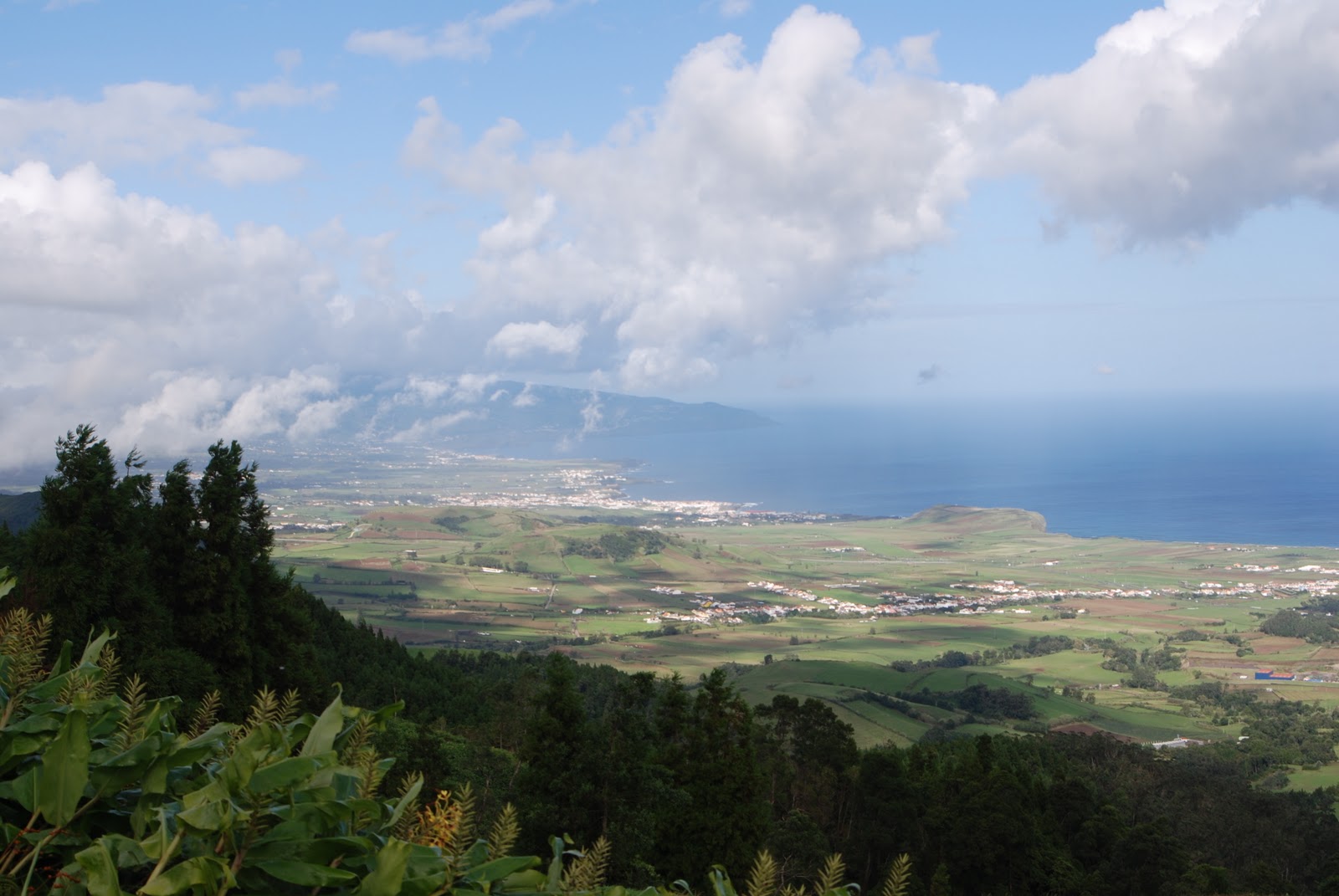
We’d arrived early in the day to the largest island in the Azores archipelago—San Miguel. We disembark early and three of us—Glenda, myself and Brian of Copenhagen, rent a car and head due west out of Ponta Delgada. The island is very green and at the end of the rainy season. It’s really quite lovely, with hedges of hydrangea and wild lilies lining the road. We drive a bit, then head into the mountains in the center of the island. There are hot springs and geothermal plants and the smell of sulfur everywhere. I’m back in Iceland, but then this is another highly volcanic island. We climb into a cloud forest and stop the car to take a short hike.


There are bromeliads and tree ferns and bubbling pools of boiling hot water that locals use to prepare food in. “No swimming,” the sign says. As if you’d actually step into a pool of water that boils from geothermal activity.

Further up the trail is a swimming hole—temperature a Jacuzzi comfortable 102 degrees.

We turn around and begin to trek back to the ship. Brian and I spend the part of the afternoon exploring Ponta Delgada, but an early afternoon island siesta has taken over and most of the shops have closed. Instead, I return to the ship, get my computer and spend two hours using free wi-fi that restaurants at the port provide in exchange for drinks or a lunch. Cheaper this way than the absurd 80- cents-per-minute fee the ship provides. There are lots of emails as I’ve not been online in over a week.

By 5:00 p.m. we are on our way. I stand on deck and watch as we pull away from the island. This is the last any of us will see for more than six days. We were truly in the Atlantic and the greatest portion of the transatlantic had just begun.

Day 5 – Friday, September 30, 2011 – At sea – Latitude 33° 30’ N

I’ve decided to take the day off. Not that all the other days aren’t days off. In this sense I’ve decided just to seize the day and not allow other activities on board the ship to divert me. The whole expanse of a long, blue day at sea lay before me.

It was a glorious last day of September. The sun was strong and hot. After a month in Northern Europe with its weak, late summer sun, laying poolside would be indulgent.

I was keenly aware that the Norwegian Sun was but a speck on the sea. We were mid-point between Lisbon and Orlando—truly in the middle of the sea. I had to remind myself of this all the time. Since we left the Azores, there had been no traffic. Nothing. It was wonderful.

I find a place to sit on the deck 12, position my lounge chair to face the sun, lather on sun lotion, plug in my iPod and lay down. I have the space of a long, white afternoon in which to make my own time, my own sound.

When I do look up I face the sea—a marine blue expanse of water greater than I ever seen. The nearest land is still the Azores—970 miles behind us. The sea is moderate and the Norwegian Sun pushes forward south southwest. Small frothy waves break on the surface, fizzle, then disappear. There is nothing but sea and a powerful blue sky dotted with patches of big white clouds scudding by.

Javier, my Peruvian bartender buddy, walks by. I’d met him on the previous cruise when he was working the 12th floor Observation deck bar. More than once I’ve asked him for help with Spanish homework I’ve assigned myself.

“Estás bien, Daniel?” he asks me. We only speak Spanish. My request. “How are you?”

“Múy bien,” I tell him. “Más Diet Pepsi,” he wants to know.

These guys are trained well. Know what the passenger what. He knows my bad habits.

“Gracias, Javier.” I’ve paid $6.00 a day for the “all you can drink Pepsi” package and fully intend to get my money’s worth.

Noon. The deck empties out a bit. Lunch time. It’s 75 degrees and a light tailwind pushed us forward at 22 miles per hour. There’s no breeze. The sun grows hotter. I get lost in thought. There is something about this date and it takes some time to go back in time.

Saturday, September 30, 1967. It’s a rainy day in Plattsburgh. My best friend from high school, David Heath, died two days earlier. 16. Two weeks earlier we’d gone to a football game. I was a Freshman in college, he a high school Senior. Shortly after the football game, back in Troy, NY, my mother called to tell me David was in the hospital. The next day he’s in a coma. Twelve days later he’s dead. Leukemia. No warning.

I returned to college the day after the funeral. Somehow I processed the grief. There were certainly enough diversions in my first months in college. In time, I compartmentalize the loss, but realized, when I visited his parents, that their grief is very much different. “I keep expecting him to come through the front door,” his mother once told me. I imagine they never got over the sudden, unexplainable loss.

Once in awhile I visit the cemetery in Albany. Both his parents are gone now and on my last visit I realize how young they were when this happened. They were only in their 40’s and each time I come away from the cemetery I experience a different level of sadness. One it was for a life lost so young, but as time went on I learned to grieve for his parents’ loss.

Why is it that some die so young? Why, in eighteen months, will I have lived four life times to his one?

The afternoon slipped away. By now the sun—early autumnal—is past its full tanning potential. By 4:30 I’m exhausted. What with five hot tubs and three pools to choose from and decisions to make about where to eat lunch—in the Garden Café or in the Sports Bar or the on-deck BBQ buffet. Well..all this decision-making has exhausted me.

It had been a fine day, saturated with the rich color of sea and sky, but it was time to think about dinner, and my daily trek to the gym. I take one last soak, grab another Diet Pepsi from Javier, pack up and leave.

Day 6 – Saturday, October 1, 2011 – At sea – Latitude 31° 10’ N

This was a day of change. At sunrise there was a slight rain, but by lunch we had passed the storm front and sailed into fine weather.

All day, everywhere, there was nothing but water—always in motion, never still. “The pulse of the Earth,” Steve would tell me. And he’s right. What appeared to be still, calm waters from the highest deck were, in reality, tiny wavelets, stirred on by currents and a slight chop of wind. Water, the color of pewter, glistened in the noonday sun.

But today was a fine day, and we were mid-sea—truly in the middle of the ocean. It was a day of abundant sunshine and a day of powerful natural beauty. If water is the pulse of the Earth then somewhere, in the center of the Atlantic, must be its heart. But the beat was irregular. Today we were sailing through small, one foot swells; at other times swells, four to seven feet high, created white caps. As far as one could see at those times, the seas frothed white and fizzy.

Today, from the lower deck, I watched a series of different currents tracing the sea—great serpentine rivers within the ocean that created their own distinct paths. The sea was the color of dark granite, but the currents, under the deep sunshine, took on the hue of polished gun metal.

There were clouds, too. Giant strato-cumulus that climbed out of the sea then rode the skies, layer upon layer of shaded whites and grays. At other times they lined the flat horizon where sea and sky met—colossal mountain ranges, snow-capped and gorgeous. As the day progressed, the highest clouds took on a luminescence as they caught the highest rays of the sun.

In the hour before sunset, when the sun reflected low in the sky, light reflected off the lowest level of cumulus clouds, and illuminated them in a shower of light.

Sea and sky. Nothing else, constantly changing.

Day 7 – Sunday, October 2, 2011 – At sea – Latitude 29° 18’ N

For five days there was nothing but sea and sky. No contrails of jets overhead; no passing tankers. Just the endless sea and a giant, exaggerated sky. Other than life on the ship, there was no other sign of human evidence.

Today, though, a freighter passed, heading east towards Europe. There could be no other destination. Our nearest neighbor, to the north, was Bermuda 350 miles to the north and the Azores, 1,940 east. I had been laying poolside enjoying a sunny, warm day when I looked up and saw a jet, high in the sky, flying, I imagine, towards North America.

This isolation had been a marvel. This was day seven of the transatlantic passage, and aside from some freight traffic between Portugal and the Azores archipelago, the 2,000 passengers of the Norwegian Sun had been comfortably encompassed in the confines of the ship and had been coddled in all ways possible by a crew of almost 1,000. It was wonderful.

And so passed another day, another afternoon under a warm, early October sun, another day reading poolside, another day of decision making. Gym at 4:00 p.m. or 5:00p.m.? Drinks at 6:30 with a large group of guys I’ve gotten to know or an early dinner at Four Seasons or the Seven Seas? Tonight’s show at 7:00 p.m.or 9:00 p.m.? And should I stick around for the late night comedy show or make my way to the 12th floor observation deck to listen to the Sun’s show band play dance tunes?

In the end, I did it all. By midnight, after the Observation deck closed, I stood on deck. For days we’d been sailing under a starry but moonless night sky. Tonight, though, a rising crescent of a cool silvered moon hung in the eastern sky. We were travelling a smooth 20 knots an hour and the seas were calm.

Absorbing the marvel of sea and night sky was a splendid way to end another perfect day.

Day 8 – Monday, October 3, 2011 – At sea – Latitude 27° 54’ N

I’m taking tango lesson 3#7. There was enough interest two weeks earlier to continue beyond the basics. This is American Tango, different from the Argentinean form we’d learned in South America. My knee doesn’t allow me to do an ocho--quick footed crossovers. “We’re senior citizens and our bodies…” I block out what a woman was telling me. “Huh? Me a Senior Citizen? A Senior Citizen is someone five years older than I.

In truth, though, almost everyone onboard is a senior citizen. Almost no one is under 50. The boat is full of Europeans heading to Florida to spend the winter. It’s full of Americans heading home after summering in Europe. There are people on one leg of an around-the-world trip. The majority, though, are people just out for the ride. When ships reposition form one continent to another, the price drops considerably. It’s a great vacation. I met one couple who paid less than $500.00 each for 16 days of food, entertainment, lodging and transportation. Not a bad deal at all!

Day 9 – Tuesday, October 4, 2011 – At sea – Latitude 27° 31’ N

Last day at sea. I’m sad in a way. Crossing the Atlantic was the culmination of a dream, and two days ago, when we were mid-point between Europe and North America was an extraordinary feeling—a feeling of being very, very far away.

Today, though, we are135 miles from the closest Bahamian island and only 299 miles from Port Canaveral, where we will land early tomorrow morning. The sky is clear and the sun is strong and the Norwegian sun has slowed to 15 miles per hour. What a perfect way to spend this last day.

I spend the afternoon under a sun-filled sky. Shortly after noon we passed another cruise ship heading to one of the Bahamian islands. But through the day, however, it was the only evidence of human beings. Around noon I was startled by a flock of birds—miles out at sea. They circled the boat, then flew off.

It was a day of private reminiscing—our going-away dinner almost a month ago in Copenhagen, then sailing out of the city’s harbor late on a lovely late summer Sunday afternoon. I thought of the fun train ride in Northern Germany and of the wet and wonderful hyper-paced days in St. Petersburg. I thought of the splendors of medieval Stockholm and the lily and hydrangea-filled roadways of the Azores.

My deck chair faced the sea. I was in the identical spot where, twenty months earlier, Glenda and I rounded Cape Horn at the very tip of South America. Today, though, was sunny and warm and the Norwegian Sun had slowed down to 15 miles per hour. We were ahead of schedule and the day would progress at a slow crawl.

I was reluctant to leave the 12th floor deck. The blue seascape and ever changing vista of clouds kept me there until almost sunset.

All day I’d been on the lookout for whales and dolphins. The water, 81 degrees, was certainly warm enough. But there were none. Perhaps we were too far out at sea. Perhaps it was the underwater rumbling of the giant cruise liner that kept them away. We’d seen dolphins leaping out of the water as the ship pulled away from Punta Delgada six days earlier, so there was hope.

Instead I just watched the sea—rough textured with tiny, one foot wavelets—and the sky and clouds. These were precious hours. Twelve hours later we’d be docked in Florida.

By 5:30 I’d moved to the left side of the ship. The ocean glittered as the sun slowly dropped to the horizon. We were at the 27th Parallel and the sun, as sit slipped to the edge of the horizon, was Caribbean orange. Sunset was ruddy and the glow sent shafts of orange light throughout the limpid air.

I never did see a dolphin or a whale, but I had seen God’s majestic hand, had lived for one week in the center of His boundless creation of sea and sky. I’d marveled at the sea’s depth—at times over 19,000 feet and at the seemingly endless variety of clouds that painted the sky each day.

Once again I’d lived in a space of privilege and I was abundantly thankful.

In the End: Part 2 -- Baltic Cruise and a Transatlantic Crossing

Port Canaveral, Florida
Latitude 28° 24' 46” N
October 8, 2011

In the end, we spent 24 days on the Norwegian Sun and travelled, between the two cruises, a total of 8,641 miles—2,290 on the Baltic portion and 6,350 miles on the transatlantic portion. The great ship made port calls in ten countries—Denmark, Germany, Estonia, Russia, Finland, Sweden, The Netherlands, Belgium, Portugal and the United States.

In the end, the Baltic portion of the cruise was overkill. There were too many ports in too short a time. Eight hours in a capital city, barely scratching the surface of the place is, at least to me, supremely frustrating. On my first cruise I’d made peace with the idea that it’s about the boat and not about the land. I guess I’ve lost that. I have a much deeper curiosity about people and places and much prefer to spend longer than a third of day in a country.

In the end, we spent 16 days on the transatlantic portion of the cruise, with only four of those days in ports. In all, we spent 319 hours sailing between Europe and North America. That averages to 19.5 miles per hour. I ride my bike faster than that. But this was not about speed. It was all about crossing, taking one’s time, enjoying the great expanse of ocean, of being in the middle of the sea, in the great fresh open of the Atlantic, being very, very far away. The sea is its own distant land, a land I’d never known before. It was everything I could have imagined—days spent under a powerful and exaggerated sky, languid days that ended when light would fade and the sky turned a dark, sweet blue. It was people and good food and tango classes at 10:00 a.m.

In the end, I will continue to cruise, despite what I’ve said. Life aboard a ship is great fun and it’s no hardship to spend day after day at sea. But I won’t cruise just to say I’ve been to a place. Having said that, there are places where a cruise makes sense—The Northwest Passage, the Antarctic, down the Amazon or on European river cruises where there is, at least, some connection to the land. And after a month’s touring some corner of Europe of South America…what a great way to come home.

In the end, I’d forgotten how nice it is to travel in Europe. It’s been years since I’ve been on the continent. In fact, I’d never used a Euro. But I won’t stay away. There are too many places to revisit and many more I’ve never seen. It’s outrageously expensive, especially in the north, but there are ways to economize. What was a bit alarming was that I had no memory of some of the places I’d visited years earlier. That was the case in Copenhagen and again in Lisbon. My thinking is that I spent very little time in those capital cities. As now, as it was in the past, I much prefer smaller towns to cities. Perhaps I just passed through. The journals I wrote during those trips will tell me.

In the end, we’re already talking about the next cruise—or cruises as it were. Panama Canal. Alaska’s Inside Passage. More Caribbean. And those are only with NCL!

In the end, I will try to get back to St. Petersburg and back to Portugal and the Azores, each for a longer stay. The splendors of St. Petersburg require far more than a two day gloss-over and Portugal…well, with its fine weather and Latin heart, this is a place I could stay in for a long, long time.

In the end, the cruise brought us through seven different time zones and from the 60th Parallel to the 28th! A total of 32 degrees—all of it on water. We changed our clocks eight times, sometimes as often as every night. How nice it was, in the finally stretch, to roll back an hour each night and have eight 25 hour days!

In the end I’d fulfilled one of my life’s travel dreams—crossing the Atlantic on sea. Yay! Cross one more off the Bucket List.

In the end, it was great.